Auto Glass Repair
TL;DR:
- Lane assist fails mainly due to blurry camera views or loss of calibration caused by glass damage or misalignment.
- Perform quick checks like cleaning the interior and exterior windshield cameras, and restart the vehicle safely before seeking professional repair.
Lane assist not working usually means one of two things: the camera cannot read lane markings clearly, or the system has lost a trusted technical reference — a stored Diagnostic Trouble Code (DTC), a calibration shift, or unstable power. Industry guidance from the Auto Glass Safety Council (AGSC) confirms that even a 0.6-degree camera misalignment degrades safety-system reaction time significantly, which is why precise recalibration matters after any camera disturbance. For Portland drivers, Collision Auto Glass & Calibration handles in-house ADAS diagnostics and calibration the same day.
Three fastest checks before you call a shop:
- Clean the interior windshield directly in front of the camera with a microfiber cloth and a streak-free glass cleaner.
- Confirm no other ADAS warning lights are active (multiple warnings together point to a power or communication fault, not just lane assist).
- Turn the vehicle off, wait 60 seconds, and restart — only if you are safely parked.
Pro Tip: Tobacco smoke, vaping residue, and off-gassing from dashboard plastics leave a hazy film on the interior glass that scatters camera light. Cleaning that specific zone — not just the whole windshield — often restores function without a shop visit.
Calibration sensitivity: A 1-degree misalignment shifts the focal point roughly 8 feet at 100 feet — enough to cause AEB and lane systems to misjudge lane position entirely.
Table of Contents
- What quick checks can you do before visiting a shop?
- What are the most common technical causes of lane assist failure?
- When does lane assist need professional repair or calibration?
- What does professional ADAS calibration actually involve?
- How much does calibration cost, and does insurance cover it?
- How does a professional shop diagnose lane-assist problems?
- What should you do while lane assist is disabled?
- What questions should you ask when choosing a shop?
- Key Takeaways
- What we see every day at the shop
- Portland’s local option for ADAS calibration and glass repair
- Useful sources and further reading
- FAQ
What quick checks can you do before visiting a shop?
Pull safely off the road before doing anything. Troubleshooting while moving is never worth it.
Start inside the cabin. The camera sits behind the rearview mirror, and the interior glass in that zone collects film faster than the rest of the windshield. A clean microfiber and a quality glass cleaner (not an ammonia-based product near tinted glass) takes two minutes and clears the most common cause of lane assist malfunction.
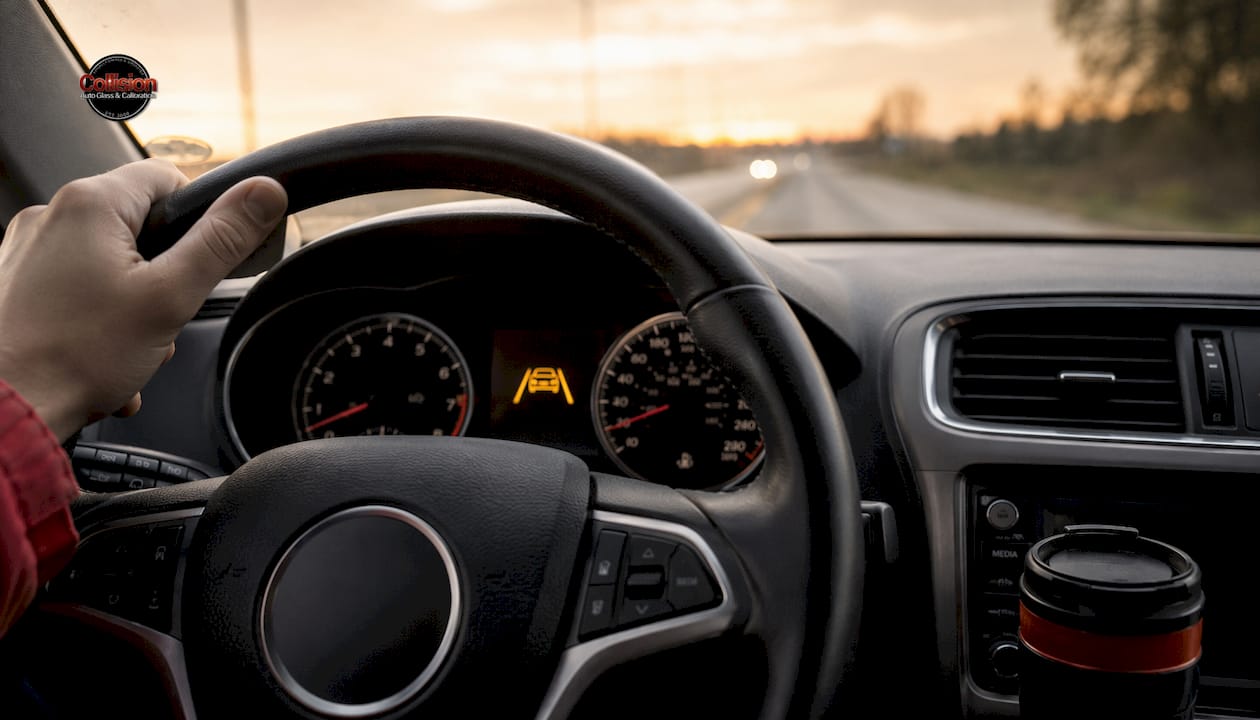
Outside, check for heavy grime, ice, or debris on the front camera housing and any radar sensor grilles. On Portland’s wet winter roads, mud and road spray build up fast. While you’re there, look for visible cracks or chips in the windshield near the camera mount — even a small crack in that zone can scatter light enough to disable the system.
Check your battery and fuses. If the infotainment screen is sluggish or other warning lights are present, a weak charging system may be forcing ADAS modules into protection mode. Consult your owner’s manual for the ADAS-related fuse locations and inspect them visually.
Pro Tip: If the lane keep assist problem began right after a battery disconnect or replacement, the module may need a reinitialization sequence — a controlled restart alone may not be enough. That is a shop-level step.
Stop DIY troubleshooting and call a professional when: the warning persists after cleaning and a restart, the message is permanent or appears alongside other safety-system alerts, or the issue started immediately after windshield replacement or collision repair.
What are the most common technical causes of lane assist failure?
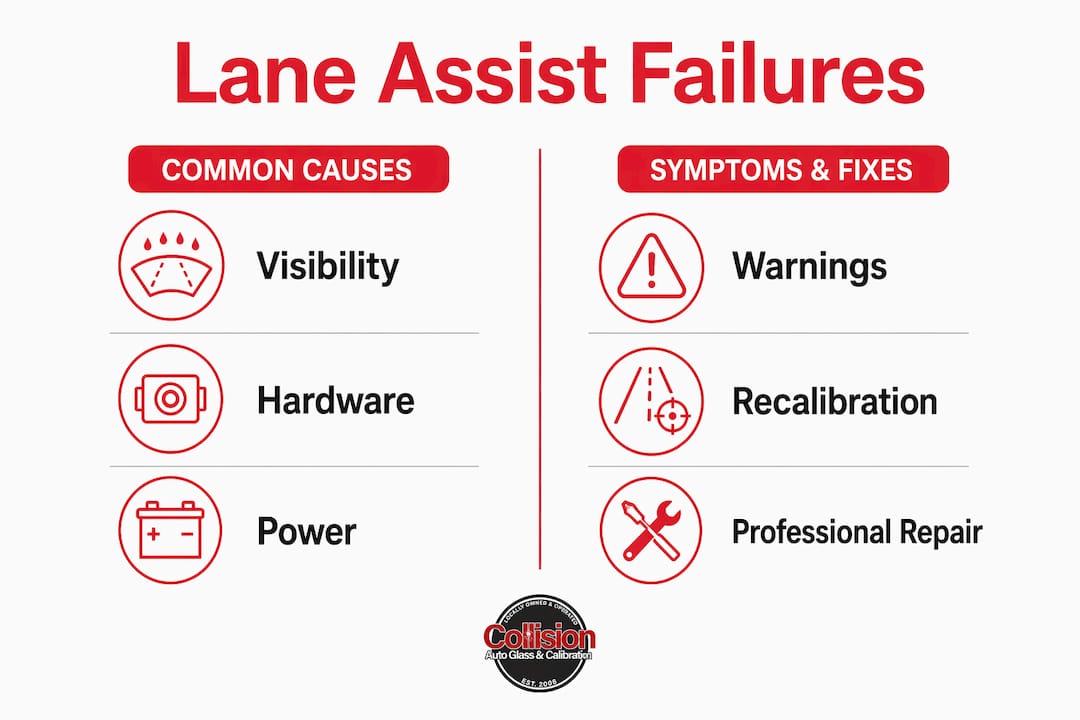
Most lane-assist failures fall into four categories. Understanding which one applies tells you whether the fix is a microfiber cloth or a calibration rig.
| Cause category | Typical symptoms | DIY check | Recalibration or pro scan needed? |
|---|---|---|---|
| Visibility (camera/glass) | Intermittent warning, clears in good light | Clean interior and exterior glass | Usually not — unless warning persists |
| Hardware/windshield | Warning after glass work, visible damage near mount | Visual inspection only | Yes — calibration often mandatory |
| Power/communication | Multiple ADAS warnings at once, voltage-related | Check battery, fuses, grounds | Yes — diagnostic scan required |
| Software/DTCs | Permanent warning, no environmental trigger | None reliable | Yes — scan tool and module-level work |
Visibility and environment account for a large share of temporary lane departure warning issues. Heavy rain, direct low-angle sun, construction zone markings, and faded lane lines all cause the system to suspend itself by design — not because something is broken.
Hardware and windshield faults are more serious. A replaced windshield that was not followed by ADAS recalibration is one of the leading causes of persistent lane assist system errors. The camera bracket can shift during glass removal, and even OEM-fit glass changes the optical geometry slightly.
Power and communication faults often show up as multiple simultaneous ADAS failures. A weak battery or unstable ground creates voltage swings that push modules offline. This is shop territory — diagnosing car problems of this type requires a battery load test and a CAN-bus scan, not a fuse swap.
Stored DTCs are the most misunderstood category. Cleaning the glass and waiting for better weather will not clear a stored fault code. A scan tool is required, and many ADAS modules will not complete calibration if unresolved DTCs exist elsewhere in the vehicle network.
When does lane assist need professional repair or calibration?
Some situations move past DIY triage immediately. Schedule professional diagnostics when you recognize any of these:
- The warning light or “unavailable” message does not clear after cleaning and a controlled restart.
- The lane keep assist problem began right after windshield replacement, collision repair, suspension work, or a tire-dimension change — recalibration is mandatory after all of these events.
- Multiple ADAS features fail at the same time (lane assist plus automatic emergency braking plus adaptive cruise control).
- There is visible physical damage near the camera mount: cracks in the windshield near the mirror base, a misaligned bracket, or poor glass fit.
- A scan reveals stored DTCs in the ADAS module or the vehicle fails a system self-test.
Fleet managers: if several vehicles show the same lane assist malfunction after the same service event — a tire rotation, a suspension alignment, or a batch windshield replacement — treat it as a systemic calibration procedure failure and escalate all affected units at once.
What does professional ADAS calibration actually involve?
ADAS calibration means restoring the camera’s aim to OEM reference geometry and verifying that sensor data falls within manufacturer tolerances. It is a technical requirement, not an optional add-on.
Static calibration is performed in a controlled shop environment. The technician sets up a printed target board at a precise measured distance in front of the vehicle on a level surface, then uses manufacturer-specific software to align the camera to that target. Lighting, floor levelness, and target placement all affect the result — which is why the AGSC stresses proper setup and technician training.
Dynamic calibration takes the vehicle on a road drive at specified speeds, typically on roads with clear lane markings. The camera relearns its reference geometry from real-world lane data. Some vehicles require only dynamic calibration; others require only static. Many require both passes.
Verification closes the loop. A post-calibration DTC scan confirms no new faults were introduced, and a test drive checks for false alerts or missed detections. Written documentation of the calibration type used and the pass/fail result should accompany every completed job.
Pro Tip: Always request written confirmation that the technician performed both a pre-calibration DTC scan and a post-calibration test drive. A shop that cannot produce that documentation has not completed the job properly.
How much does calibration cost, and does insurance cover it?
| Service type | Typical shop time | Typical cost range | When required |
|---|---|---|---|
| Static calibration | 30–90 minutes | $150–$300 | After windshield replacement, bracket disturbance |
| Dynamic calibration | 30–90 min + 5–20 miles driving | $100–$200 | After suspension/tire changes, some windshield replacements |
| Dual (static + dynamic) | 60–120+ minutes | $250–$400 | Vehicles requiring both passes per OEM spec |
ADAS recalibration costs vary depending on method and vehicle complexity. Static procedures typically take under two hours, with dynamic calibrations requiring additional driving time.
Insurance coverage varies. Many comprehensive policies cover windshield replacement and include calibration in the estimate — but you need to confirm this before the work starts, not after. Ask the shop whether they bill the insurer directly and whether calibration is itemized in the claim. Collision Auto Glass & Calibration handles direct insurance billing, which removes the reimbursement paperwork from your plate entirely.
For fleet managers, mobile calibration service reduces vehicle downtime significantly. Scheduling a technician to come to your lot is often more cost-effective than pulling a driver off route for a shop appointment.
The cost of skipping calibration: A camera running at even a 1-degree misalignment shifts its focal point by roughly 8 feet at 100 feet of distance — silently, with no dashboard warning, until a near-miss or worse.
How does a professional shop diagnose lane-assist problems?
A thorough diagnostic workflow follows a specific sequence:
- Intake: Technician confirms when the fault started, what repairs preceded it, and whether other ADAS features are affected.
- Pre-scan: An ADAS-capable scan tool retrieves all stored and pending DTCs across the vehicle network — not just the lane-assist module.
- Physical inspection: Camera image quality check, bracket and wiring condition, windshield integrity near the mount, and connector seating.
- Power check: Battery load test, alternator output, and ground integrity — because voltage instability is a frequent silent cause of ADAS module faults.
- Calibration: Static target setup or dynamic road drive (or both) per the vehicle’s OEM procedure, using VIN-specific calibration data.
- Post-calibration verification: DTC re-scan, test drive, and written documentation of results.
Pro Tip: Ask the shop for the printed DTC report from both the pre-scan and the post-calibration scan. Two clean scans — before and after — are the only objective proof the job was done correctly.
What should you do while lane assist is disabled?
When the system shows “unavailable,” you are fully responsible for steering. Do not assume the system will intervene.
There is an important distinction between a temporary inhibition and a stored fault. Heavy rain, direct glare, construction zones, and faded lane markings cause the system to suspend itself by design. That is normal behavior. A persistent warning that does not clear when conditions improve is a different situation and needs a scan.
While the system is offline: reduce speed, increase following distance, and choose well-marked roads if you need to test whether the system has recovered after a repair. Avoid relying on lane-centering maneuvers entirely until a technician confirms the system is functioning correctly.
Fleet operators should check company policy on reporting disabled safety systems. Some fleet agreements require immediate notification when an ADAS feature is non-operational.
Safety note: Driving with a disabled lane-assist system is legal, but the driver bears full responsibility for lane control. Confirm current requirements with your fleet policy or a qualified professional for your specific situation.
What questions should you ask when choosing a shop?
Start with capability. Not every auto glass or repair shop performs both static and dynamic ADAS calibrations — some outsource it, which adds time and a hand-off point where documentation can get lost.
Ask specifically: Does the shop perform static and dynamic calibrations in-house? What diagnostic tools do they use, and are those tools ADAS-capable across multiple makes? Can they show you the pre- and post-calibration scan reports? What is the warranty on the calibration work, and will they recheck the system if a warning returns within a defined period?
On the glass side, ask whether calibration is included in the windshield replacement estimate or billed separately. A shop that quotes glass replacement without mentioning calibration is either planning to skip it or planning to surprise you with an add-on charge. Both are red flags. Reviewing tips for choosing an auto glass shop before you call can sharpen your questions considerably.
For fleet accounts, ask about mobile service availability, consolidated invoicing, and volume scheduling. A shop that can come to your lot and handle direct insurance billing on multiple vehicles is worth more than a marginally lower per-unit price at a shop that requires you to drive each vehicle in.
Red flags: evasive answers about calibration procedures, refusal to share scan reports, no written warranty, or a windshield estimate that makes no mention of ADAS recalibration.
Key Takeaways
Lane assist failures almost always trace back to one of four fixable causes: camera visibility, hardware or glass disturbance, power instability, or a stored DTC — and each requires a different response.
| Point | Details |
|---|---|
| Clean the camera zone first | Interior glass film is the most common, lowest-cost cause of lane assist malfunction — clean it before calling a shop. |
| Recalibration is mandatory after key events | Windshield replacement, collision repair, suspension changes, and tire-dimension changes all require ADAS recalibration. |
| Stored DTCs need a scan tool | Cleaning and restarting will not clear a stored fault; only an ADAS-capable scan tool can retrieve and resolve DTCs. |
| Calibration costs $150–$500 | Static, dynamic, or dual calibration typically runs $150–$500 and 30–120 minutes depending on vehicle and method. |
| Collision Auto Glass & Calibration | Portland’s in-house ADAS calibration option with same-day mobile service, direct insurance billing, and a lifetime no-leak guarantee. |
What we see every day at the shop
Most lane-assist failures that come through our doors fall into a predictable pattern: a windshield was replaced somewhere, calibration was either skipped or done incorrectly, and the driver has been living with a persistent warning for weeks before calling us. The fix is rarely the camera itself. It is almost always a calibration that was never completed to OEM specification.
What concerns us more than the missed calibration is the driver who assumes the system is still protecting them. A camera running with even a small angular error can appear to function — no warning light, no obvious symptom — while its detection zone is shifted enough to miss a lane departure at highway speed. That is the scenario the AGSC’s calibration guidance is written to prevent.
Collision Auto Glass & Calibration has been performing in-house ADAS calibration in Portland since 2008. Every job includes a pre-calibration DTC scan, the appropriate static or dynamic calibration procedure, a post-calibration verification drive, and written documentation. Same-day and mobile service are available, and we handle direct insurance billing so the claim process does not fall on you.
Portland’s local option for ADAS calibration and glass repair
When a lane departure warning issue points to a calibration or glass problem, the next step is a shop with the right equipment and a clear process.
Collision Auto Glass & Calibration offers same-day mobile windshield replacement and in-house static and dynamic ADAS calibration for cars, trucks, RVs, and commercial vehicles across the Portland area. Every installation carries a lifetime no-leak guarantee. Every calibration includes written pre- and post-scan documentation. Direct insurance billing is standard, not an exception.
Fleet managers can arrange mobile service at their lot, consolidated invoicing, and priority scheduling to keep vehicles on the road. For individual owners, the process is straightforward: one call, one visit, one written verification that your safety systems are working as designed.
Visit collisionautoglass.com to request a quote or schedule a same-day appointment. If you have questions about coverage or what your insurance includes, the auto glass FAQ covers insurance, warranties, and mobile service in plain language.
Useful sources and further reading
The claims in this guide draw on the following sources. Each is worth bookmarking if you want to go deeper on a specific topic.
- Auto Glass Safety Council — Understanding the Importance of Calibration: The industry standard reference for technician training, target placement, and post-calibration verification requirements.
- RepairsAdvisor — How Lane Departure Warning Works: Explains the 0.6-degree sensitivity threshold and how environmental inhibitions differ from stored faults.
- Colfax Glass — ADAS Windshield Calibration After Replacement: Source for the $150–$500 cost range, 30–90 minute time estimates, and the 1-degree/8-foot focal-point shift figure.
- XeroDrive — Lane Keep Assist System Unavailable: Covers stored DTCs, interior glass contamination, and voltage-related ADAS module faults in detail.
- CarADAS — Why Is My Lane Departure Warning Light On?: Explains mandatory recalibration triggers including windshield replacement, suspension changes, and tire-dimension changes.
- RevvHQ — When Is ADAS Recalibration Necessary?: Industry perspective on calibration as a technical requirement and the dual static/dynamic procedure standard.
Key statistic: A 1-degree camera misalignment shifts the focal point by roughly 8 feet at 100 feet — the core reason calibration cannot be skipped after any camera disturbance.
FAQ
Why is my lane assist not working after a windshield replacement?
Windshield replacement disturbs the camera bracket and changes the optical geometry, making ADAS recalibration mandatory. The system will often show a persistent warning or disable itself entirely until a technician performs the correct static or dynamic calibration procedure.
Can I fix a lane assist malfunction myself?
Cleaning the interior windshield at the camera zone and performing a controlled restart can resolve temporary visibility-related issues. Stored DTCs, calibration loss, and hardware faults require professional diagnostic tools and cannot be resolved at home.
How long does ADAS calibration take?
Static calibration typically takes 30–90 minutes in a shop. Dynamic calibration adds a road drive of 5–20 miles on top of that. Vehicles requiring both passes may need 60–120 minutes or more of total shop time.
Does insurance cover ADAS calibration?
Many comprehensive policies cover windshield replacement and include calibration, but coverage varies by policy. Confirm with your insurer before the work begins, and ask the shop whether they offer direct insurance billing to simplify the claim.
When should I stop driving and get the system checked immediately?
Schedule diagnostics promptly if multiple ADAS features fail simultaneously, if the warning appeared right after glass or collision repair, or if there is visible damage near the camera mount. A system running with an uncorrected calibration error may show no warning light while its detection zone is already compromised.
Recommended
- Why You Shouldn’t Delay Getting Windshield Repair or Replacement – Collision Auto Glass & Calibration
- Why You Shouldn’t DIY Repair Your Car’s Windshield Glass – Collision Auto Glass & Calibration
- The Hazards of Driving With a Cracked Windshield – Collision Auto Glass & Calibration
- Common Misconceptions about Auto Glass Repair – Collision Auto Glass & Calibration
Share
Recent Posts

August 23, 2026
Wind Noise After Windshield Replacement: Causes and Fixes
Experiencing noise from your new windshield? Discover causes and effective solutions to ensure a quiet, safe ride after replacement....

August 22, 2026
A Rock From a Gravel Truck Cracked My Windshield: Who Pays?
If a rock from a gravel truck cracked your windshield, learn how to file a successful claim and get the compensation you deserve....

August 21, 2026
Subaru EyeSight Recalibration: What Owners Must Know
Discover why recalibrating Subaru EyeSight is essential after repairs. Ensure your safety with expert guidance on this crucial procedure....