Auto Glass Repair
The trucking company is usually liable if a rock from its load damaged your vehicle, but you must prove where the rock came from. That single requirement decides most claims. The moment it happens, pull over safely, check for injuries, and call police if the damage is significant or anyone is hurt.
Before you leave the scene or lose the moment, do three things:
- Photograph the truck’s rear, plate, and any company markings before it pulls away
- Note the time, mile marker or cross street, and direction of travel
- Photograph your damage immediately, including the windshield surface and any rock fragments still in the glass
Key Takeaways
Winning a gravel truck rock claim depends on proving the debris came from a specific truck through DOT numbers, dashcam footage, or witness accounts collected immediately.
| Point | Details |
|---|---|
| Liability follows proof of origin | The trucking company is typically liable, but you must show the rock came from their load, not the road. |
| DOT numbers matter most | Capture the DOT number and company name before the truck leaves, since many trucks lack rear plates. |
| Signage isn’t a legal shield | Disclaimer signs on truck beds carry no legal weight against a valid negligence claim. |
| Insurer subrogation covers most claims | Filing under your own comprehensive coverage often gets faster repairs while your insurer pursues the carrier. |
| Collision Auto Glass & Calibration handles repair and calibration | Same-day mobile service, direct insurance billing, and in-house ADAS calibration support claims after a strike. |
This article is general information, not a substitute for advice from a qualified lawyer. Consult a qualified legal professional about your own circumstances before acting on anything here.
Table of Contents
- How to File a Gravel Truck Rock Claim With Strong Evidence
- Who’s Actually Liable for a Rock From a Truck?
- How Insurance Handles a Gravel Truck Rock Claim
- When Should You Report the Incident, and to Whom?
- Is It Worth Suing Over Gravel Truck Windshield Damage?
- Tools and Habits That Reduce Rock Strike Risk
- What Causes Gravel Truck Rock Damage, and How Can It Be Prevented?
- What Kind of Damage Does a Gravel Truck Rock Actually Cause?
- What Compensation Can You Actually Recover?
- What Do Successful Gravel Truck Rock Claims Look Like?
- What If Your Gravel Truck Rock Claim Gets Denied?
- Get Your Windshield Fixed Fast After a Rock Strike
- Sources
- FAQ
How to File a Gravel Truck Rock Claim With Strong Evidence
A gravel truck rock claim lives or dies on documentation collected in the first few minutes. Insurers and courts want proof the debris left that truck’s bed, not the road surface. Here’s the order that protects you best.
- Get the truck’s identifiers first. The DOT number stenciled on the door or cab links the vehicle to a specific carrier and its insurance policy. Write it down, photograph it, or say it out loud into your phone’s voice memo if you can’t safely stop.
- Photograph the damage from multiple angles. Shoot the impact point straight on, then from a 45 degree angle to capture depth, then a wide shot showing the whole windshield for scale.
- Preserve dashcam footage immediately. Many dashcams overwrite loop footage within hours, so save the clip to your phone or cloud storage before it’s gone. Footage with an embedded timestamp and GPS coordinate carries far more weight with insurers than a phone video shot after the fact.
- Collect witness information. A driver in the next lane who saw the rock leave the truck bed is often the difference between a paid claim and a denied one.
- File a police report even for property-only damage in states that allow it, since it creates a neutral, timestamped record.
Investigative reporting on these disputes has found that many dump trucks lack rear license plates or clear identifying marks, which is exactly why the DOT number and company name matter more than the plate alone.
Pro Tip: If you can’t safely get a clear photo of the truck, note the load type, trailer color, and any visible company logo. Insurers can often cross-reference that description with local hauling companies operating in the area that day.
Who’s Actually Liable for a Rock From a Truck?
Civil liability turns on negligence, and negligence is decided by a preponderance of the evidence, meaning it’s more likely than not the truck caused the damage. That’s a lower bar than criminal court, but you still need something concrete tying the rock to that specific vehicle.
Trucking companies and their insurers commonly raise three defenses, and each has a practical counter:
- “The rock was already on the road.” A dashcam clip showing the rock in flight from the truck bed defeats this outright.
- “You can’t identify our truck.” A DOT number, company name, or a witness description of distinctive markings overcomes this.
- “Our truck displays a disclaimer sign.” Signage claiming the carrier isn’t responsible for windshield damage carries no legal weight in most states; it doesn’t change the law of negligence.
Federal rules give claimants a real advantage here. FMCSA cargo securement regulations under 49 C.F.R. § 393.100 require that loose material be covered or otherwise secured against spillage, and most states layer additional tarp and load-cover statutes on top of that federal floor. When a hauler violates those rules, a claimant can argue negligence per se, meaning the violation itself is evidence of fault.
Road debris is a real and measurable hazard, not a rare fluke. AAA Foundation research has documented road debris as a recurring factor in crashes across the United States, which is part of why regulators treat load securement as a serious compliance issue rather than a technicality.
How Insurance Handles a Gravel Truck Rock Claim
Most drivers get repaired faster by filing under their own comprehensive coverage first, then letting their insurer pursue the trucking company as explained in How to file fleet and plant insurance claims efficiently. Comprehensive typically covers rock strikes with a deductible, and your insurer has the resources and legal footing to chase reimbursement on your behalf.
That reimbursement process is called subrogation. Once your insurer pays your claim, it steps into your shoes and pursues the truck’s commercial carrier for the money it paid out, assuming your evidence supports the case. Local reporting on these disputes shows insurers frequently settle through subrogation once dashcam footage or witness statements make fault reasonably clear.
Expect your insurer to request:
- Photos of the damage and the truck (if captured)
- Any dashcam or witness contact information
- A copy of the police report, if one exists
- The repair or replacement estimate
If your deductible is close to the repair cost, filing directly with the trucking company’s insurer may make more sense than triggering your own policy. Compare the typical cost to replace a windshield against your deductible before deciding, and check whether a rock chip repair rather than full replacement is even on the table, since chips caught early often cost far less either way.
When Should You Report the Incident, and to Whom?
Timing matters more than most drivers assume. Follow this sequence:
- Call police at the scene if the damage is significant, and request a copy of the report number before you leave.
- Notify your own insurer within a few days, even if you plan to pursue the trucking company directly, so your policy stays active for later use.
- Contact the trucking company’s insurer once you’ve identified the carrier through the DOT number.
- Check for government notice deadlines if the vehicle involved was a public works or municipal truck. Claims against government entities often carry short statutory notice windows, sometimes as brief as 30 to 90 days, and vary significantly by state.
Preserve your photos, footage, and witness contacts for at least 90 days regardless of how the claim proceeds.
Is It Worth Suing Over Gravel Truck Windshield Damage?
Small claims court limits vary by state, but most windshield repair and replacement costs fall comfortably within them, making small claims a realistic option when a trucking company’s insurer denies a well-documented claim.
Consider an attorney instead of small claims when:
- The incident caused an injury, not just vehicle damage
- Fault is contested and causation is unclear
- ADAS calibration and other repair costs push the claim well past small claims limits
- The trucking company disputes liability entirely and litigation looks likely
Litigation takes months and costs more than most windshield claims are worth, so weigh a quick settlement against the time and expense of a lawsuit before committing.
Tools and Habits That Reduce Rock Strike Risk
A dashcam that timestamps footage and logs GPS location is the single most useful tool for a future claim. Keep at least three car lengths behind any gravel or dump truck, since the extra following distance also gives you time to react to a bouncing rock.
Watch for warning signs of an unsecured load:
- A flapping or loose tarp
- Gravel visibly overflowing above the bed’s rim
- Missing or damaged mud flaps
Pro Tip: If you spot an unsecured load before anything falls, back off immediately and, when safe, call it in to the non-emergency police line with the truck’s DOT number. You may prevent someone else’s claim.
What Causes Gravel Truck Rock Damage, and How Can It Be Prevented?
Most incidents trace back to a small handful of preventable failures. Overloaded beds that exceed the tarp’s coverage area let material bounce loose over bumps and highway expansion joints. Torn or improperly secured tarps are the second most common culprit, since even a small gap lets wind pull material out at highway speed.
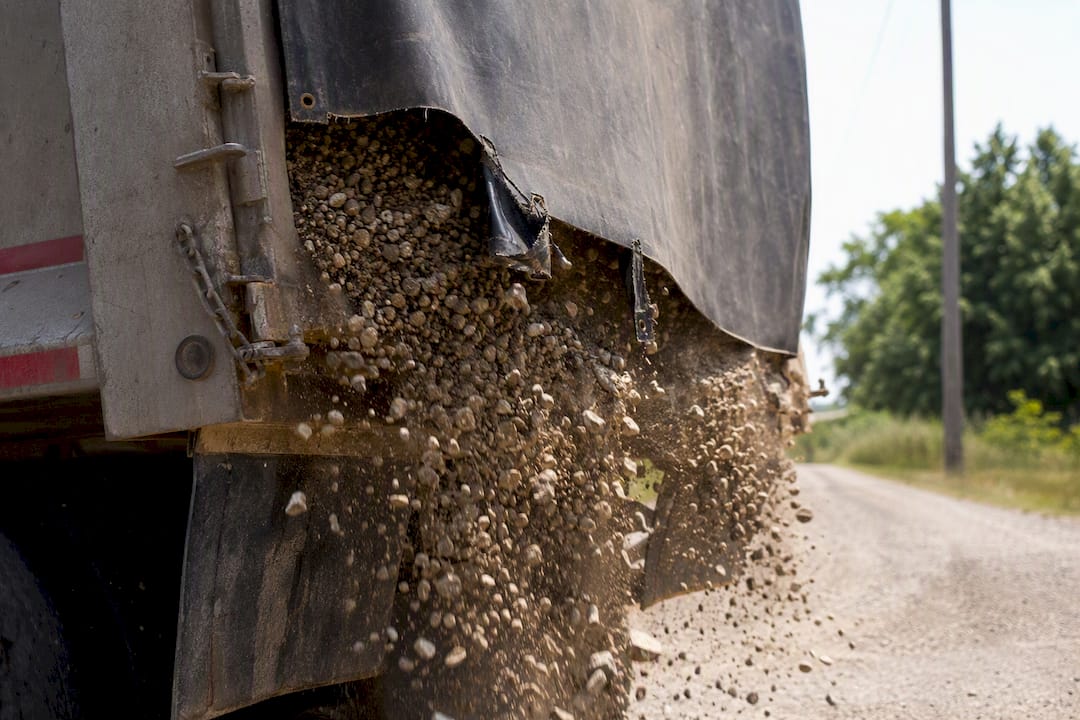
Drivers hauling from active gravel mining operations or aggregate pits sometimes skip the tarp entirely for short local hauls, assuming lower speeds make it unnecessary. That assumption is wrong. Even at 35 miles per hour, wind resistance is enough to launch loose gravel off the top of a load.
Prevention starts with the hauler, not the driver behind them. Reputable gravel trucking companies train drivers to visually inspect tarps and load height before every trip and to re-secure covers after any stop. Regulatory oversight matters too. Gravel pit regulations in most states require operators using public roads to certify that vehicles leaving the site meet load-covering standards, and enforcement inspections increasingly target this specific violation.
For drivers, prevention comes down to distance and awareness. Following a covered, properly loaded truck at a safe distance is a low-risk situation. Following an overflowing bed with a flapping tarp corner is not. The visual cues are usually obvious once you know what to look for, and backing off costs you nothing but a few seconds of drive time.
What Kind of Damage Does a Gravel Truck Rock Actually Cause?
Windshield damage from a gravel truck rock ranges from a small pit that never spreads to a full crack that requires immediate replacement. The size and speed of the impact determine which outcome you get, and impact speed at highway velocity is often high enough to produce more than a shallow surface chip.
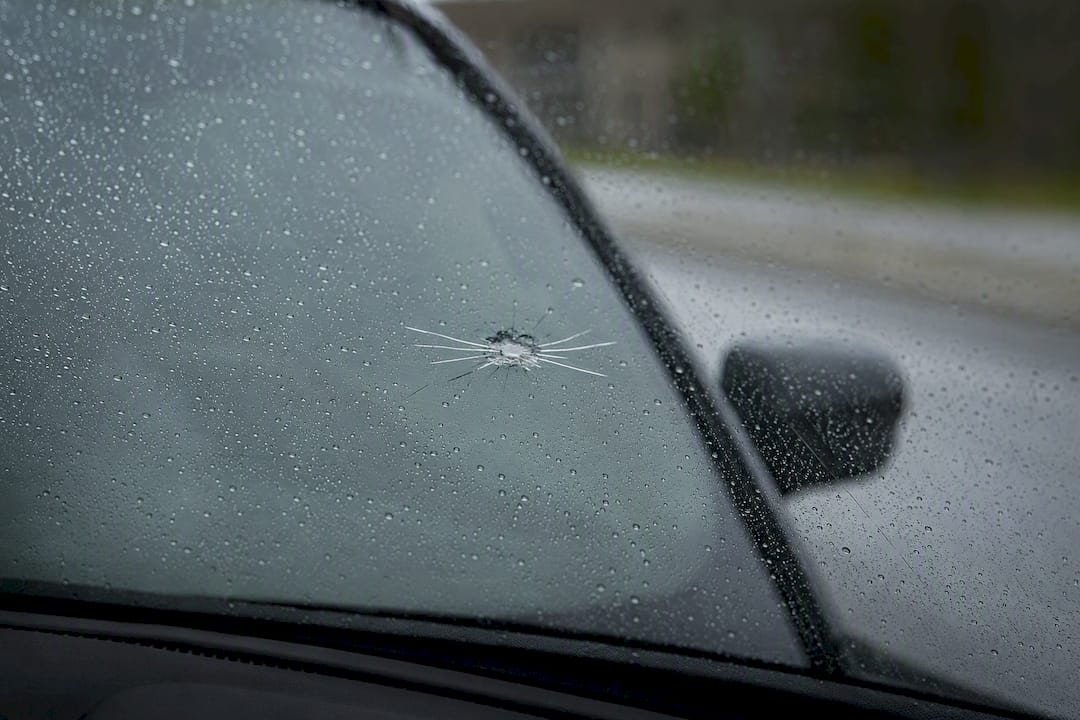
A single chip can look minor and still spread within days, especially with temperature swings between hot afternoons and cool nights. A chip near the edge of the windshield or one larger than a quarter is more likely to spread into a crack that requires full replacement rather than a simple repair.
Beyond glass, gravel truck rock impacts sometimes cause secondary damage that owners overlook. A rock traveling with enough force can chip or crack a side mirror housing, dent a hood or fender, or damage a forward-facing camera housing mounted near the windshield. On newer vehicles, that camera housing often supports the ADAS system that manages lane-keeping and automatic braking, so any impact near that zone deserves a closer inspection than a quick glance.
Injuries from gravel truck rock strikes are less common than property damage but do happen, particularly when a rock shatters a side window rather than chipping a windshield. Glass fragments can cause facial or eye injuries to a driver or passenger, and a sudden startle reaction at highway speed has caused secondary collisions in documented cases. Any injury claim shifts the case from a simple property dispute into a personal injury matter with different evidence standards and higher potential compensation.
What Compensation Can You Actually Recover?
A successful gravel truck rock claim typically compensates for the direct repair or replacement cost, and that’s the baseline recovery in nearly every case. Beyond that baseline, several additional categories of compensation are worth understanding.
Diminished value applies when a repaired vehicle is worth less on resale despite a quality repair, though this is harder to prove for windshield damage than for structural body damage. Rental car costs during the repair window are recoverable when the trucking company’s insurer accepts liability, particularly if the vehicle is undrivable. ADAS recalibration costs deserve their own line item, since many 2026 model year vehicles require camera and sensor recalibration after any windshield replacement, and that cost can meet or exceed the glass itself.
For injury claims, compensation expands to medical expenses, lost wages, and pain and suffering, calculated under standard personal injury frameworks rather than simple property valuation. These claims almost always benefit from legal representation given the higher stakes and more complex proof requirements.
Legal remedies generally fall into two tracks: a negotiated insurance settlement, which resolves the overwhelming majority of gravel truck rock claims without litigation, or a civil lawsuit when settlement talks stall or liability is disputed. Small claims court handles most simple property damage disputes, while personal injury claims or high-value commercial losses typically require a formal complaint filed in a higher court.
What Do Successful Gravel Truck Rock Claims Look Like?
Court records and investigative journalism point to a consistent pattern behind claims that actually get paid: strong, timely evidence connecting a specific truck to specific damage. The Maryland Court of Special Appeals, for example, upheld gross negligence findings against a driver who spilled a large load of gravel and failed to mark or report the hazard, a case that illustrates how failing to remediate a known spill compounds liability well beyond the original incident.
Civil claims that succeed generally share three traits. First, the claimant identified the truck through a DOT number, company name, or distinctive markings within minutes of the incident, not days later from memory. Second, dashcam or witness evidence placed the rock’s origin at the truck rather than the roadway, closing off the most common defense. Third, the claimant filed promptly with either their own insurer or the trucking company’s carrier, keeping the evidence fresh while adjusters could still verify it.
Claims that stall or get denied almost always share the opposite pattern: no identifying information, no independent witness, and a gap of days or weeks between the incident and the first report. Insurers aren’t being unreasonable when they push back on those files. Without a specific truck to investigate, there’s no carrier to pursue for subrogation, and the claim effectively has nowhere to go.
What If Your Gravel Truck Rock Claim Gets Denied?
A denial isn’t always the end of a legitimate claim. Insurers deny gravel truck rock claims for a handful of recurring reasons, and most are worth challenging rather than accepting at face value.
The most common denial reason is insufficient proof of origin, meaning the insurer doesn’t believe the evidence ties the damage to their insured truck specifically. If you have dashcam footage, a witness statement, or even a partial DOT number you didn’t initially submit, resubmit the claim with that additional documentation attached. A second denial reason involves disputed causation, where the insurer argues the damage predates the incident or resulted from a different cause entirely; a repair shop’s written assessment of fresh impact damage versus old stress cracking can directly counter this.
If a denial persists after resubmission, your options escalate in order of cost and complexity:
- Request a formal written explanation of the denial, which most states require insurers to provide
- File a complaint with your state’s insurance regulator if the denial appears to violate claims-handling rules
- Pursue small claims court against the trucking company directly, using the same evidence packet
- Consult an attorney if the claim value or complexity justifies representation
Keep every piece of correspondence with the insurer in writing, since a paper trail of denial reasoning becomes valuable if the dispute escalates.
Shop-Side View: How Repair Documentation Strengthens a Claim
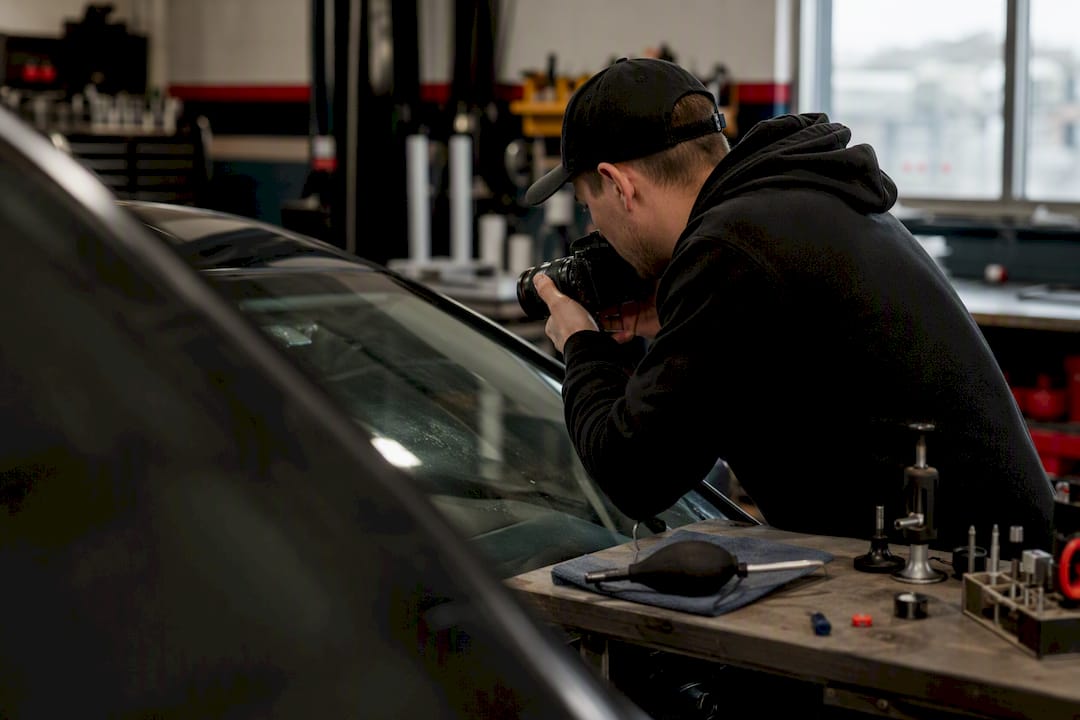
Repair shops that document damage well give claimants an edge insurers respect. High-resolution photos with a ruler for scale, a written repair estimate, and an ADAS calibration report when a forward camera is affected all carry weight with adjusters. Shops that direct-bill insurers also remove a layer of friction that otherwise falls on the claimant.
Get Your Windshield Fixed Fast After a Rock Strike
Collision Auto Glass & Calibration gets you back on the road the same day, with free mobile installation anywhere in the Portland area, so you’re not waiting around while your claim gets sorted out. Whether the damage is a small chip that needs quick repair or a full crack that demands replacement, the team handles cars, trucks, RVs, and fleet vehicles with equal speed.

Every windshield replacement includes in-house ADAS calibration, which matters more than most drivers realize since a miscalibrated camera can affect lane-keeping and automatic braking after a repair. Direct insurance billing means the shop works with your insurer or the trucking company’s carrier directly, so you’re not stuck chasing paperwork on top of everything else. Every installation carries a lifetime no-leak guarantee, backed by a family-owned team that’s been doing this work in Portland since 2008.
If a rock from a gravel truck just cracked your glass, start with a same-day windshield replacement quote and let the direct billing handle the rest while your insurer works out the claim.
Sources
- Maryland Court of Special Appeals opinion on gravel spill and vehicular manslaughter
- Who is responsible when rocks, debris from a dump truck damage your vehicle? – WECT
- Prevalence of motor vehicle crashes involving road debris — AAA Foundation
- Who’s responsible for vehicle damage caused by dump truck debris? – ReviewJournal
FAQ
Are Trucks Liable for Rocks That Fall From Their Load?
Yes, in most cases the trucking company is liable if you can prove the rock came from their truck, since federal and state load securement laws create a duty to prevent spillage.
Can You Sue if a Rock Hits Your Windshield?
Yes, small claims court is a realistic option for straightforward property damage once you have evidence linking the rock to a specific truck, though most claims settle through insurance before reaching a courtroom.
What Happens if a Rock From a Truck Hits My Car?
Photograph the damage and the truck’s identifiers immediately, then file with your insurer or the trucking company’s carrier using that evidence to support a gravel truck rock claim.
How Much Does a Dump Truck Load of Crushed Rock Cost?
Pricing for a truckload of crushed rock varies widely by region, quantity, and material grade, and isn’t standardized enough to quote a single figure; local gravel transport services can provide current rates for delivery in your area.
Does a “Not Responsible” Sign on a Truck Protect the Company From Claims?
No, these signs have no legal effect in most states and do not shield the carrier from a valid negligence claim if you can prove the rock came from their load.
Recommended
- Who Pays When A Rock Hits Your Windshield? – Collision Auto Glass & Calibration
- Who Pays When A Rock Hits Your Windshield? – Collision Auto Glass & Calibration
- A Guide to Navigating Windshield Replacement Insurance Claims – Collision Auto Glass & Calibration
- Frequently Asked Questions About Auto Glass Replacement & Repair
🎧 Listen to This Article
Share
Recent Posts
October 16, 2026
Fleet Auto Glass Programs: Keep ADAS Records Ready for DOT Checks
A fleet auto glass program combines mobile repairs, ADAS calibration, and records that support 49 CFR 393.60 compliance and limit fleet downtime....

October 15, 2026
Auto Glass Claims: Choose a U.S. Shop Before ADAS Billing Surprises
See how U.S. drivers can choose an auto glass shop for an insurance claim, confirm ADAS calibration, protect their rights, and prevent billing...
October 14, 2026
Fleet Windshield Maintenance: A 20 Minute Repair Can Prevent Days Down
Catch chips early, log the VIN and photos, and require part number and ADAS calibration records to keep fleet vehicles moving and avoid...