
Auto Glass Repair
No, wind or whistling noise after a windshield replacement is not normal. A properly bonded windshield sits virtually silent at highway speed, so a new whine, hiss, or flutter almost always points to a gap in the seal or a fitment problem that needs a warranty inspection, not patience.
Two things to do right now, before you call the shop:
- Log the conditions. Note the speed where the noise starts, whether it’s worse in a crosswind or straight headwind, and which side of the windshield it seems to come from.
- Look, don’t touch. Walk around the car and check for a lifted molding, a gap at the cowl, or trim that doesn’t sit flush. Don’t pry at anything or push adhesive around yourself.
Pro Tip: Record a short video from the driver’s seat at the speed where the noise happens. Installers can often pinpoint a seal issue faster from ten seconds of audio than from a phone description.
Once you’ve got that information, contact the installer and ask for a warranty inspection. Reputable shops treat post-installation noise as a workmanship issue covered under their guarantee, not something you wait out.
Key Takeaways
Wind noise after a windshield replacement almost always signals a seal or fitment issue that a qualified installer can diagnose and correct under warranty.
| Point | Details |
|---|---|
| Noise is a signal, not normal | A properly bonded windshield is silent; whistling means air is entering through a gap. |
| Document before you call | Record speeds, wind direction, and side of the noise, plus video if possible. |
| Cure time varies by product | Safe drive-away can be 30 minutes to 8+ hours, with full cure up to 24+ hours depending on conditions. |
| Skip DIY fixes | Never apply sealant or pry trim yourself; it can void the workmanship warranty. |
| Ask for tested proof | Collision Auto Glass & Calibration backs installs with a lifetime no-leak guarantee and documented road and leak tests. |
Table of Contents
- What Causes Wind Noise After a Windshield Replacement?
- How Do You Find Where Windshield Noise Is Coming From?
- What Should a Windshield Installer Do to Fix the Noise?
- How Long Does Windshield Adhesive Take to Cure?
- Why Windshield Noise Can Signal a Real Safety Issue
- How to Get Your Windshield Fixed Under Warranty
- Booking a Warranty Inspection With Collision Auto Glass & Calibration
- Sources
- FAQ
What Causes Wind Noise After a Windshield Replacement?
Wind noise after a new windshield almost always traces back to one of a handful of installation or material issues, and most of them share a common thread: air is finding a path through a seal that should be continuous.
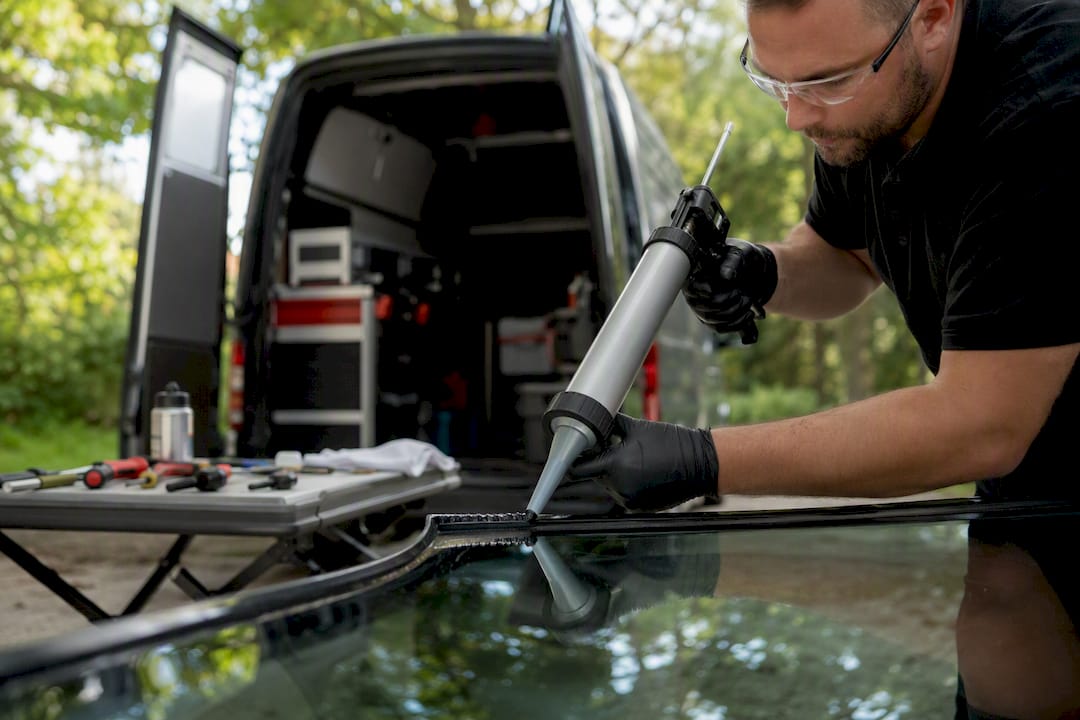
An uneven or incomplete urethane bead. The windshield bonds to the frame through a bead of urethane adhesive applied in a continuous loop. If the technician’s bead has a thin spot, a skip, or a void, even one the size of a pinhole, air can whistle through it at highway speed. Technicians who troubleshoot these calls regularly point out that tiny gaps in the adhesive bead are one of the most common sources of that thin, high-pitched whine drivers report after 45 or 50 miles per hour.
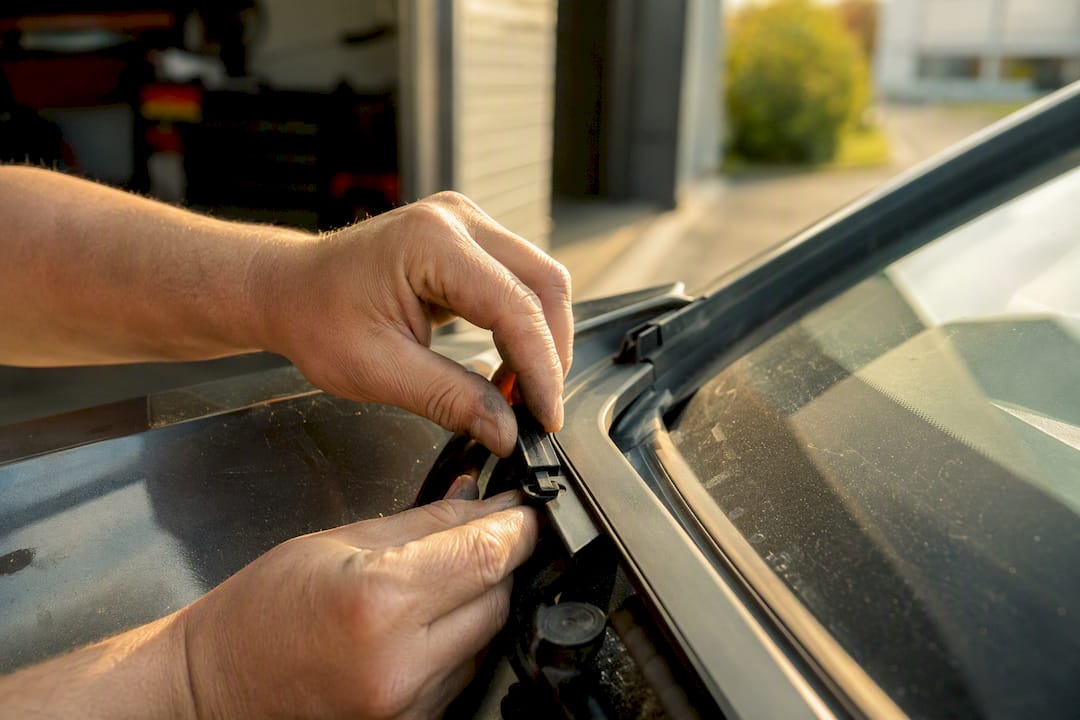
Trim, molding, or cowl panels that aren’t fully seated. The plastic molding around the windshield edge and the cowl panel below it are designed to lock into place with clips. If a clip missed its slot or a molding edge is lifted even a few millimeters, air catches under it and creates a flutter or rattle that gets louder as speed increases.
A glass mismatch that changes the acoustics. Not every replacement windshield matches the acoustic properties of the factory glass. Windshields that lack the original acoustic laminate layer can let in more cabin and road noise even when the installation itself is flawless. This is a different problem from a seal leak, and it’s worth knowing the difference before you assume something is wrong with the bond.
Old adhesive that wasn’t fully removed. When a technician cuts out the old windshield, some urethane residue should remain as a bonding surface, but excess old material or improperly trimmed remnants can create uneven thickness across the bead. That unevenness produces the same thin spots that let air through.
Noise that isn’t actually coming from the windshield. Sometimes a side mirror housing, a door seal, or a roof rack becomes newly noticeable simply because you’re paying closer attention after a repair. It’s worth ruling this out, but don’t let a shop wave off a genuine whistle by blaming your mirror without actually testing it.
How Do You Find Where Windshield Noise Is Coming From?
Before you hand the car back to the installer, a few simple checks help you describe the problem precisely, and precise descriptions get faster warranty fixes.
- Reproduce it on purpose. Drive the same route at a few different speeds, ideally 40, 55, and 65 miles per hour, and note where the sound starts and stops. Test with windows up and down, and pay attention to whether a crosswind makes it worse than a straight headwind.
- Compare left and right. Roll each window down individually for a few seconds at speed. If the noise disappears or shifts when you isolate one side, you’ve narrowed the search significantly.
- Inspect the car parked, engine off. Walk the entire perimeter of the glass. Look for a molding edge that sits higher than its neighbors, a cowl panel with a visible gap, or weatherstripping that looks pushed out of place.
- Try the tissue test. With the engine running and windows up, hold a strip of tissue paper or a thin piece of paper near the A-pillars, the top of the windshield frame, and the mirror base. Airflow that catches the paper indicates a genuine leak point rather than road drone.
Pro Tip: Do this test in a quiet parking lot with the fan off, then repeat it at speed on a straight stretch of road. Wind noise is deceptive in a moving car, since cabin acoustics amplify sound differently than a stationary test.
Stop there. Don’t reach for silicone caulk, weatherstrip adhesive, or a screwdriver to push the molding back into place yourself. Working under the trim yourself is one of the fastest ways to void a workmanship warranty, and it can make the eventual professional fix harder if it disturbs the urethane bead underneath.
What Should a Windshield Installer Do to Fix the Noise?
A shop that takes wind noise seriously follows a specific inspection sequence, not a guess-and-check approach.
- Road test at multiple speeds. A technician should ride along or drive the vehicle through the speed range where you reported the noise, confirming it independently rather than taking your word alone.
- Controlled leak test. Shops use a water test or a smoke/pressure test around the perimeter of the glass to find exactly where air or water is getting through.
- Visual and physical bead check. In many cases this means removing trim to inspect the adhesive bead directly, checking for voids, thin spots, or uneven coverage.
- Trim and clip inspection. Every molding clip point gets checked to confirm nothing popped loose during the original install.
The corrective action depends on what they find. A molding that simply wasn’t clipped in fully just needs to be reseated, a five-minute fix. A small adhesive void might be correctable by injecting additional urethane at the gap. But if the bond itself is compromised across a wider section, or the glass was set with incorrect spacing, the only real fix is pulling the windshield and reinstalling it with a fresh, continuous bead.
Ask for documentation either way: a written inspection report, photos of what they found, and a warranty statement covering the repair. If the noise returns, you’ll want that paper trail rather than a “we already looked at it” conversation. Reviewing what makes a shop reliable in the first place is useful even after the fact, since it tells you what standard to hold your installer to during the fix.
How Long Does Windshield Adhesive Take to Cure?
Urethane adhesive cures in stages, and confusing “safe to drive” with “fully cured” is where a lot of premature noise and leak complaints start.
Safe drive-away time is the minimum period before the bond can withstand normal driving forces and, critically, meet the retention standards a windshield needs in a crash. I-CAR’s documentation shows this window varies widely by product: fast-cure urethanes may allow safe drive-away in 30 to 60 minutes, while conventional moisture-cure formulas can require 2 to 8 hours or longer. Full cure, the point where the adhesive reaches its complete strength, can take 24 hours or more depending on temperature and humidity.
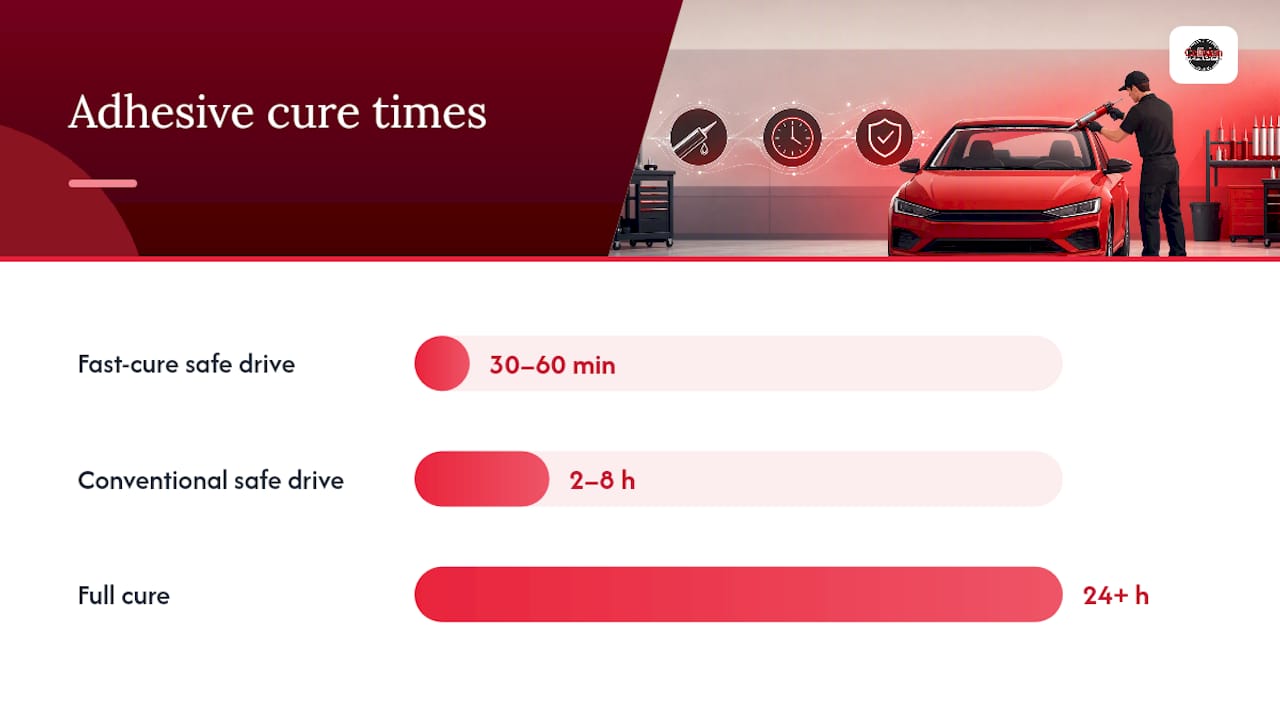
Cold weather and low humidity both slow urethane cure time significantly, which is why a reputable installer references the manufacturer’s performance data sheet for the specific product they used rather than quoting a generic number.
While the adhesive finishes curing, a few habits protect the bond:
- Crack a window slightly for the first day if your installer advises it, since slamming doors with the cabin sealed shut creates a pressure spike that can push against a not-yet-cured bead.
- Skip the car wash, especially high-pressure or touchless bays, for at least 24 to 48 hours.
- Avoid parking on rough roads or gravel that invites hard door slams and vibration during the first day.
A concentrated water jet aimed near the edge of fresh urethane can displace material that hasn’t set, and that’s a common, preventable cause of noise or a slow leak showing up days after a clean install.
Why Windshield Noise Can Signal a Real Safety Issue
A whistle is annoying. What it represents underneath is worth taking seriously.
The urethane bead isn’t just a weatherstrip, it’s a structural component. Federal Motor Vehicle Safety Standards 212 and 208 govern windshield retention in a crash, and those standards assume a complete, fully cured adhesive bond holding the glass in place. A void large enough to whistle is also large enough to compromise that retention margin, and it’s a path for water intrusion that can damage headliner, electronics, or create mold over time.
Reputable shops treat a post-installation whistle or leak as a workmanship issue to be tested and corrected, never as something a customer should simply wait out. The I-CAR standard around minimum driveaway time exists precisely because adhesive performance is tied to passing those retention standards, not just customer comfort.
That’s the real argument for asking for documented cure times and a written inspection: this isn’t a cosmetic complaint, it’s a safety-adjacent one.
A few things worth knowing about how a shop should be equipped to handle it:
- Family-owned, established installers tend to have seen more edge cases and are less likely to dismiss a genuine complaint.
- Same-day mobile service means a warranty inspection doesn’t require you to lose a day off work.
- A lifetime no-leak guarantee only means something if the shop actually performs road and leak tests rather than taking a quick look and sending you home.
- In-house ADAS calibration capability signals a shop invests in the equipment and training to catch installation issues most competitors miss entirely.
How to Get Your Windshield Fixed Under Warranty
Call the shop and lead with specifics: the speeds where you hear it, which side, the weather conditions, and your invoice number and installation date. Attach the video if you took one.
Ask directly for three things: a road test, a leak test, and a written timeline for the fix. A shop that runs those tests as a matter of course will say so without hesitation.
Watch for red flags. If a rep tells you to “give it a few more days,” pushes back on scheduling an inspection, or asks you to sign anything before they’ve even looked at the car, that’s a shop not following standard workmanship practice. Your next move is asking to speak with a manager, contacting your insurer if the original repair was billed through a claim, or getting a second shop’s opinion. Documentation matters here too, since a clear paper trail speeds up any insurance-mediated resolution if it comes to that. A misaligned panel elsewhere on the vehicle can sometimes complicate a fit issue too, and a basic alignment checklist is a useful reference if body work happened around the same time as the glass replacement.
Booking a Warranty Inspection With Collision Auto Glass & Calibration
If your current installer is dragging its feet, you don’t have to keep driving with a whistle you can’t unhear. Collision Auto Glass & Calibration backs every installation with a lifetime no-leak guarantee, which means a road test and a controlled leak test aren’t upsells, they’re standard practice on every warranty call.
Same-day mobile service means a technician can come to you anywhere in the Portland area rather than adding another trip to your week, and every inspection includes documented findings so you have a record if the issue needs a second look down the line. Because Collision Auto Glass & Calibration also handles in-house ADAS calibration, technicians are trained to catch the kind of fitment and sensor-adjacent details that a rushed installer might miss entirely.
If you’re dealing with wind noise from a replacement done elsewhere, or you want the job done right the first time, book a windshield replacement or warranty inspection and get a same-day appointment with a documented road and leak test included.
Sources
For readers who want to see the underlying standards, I-CAR’s guidance on minimum driveaway time lays out how urethane cure windows vary by product and condition. Independent installer writeups, including detailed breakdowns of why new windshields whistle at highway speed, cover the same troubleshooting steps professional shops use. Both are worth bookmarking before your next warranty conversation.
- Minimum Driveaway Time For Urethane Adhesive
- Why does my new windshield whistle or make noise at highway speeds?
- Wind noise after windshield replacement: Causes and fixes
- Windshield glue dry time: How long to wait? Safety guide
FAQ
Is it normal for a windshield to make noise after replacement?
No. A correctly installed windshield should be silent at highway speed, so persistent whistling or wind noise usually points to a seal or fitment issue that needs inspection.
Why does my windshield rattle after being replaced?
Rattling usually means a molding, clip, or cowl panel wasn’t fully seated during installation, letting a trim piece vibrate or lift slightly at speed.
How long does it take for a new windshield to settle?
Safe drive-away time can range from 30 minutes for fast-cure adhesive to 8 hours or more for conventional formulas, while full cure often takes 24 hours or longer depending on temperature and humidity.
Is wind noise normal after a windshield replacement?
No, and it shouldn’t be dismissed as something that resolves on its own; a shop offering a genuine workmanship guarantee, like Collision Auto Glass & Calibration’s lifetime no-leak guarantee, should road test and leak test the vehicle to find the cause.
Recommended
- How to Properly Care for a New Windshield – Collision Auto Glass & Calibration
- How Long Does a Windshield Replacement Take? – Collision Auto Glass & Calibration
- Top 5 Myths About Windshield Replacement Debunked – Collision Auto Glass & Calibration
- How Seasonal Changes Can Affect Your Windshield Replacement Needs – Collision Auto Glass & Calibration
🎧 Listen to This Article

Share
Recent Posts

October 15, 2026
Auto Glass Claims: Choose a U.S. Shop Before ADAS Billing Surprises
See how U.S. drivers can choose an auto glass shop for an insurance claim, confirm ADAS calibration, protect their rights, and prevent billing...
October 14, 2026
Fleet Windshield Maintenance: A 20 Minute Repair Can Prevent Days Down
Catch chips early, log the VIN and photos, and require part number and ADAS calibration records to keep fleet vehicles moving and avoid...
October 13, 2026
Calibration After Collision Repair: Ask for Scans Before You Drive
Learn when collision repairs require ADAS calibration, how shops verify the work, and which scan records and paperwork to request before driving....