
Auto Glass Repair
The most common types of windshield chips are the bull’s-eye, star break, half-moon (partial bull’s-eye), surface pit, floater/long crack, edge crack, stress crack, and combination break. The quick repairability rule: chips smaller than a common coin and cracks of short length are often repairable, provided the damage is not in the driver’s primary viewing area, not within roughly two inches of the edge, and does not penetrate through the glass interlayer.
Usually repairable (with professional assessment):
- Bull’s-eye chip
- Half-moon/partial bull’s-eye
- Star break (within size limits)
- Surface pit
Often require replacement:
- Edge crack
- Stress crack
- Long floater crack (beyond dollar-bill length)
- Combination break with crushed glass or multiple legs
Pro Tip: Photograph the damage immediately after you notice it. Shoot one close-up showing the chip clearly, one from arm’s length with a coin or ruler next to it for scale, and one wider shot showing how far the damage sits from the nearest edge and from any camera or sensor mounted behind the glass. These three images give a shop everything needed to give you an accurate remote estimate.
Table of Contents
- 1. What are the main types of windshield chips and cracks?
- 2. How pros decide: the repair vs. replace checklist
- 3. Typical prices and how insurance affects repair vs. replacement
- 4. What to do right after you notice a chip or crack
- 5. How professional windshield repairs work — and why pros outperform DIY kits
- 6. When replacement is necessary: edge damage, safety zones, and ADAS
- Key Takeaways
- What we see every day at the shop
- Portland’s same-day auto glass service, from chip repair to ADAS calibration
- FAQ
1. What are the main types of windshield chips and cracks?
Knowing what you are looking at is the first step toward getting the right repair. The ROLAGS standard (Repair of Laminated Auto Glass Standard, published under ANSI/AGSC/NWRD) gives technical definitions for each damage type and sets size thresholds that shops use to decide whether a chip is repairable. A quick household measurement trick: hold a quarter next to a chip or a dollar bill next to a crack to gauge size before you call a shop.
| Damage Type | What It Looks Like | Common Cause | Typical Repairability |
|---|---|---|---|
| Bull’s-eye | Circular impact point with a cone-shaped pit; clean, round outline | Road debris, gravel | Usually repairable up to ~1 in diameter |
| Star break | Central impact with multiple cracks radiating outward like a starburst | High-speed rock strike | Often repairable up to ~3 in across (per ROLAGS) |
| Half-moon / partial bull’s-eye | Semicircular chip, like a bull’s-eye cut in half | Angled rock impact | Usually repairable at similar size limits as bull’s-eye |
| Surface pit | Tiny divot or nick; no visible crack legs | Sand, small debris | Usually repairable; often cosmetic only |
| Floater / long crack | Straight or curved crack that starts away from the edge | Temperature stress, prior chip that spread | Repairable if under ~6 in and no edge involvement |
| Edge crack | Crack that starts within ~2 in of the glass border | Road vibration, thermal stress | Usually requires replacement |
| Stress crack | Crack with no visible impact point; often curves | Extreme temperature swings | Usually requires replacement |
| Combination break | Multiple damage types in one spot (chip + star legs + crack) | High-velocity impact | Often requires replacement; crushed glass common |
Size thresholds matter. Per ROLAGS/ANSI-based standards, bull’s-eye chips up to approximately 1 inch and star breaks up to approximately 3 inches are within the repairable range — but location and depth always override size alone.
Pro Tip: A star break and a combination break can look similar at first glance. The key difference is crushed or missing glass at the impact point. If you see white, powdery glass fragments or a pit with no clean edges, you are likely looking at a combination break, which carries a higher replacement risk.
2. How pros decide: the repair vs. replace checklist
Technicians do not rely on a single measurement. They run through five criteria in sequence, and any one of them can push the decision from repair to replacement.
- Size. Chips smaller than a quarter (~1 inch) and cracks shorter than a dollar bill (~6 inches) fall within the repairable range for most damage types. Larger damage almost always requires full replacement.
- Location. Damage inside the driver’s primary viewing area (roughly the area swept by the wipers directly in front of the driver) is held to a stricter standard. Even a small, otherwise-repairable chip in this zone may be declined for repair because resin can leave a slight optical distortion.
- Depth/penetration. A windshield has two glass layers bonded by a plastic interlayer (polyvinyl butyral). Damage that penetrates through the outer layer into or through the interlayer cannot be repaired safely and requires replacement.
- Distance from the edge. Cracks or chips within approximately two inches of the glass border compromise the structural bond between the glass and the vehicle frame. Edge damage is a near-automatic replacement trigger.
- Multiplicity and clustering. Multiple small chips in close proximity can collectively weaken the glass even when each individual chip is within size limits. Industry guidance treats clustered impacts as a reason to replace rather than attempt multiple repairs.
When sending photos to a shop for a remote assessment, include: a close-up of the impact, a shot with a coin for scale, and a wider frame showing the chip’s position relative to the nearest edge and any camera or sensor housing. Clear photos cut the back-and-forth and get you a faster, more accurate answer.
3. Typical prices and how insurance affects repair vs. replacement
Rock-chip repair is significantly less expensive than full windshield replacement. Repair costs typically run in the range of $50–$150 per chip, while a full replacement can range from a few hundred dollars to well over $1,000 depending on the vehicle, glass type, and whether ADAS calibration is required afterward. For detailed local pricing, Collision Auto Glass & Calibration publishes a cost breakdown for rock-chip repairs that reflects current Portland-area rates.
Insurance note: Many comprehensive auto policies waive the deductible entirely for professional windshield chip repair, making early repair effectively free for covered drivers.
Call your insurer before scheduling any work. If your policy includes comprehensive coverage, ask specifically whether chip repair is deductible-free. Filing a claim for a repairable chip is almost always worth it. Replacement claims are different: depending on your deductible and your insurer’s history of rate adjustments, paying out of pocket for a straightforward replacement can sometimes be smarter than filing. For a deeper look at how coverage works, see Collision Auto Glass & Calibration’s guide on insurance coverage for rock chips.
4. What to do right after you notice a chip or crack
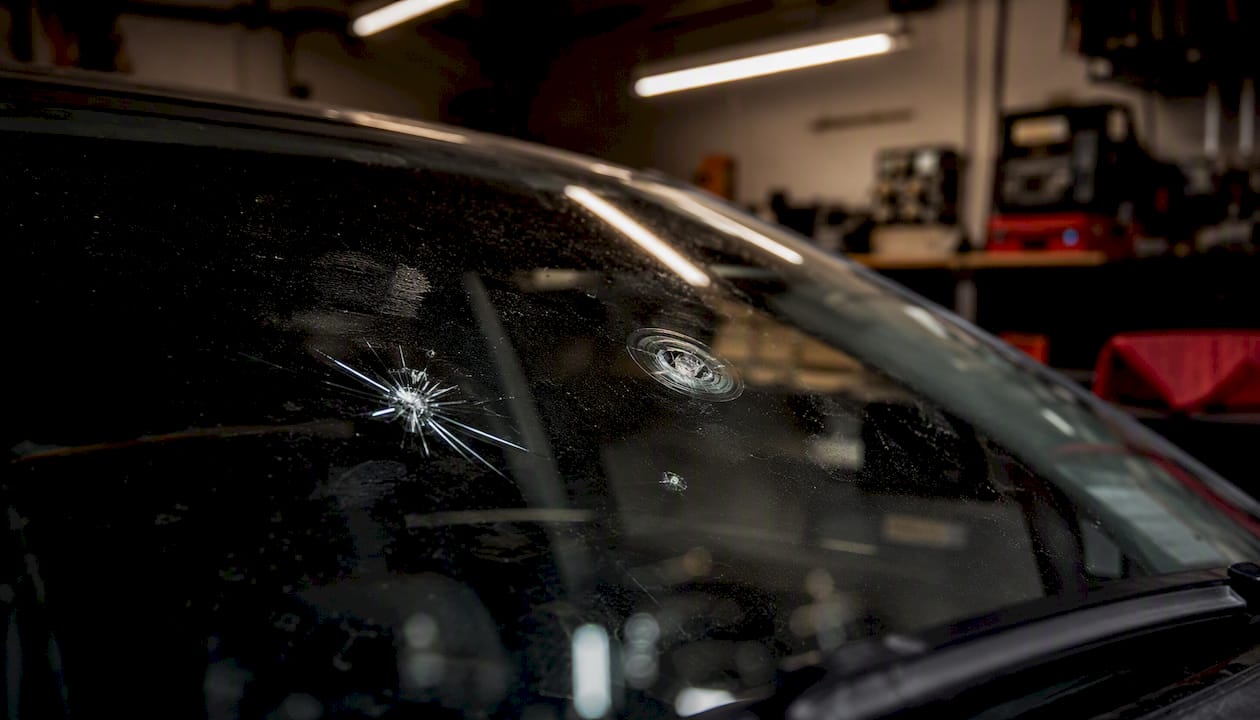
Speed matters. A small chip can turn into a longer crack within days if temperature swings, road vibration, or moisture work into the fracture. Acting within 24–48 hours keeps most repairable chips repairable.
Do this now:
- Clean the area gently with a soft cloth to remove loose debris, but do not probe the chip with anything sharp.
- Park in a garage or shaded area when possible to reduce thermal stress on the glass.
- Place a small piece of clear tape over the chip to keep moisture and dirt out until you can get to a shop (or until mobile service arrives).
- Drive carefully and avoid roads with heavy vibration until the chip is assessed.
Avoid these:
- Do not apply household superglue or nail polish. These products fill the chip with a material that blocks professional resin from penetrating properly, often making the damage unrepairable.
- Do not run aggressive windshield wipers over an open chip, especially in cold or dry conditions.
- Avoid slamming doors hard or loading the roof rack with heavy items, both of which flex the glass and can extend existing cracks.
The reason urgency matters comes down to resin chemistry. Professional repair works by injecting optical resin into the fracture under vacuum pressure. Once dirt, moisture, or a DIY product contaminates the break, the resin cannot bond cleanly to the glass surfaces, and the repair result degrades or becomes impossible.
5. How professional windshield repairs work — and why pros outperform DIY kits
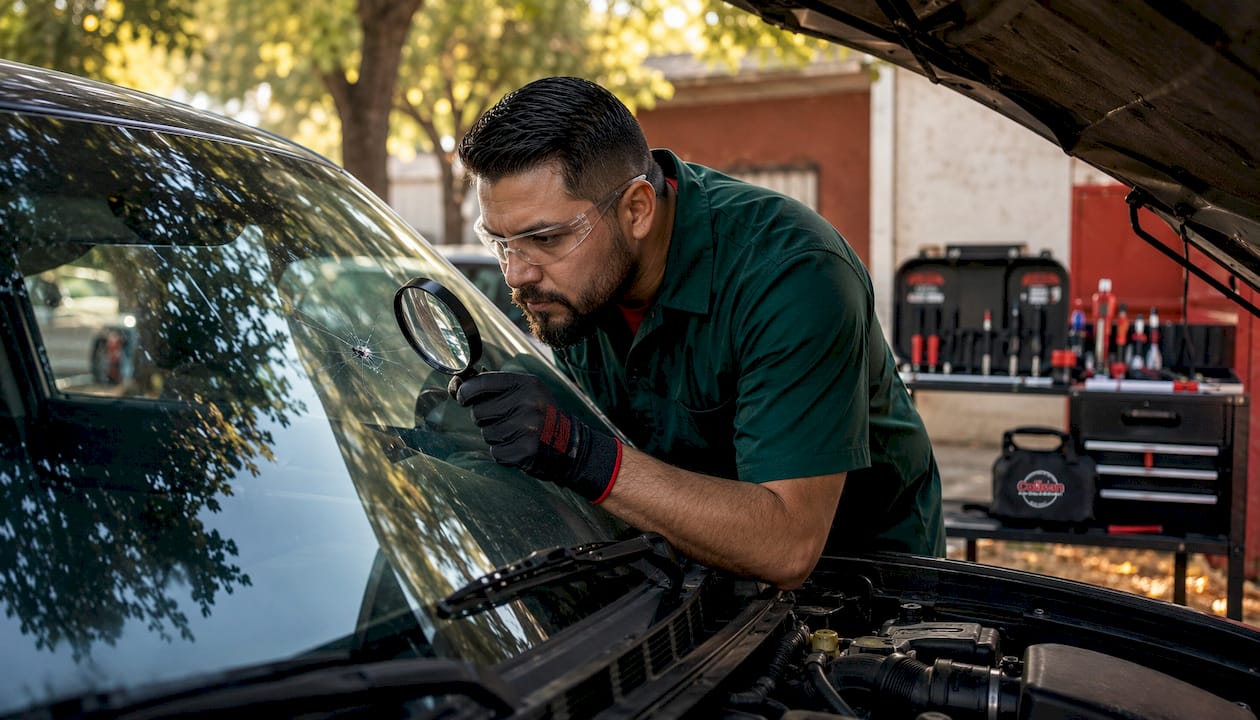
Professional technicians use vacuum-and-resin injection systems that evacuate air from the fracture before forcing optical resin into every micro-crack. A UV lamp then cures the resin to near-glass hardness, and the technician polishes the surface to restore optical clarity. DIY kits cannot fully replicate this process because they lack the vacuum stage, which means air pockets remain in the fracture and the resin bond is weaker and more prone to long-term spread.
The professional process in brief: assessment of damage type and repairability → cleaning and vacuuming the break → resin injection under pressure → UV cure → surface polish and optical check.
| Factor | Professional Repair | DIY Kit |
|---|---|---|
| Resin penetration | Vacuum system removes air first; deep fill | No vacuum; surface-level fill only |
| Optical quality | Near-invisible result in most cases | Visible distortion common |
| Equipment | Calibrated injection bridge, UV lamp | Syringe applicator, small UV light |
| Warranty/guarantee | Shop warranty; Collision Auto Glass & Calibration offers a lifetime no-leak guarantee on installations | No warranty |
For more on why DIY windshield repair carries real risks, Collision Auto Glass & Calibration’s technicians break down the most common failure points.
Pro Tip: When calling a shop, ask three questions: What injection system do you use? Do you offer a warranty on the repair? Can you come to me? A shop that answers all three confidently is worth booking.
6. When replacement is necessary: edge damage, safety zones, and ADAS
Some damage cannot be repaired safely, regardless of size. Replacement is the right call when any of the following apply:
- The crack or chip sits within approximately two inches of the glass edge, where it compromises the structural bond.
- The damage is in the driver’s primary viewing area and would leave optical distortion after repair.
- The impact has penetrated through the outer glass layer into or through the plastic interlayer.
- Multiple chips are clustered together, collectively weakening the glass.
- A combination break shows crushed or missing glass at the impact point.
- The damage is on or directly adjacent to an ADAS camera, sensor, or heating element mounted to the glass.
That last point deserves attention. Many modern vehicles mount forward-facing cameras, rain sensors, and lane-departure systems directly behind the windshield. Damage near ADAS components can mandate replacement and professional recalibration to restore manufacturer-specified system accuracy. Skipping calibration after replacement is not just a technical oversight; it can cause the vehicle’s safety systems to misread lane markings, following distances, and collision warnings.
Windshield bonding also uses structural polyurethane adhesives that meet automotive standards and FMVSS requirements; for example, a seal repair kit designed for mechanical parts can be essential in maintaining system integrity. Windshield adhesives are structural; sealants are not a substitute. A shop that uses the wrong bonding material compromises crash performance, regardless of how clean the glass looks afterward. For a full explanation of what ADAS recalibration involves and when it is required, see Collision Auto Glass & Calibration’s ADAS calibration guide.
Key Takeaways
Most windshield chips are repairable if addressed quickly, but size, location, depth, and proximity to ADAS sensors all determine whether repair or replacement is the right call.
| Point | Details |
|---|---|
| Know your damage type | Bull’s-eye, star, half-moon, and surface pits are usually repairable; edge cracks, stress cracks, and combination breaks often require replacement. |
| Use the size rule | Chips smaller than a quarter and cracks shorter than a dollar bill (~6 in) fall within the repairable range, subject to location and depth. |
| Act within 24–48 hours | Delaying repair allows moisture and debris to contaminate the break, reducing repair quality and increasing the chance of replacement. |
| Check your insurance first | Many comprehensive policies waive the deductible for chip repair, making professional repair effectively free for covered drivers. |
| Collision Auto Glass & Calibration | Portland’s same-day service handles chip repair, replacement, and in-house ADAS calibration with direct insurance billing and a lifetime no-leak guarantee. |
What we see every day at the shop
The most persistent misconception we encounter is that a DIY kit “bought time.” In reality, a chip treated with a hardware-store syringe kit is often harder to repair professionally than one left alone. The foreign material blocks resin penetration, and what started as a straightforward 20-minute repair becomes a replacement conversation. We see this pattern regularly, and it is almost always more expensive for the driver.
What actually helps us give an accurate estimate fast is a clear photo set: one close-up of the impact, one with a coin for scale, and one wider shot showing the chip’s distance from the nearest edge and from any camera housing. If the damage is near a sensor, that third photo is the most important one we receive. It tells us immediately whether calibration will be part of the job.
Collision Auto Glass & Calibration has been family-owned and operated since 2008. Every job comes with direct insurance billing, free mobile service within the Portland area, and a lifetime no-leak guarantee on all installations. When you call or submit photos online, you are talking to the people doing the work, not a call center. That matters when the answer to “can this be repaired?” depends on a detail only a trained eye can catch.
Portland’s same-day auto glass service, from chip repair to ADAS calibration
A repairable chip costs a fraction of a replacement, and most comprehensive insurance policies cover it with no deductible. The window to keep that chip repairable is short, typically 24–48 hours before temperature swings or road vibration extend it into a crack that requires full replacement.
Collision Auto Glass & Calibration handles the full range: mobile rock-chip repair at your home or office, windshield and auto glass replacement, and in-house ADAS calibration for vehicles that require it after replacement. Direct insurance billing means you do not have to chase reimbursement. The lifetime no-leak guarantee means the job is done right the first time. Service is available same-day throughout the Portland area.
To get a quote, visit collisionautoglass.com or call directly. If you are outside the Portland service area, ask your local shop specifically about ROLAGS-certified technicians and whether they perform in-house ADAS calibration — those two questions will tell you quickly whether the shop is equipped for your vehicle.
Authoritative sources and further reading
The standards and guidance below are worth reviewing if you want to understand the technical side of repair decisions, insurance coverage, and ADAS calibration requirements.
- ROLAGS (Repair of Laminated Auto Glass Standard) — The ANSI/AGSC/NWRD industry standard that defines damage types, size thresholds, and repair procedures. This is the document shops reference when making repair-vs.-replace calls.
- GEICO: How to Get a Cracked or Chipped Windshield Repaired — Practical insurer guidance on coverage, urgency, and what to expect from the repair process.
- Sika: Fast and Safe Windshield Replacement — Industry resource on structural adhesives, ADAS proximity concerns, and proper bonding after replacement.
Bring these questions to your shop or insurer: Is the damage within ROLAGS repairable limits? Does my policy waive the deductible for chip repair? Does my vehicle require ADAS recalibration after replacement? Clear answers to all three will guide every decision that follows.
FAQ
What are the different types of windshield chips?
The main types are the bull’s-eye, star break, half-moon (partial bull’s-eye), surface pit, floater/long crack, edge crack, stress crack, and combination break. Each has distinct visual characteristics defined by the ROLAGS standard used by professional technicians.
Which windshield chips cannot be repaired?
Edge cracks, stress cracks, and combination breaks with crushed glass often require replacement rather than repair. Damage that penetrates through the interlayer, sits in the driver’s primary viewing area, or is located near an ADAS camera or sensor is also typically beyond repair.
Which types of windshield chips can be repaired?
Bull’s-eye chips, half-moon chips, star breaks within size limits, and surface pits are usually repairable. The general field rule is chips smaller than a quarter and cracks shorter than a dollar bill are candidates for professional resin injection, subject to location and depth.
Does insurance cover windshield chip repair?
Many comprehensive auto policies waive the deductible for professional chip repair, making it cost-free for covered drivers. Call your insurer before scheduling work to confirm your coverage terms. Collision Auto Glass & Calibration handles direct insurance billing to simplify the process.
What is the difference between a windshield adhesive and a windshield sealant?
Windshield adhesives are structural polyurethane compounds that meet FMVSS bonding requirements; sealants are non-structural and cannot replace adhesive in a replacement installation. Using a sealant instead of a structural adhesive compromises crash performance and vehicle safety.
Recommended
- Rock Chip FAQ: Answers to Frequently Asked Questions About Rock Chips
- How to Avoid Windshield Damage – Collision Auto Glass
- 7 Signs Your Windshield Needs Repair Before It Spreads – Collision Auto Glass & Calibration
- Is It Worth Getting A Windshield Chip Repaired? – Collision Auto Glass & Calibration
Share
Recent Posts

August 26, 2026
Toyota Windshield Calibration: What to Ask and Expect
Ensure your Toyota’s safety with proper windshield calibration. Discover essential checks and costs to keep your safety systems accurate....

August 25, 2026
Auto High Beam Not Working? Fixes for Every Cause
Is your auto high beam not working? Discover easy fixes to get your automatic system back on track and drive safely at night!...
August 24, 2026
Windshield Repair Scams: What They Look Like and How to Avoid Them
Protect yourself from windshield repair scams—learn the warning signs and how to avoid costly mistakes before it’s too late....