
Auto Glass Repair
A chip near your camera may be repairable, but the decision depends on two things: whether the damage sits inside the camera’s optical view and whether your vehicle manufacturer allows repairs in that specific area. We recommend getting the damage inspected quickly by an ADAS-aware auto glass shop that knows your make, model, and year before it spreads or clouds the camera’s view.
TL;DR:
- Your vehicle’s exact year, make, model, and trim determine whether a chip sits in a manufacturer’s prohibited repair zone; no universal distance applies.
- Shops should assess the chip’s position in the camera’s optical path, depth, size, spreading cracks, glass separation, and bracket alignment before recommending repair or replacement.
- A minor repair that leaves the camera undisturbed may not require calibration; windshield replacement or camera removal and reinstallation can trigger it.
- Before booking, send daylight photos with a coin or ruler for scale, provide your full vehicle details, and ask about calibration charges and insurance billing.
- Request written proof that calibration passed, warning lights cleared, and a test drive verified system performance, then keep the records with your vehicle.
Table of Contents
- Why Windshield Damage Near the Camera Matters for ADAS
- How Shops and Manufacturers Decide Repair vs. Replacement
- ADAS Calibration: Types, Triggers, and What to Expect
- What to Expect at the Shop: Inspection, Decision, Timeline, and Cost
- How to Self-Screen and Document a Chip Near the Camera
- Collision Auto Glass & Calibration: Why ADAS-Aware Service Matters
- Get Your Chip Near the Camera Inspected
- FAQ
- Sources
Why Windshield Damage Near the Camera Matters for ADAS
Your windshield isn’t just a barrier against wind and debris. For any vehicle with a forward-facing camera, the glass functions as the first lens in an imaging system that feeds data to lane-keeping, automatic braking, and adaptive cruise control. Technical research on windshield optical impact on automotive cameras shows that windshield geometry and surface quality measurably affect image sharpness, degrading the modulation transfer function that determines how clearly a camera can resolve detail. A distortion that looks minor to the eye can still interfere with what the camera actually sees.
That optical sensitivity carries real consequences. A 2024 consumer study found that vehicle owners who needed calibration after a repair reported persistent feature problems roughly half the time, along with unexpected out-of-pocket costs. The stakes of getting this right go beyond cosmetics:
- A chip inside the camera’s field of view can scatter or refract light before it reaches the sensor.
- Even a repaired chip can leave a faint lens effect that confuses object detection.
- Calibration done after a flawed repair won’t fix an underlying optical problem.
A small chip near the camera carries outsized risk because it sits exactly where image clarity matters most for safety systems.
How Shops and Manufacturers Decide Repair vs. Replacement
There’s no single industry-wide safe distance that tells a technician “repair up to here, replace beyond it.” Each manufacturer sets its own rules, and those rules vary by model and trim. A Subaru service bulletin designates specific no-go areas near the camera where repair is prohibited outright, regardless of chip size. Other manufacturers draw their boundaries differently, which is why the vehicle’s own documentation, not a rule of thumb, has to guide the call.
When we inspect a chip near the camera, several factors determine whether repair is realistic:
- Location relative to the camera’s optical path, not just distance from the housing.
- Depth of the chip and whether it has penetrated the inner layer of glass.
- Size and whether cracks run outward from the impact point.
- Signs of delamination, where the glass layers begin separating.
- Condition of camera brackets and locating pins that must stay precisely aligned.
The manufacturer’s procedure for your exact year, make, model, and trim is what ultimately decides the outcome. A shop that skips this step and repairs or replaces by habit rather than by the book is guessing with a safety system.
ADAS Calibration: Types, Triggers, and What to Expect
Calibration realigns the camera’s understanding of the road after any disturbance to the glass or sensor. Two main approaches exist, and which one your vehicle needs depends entirely on the manufacturer’s procedure, detailed in guidance available through ALLDATA’s ADAS service information:
- Static calibration uses alignment targets placed at exact distances and heights, with specialized hardware to confirm the camera reads them correctly.
- Dynamic calibration requires a road test at specified speeds so the system can relearn lane markings and traffic patterns in motion.
- Scan-tool relearn procedures combine software commands with a brief drive cycle for vehicles that use a hybrid approach.
Calibration isn’t limited to full windshield replacement. Rivian’s position statement on 2025 and newer models confirms calibration is required whenever the windshield or camera assembly is replaced or even removed and reinstalled, which means mirror assembly service or camera replacement can trigger the same requirement as a chip repair that disturbs the glass near the sensor.
Pro Tip: Ask your shop for written confirmation that calibration was completed and verified, not just that it was attempted.
Verification should include confirmation that dashboard ADAS warning lights have cleared, a test drive to validate real-world performance, and documentation you can keep with your vehicle records. Our guide on calibration after windshield replacement walks through what that verification looks like in practice.

What to Expect at the Shop: Inspection, Decision, Timeline, and Cost
A reliable shop follows a consistent sequence once you report a chip near the camera. We typically start with a remote screening using photos you send ahead of your visit, which lets us flag likely outcomes before you even arrive.
- Remote photo review to assess location, size, and proximity to the camera.
- On-vehicle inspection to confirm depth, delamination, and bracket condition.
- Cross-reference against the manufacturer’s documented procedure for your vehicle.
- Repair-or-replace decision based on that procedure, not a generic standard.
- Calibration method selection if replacement or camera disturbance is involved.
- Final verification before the vehicle leaves the shop.
Pro Tip: Have your VIN ready when you call. It lets the shop pull the exact procedure for your vehicle instead of relying on general guidance.
Timeline varies by outcome. A straightforward chip repair that falls outside any no-go zone can often be finished same day. Replacement paired with calibration takes longer, and some procedures require a controlled road test at a minimum speed before the system is considered relearned.
Cost drivers include your insurance deductible if replacement is needed, calibration fees tied to the method required, and the possibility of the out-of-pocket costs the consumer study identified among owners who didn’t ask about billing upfront. Ask any shop directly whether they handle direct insurance billing before you commit.
How to Self-Screen and Document a Chip Near the Camera
Before you call a shop, a few minutes of documentation can speed up an accurate assessment and save you a return trip.
- Take photos from multiple angles, including one that clearly shows the chip’s position relative to the rearview mirror and camera housing.
- Include a coin or ruler in at least one photo for scale.
- Shoot in good daylight to avoid glare or shadows that obscure the damage.
- Write down your vehicle’s full year, make, model, and trim, since calibration procedures differ even between trims of the same model.
- Note whether any ADAS warning lights have appeared on your dashboard.
- Check whether the chip is surface-level or appears to penetrate toward the inner glass layer, and whether any crack extends from it.
Avoid driving long distances with compromised glass near the camera, and skip any DIY repair kit for damage in this zone. Call an ADAS-aware shop, share your photos, and let a trained eye make the repair-or-replace call before booking an appointment.
Collision Auto Glass & Calibration: Why ADAS-Aware Service Matters
We’ve operated as a family-owned shop since 2008, and chips near the camera are exactly the kind of damage that rewards careful, manufacturer-specific inspection rather than guesswork. Same-day service and free mobile installation within the Portland area mean the damage can often be assessed and addressed without disrupting your week. Because the shop performs ADAS calibration in-house, it follows your vehicle’s documented procedure from inspection through final road-test verification, backed by a lifetime no-leak guarantee on every installation.
— Collision Auto Glass & Calibration
Get Your Chip Near the Camera Inspected
We handle every piece of this process under one roof: windshield repair for chips that qualify, full windshield replacement when the damage sits inside a manufacturer’s no-go zone, and in-house ADAS calibration to confirm your camera reads the road correctly afterward.
- Windshield repair starting at a moderate cost for eligible chips.
- Windshield replacement costs vary widely depending on your vehicle.
- ADAS calibration with written verification.
- Mobile installation within the Portland area.
- No-leak guarantee on installations.
- Insurance billing options to simplify claims.
For documentation you should expect to receive after calibration, GW&P Glassworks outlines three documents to request before you leave any shop’s lot.
Ready to find out whether your chip qualifies for repair? Request a quote or schedule an inspection and we’ll walk you through your vehicle’s specific procedure.
FAQ
Can a chip near the camera always be repaired?
Not always. Repairability depends on whether the chip falls inside the camera’s optical view and whether your vehicle maker designates that area a no-go zone, as seen in Subaru’s service bulletin. A qualified shop needs to check your vehicle’s specific procedure before confirming either way.
Will I need ADAS calibration after a chip repair near the camera?
Calibration is typically required when the windshield is replaced or when the camera assembly is disturbed, according to Rivian’s calibration guidance. A minor repair that doesn’t disturb the camera’s mounting may not trigger calibration, but this should be confirmed by the shop handling your vehicle.
How do I know if my windshield chip is affecting my camera?
Watch for ADAS warning lights on your dashboard, or features like lane-keeping and automatic braking behaving inconsistently. Share clear photos of the chip’s location relative to the camera with a shop before your visit so they can flag likely issues early.
What does ADAS calibration involve after a windshield repair or replacement?
Calibration uses either static alignment targets, a dynamic road test, or a scan-tool relearn procedure, depending on your vehicle’s documented process. You can learn more about what ADAS calibration involves and what to expect during the appointment.
How much does ADAS calibration cost?
Calibration pricing depends on the method your vehicle requires and isn’t published as a flat rate. Requesting a quote for your specific year, make, and model gives you an accurate figure before you book.
Sources
- Subaru service bulletin (example of NG repair areas)
- Imaging through curved glass: windshield optical impact on automotive cameras (SPIE 2022 abstract)
- Consumer experiences with crash avoidance feature repairs (PubMed-indexed study, 2024)
- ALLDATA ADAS service guidance and examples
- Rivian position statement on ADAS calibration requirements (2025+)
Recommended
- 1–2 Inches From the Edge? How Drivers Can Self Screen a Rock Chip
- Don’t Skip ADAS Calibration: Heated Windshield Replacement in Portland
- Three or More Windshield Chips: When Repair Meets ROLAGS Criteria
- Should I Repair A Rock Chip?
🎧 Listen to This Article
Share
Recent Posts
October 11, 2026
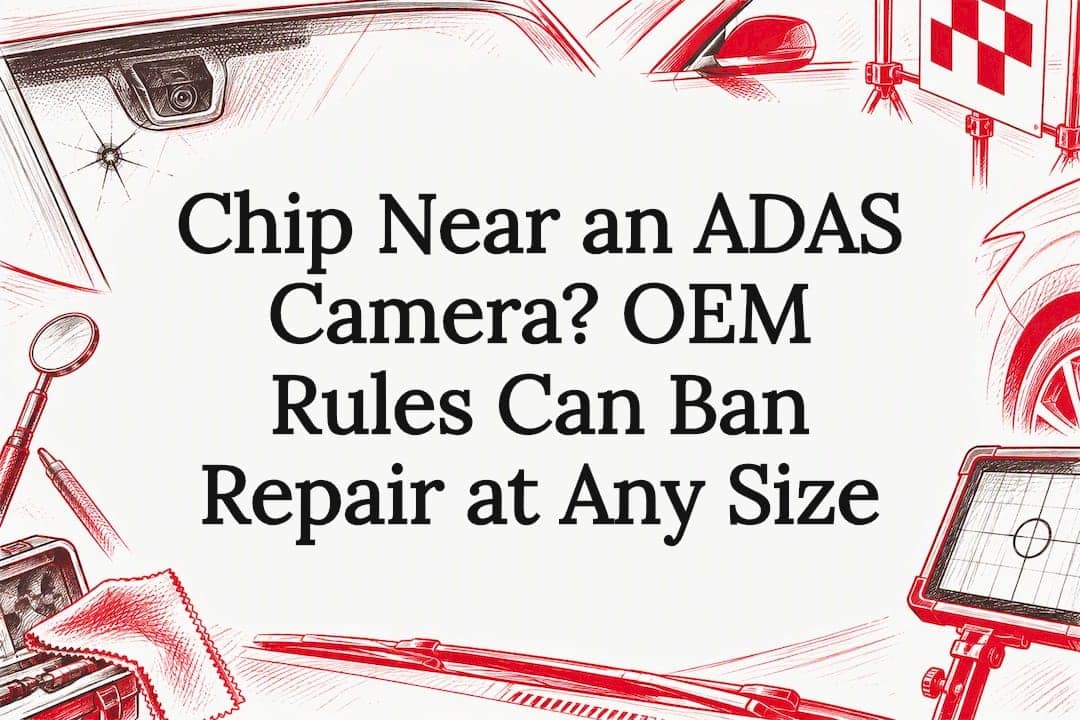
Chip Near an ADAS Camera? OEM Rules Can Ban Repair at Any Size
A chip near your ADAS camera may be repairable, but OEM rules, optical damage, and calibration needs determine the next step. Learn what...

October 10, 2026
Mobile Glass for Fleets: Static ADAS Can Mean a Shop Visit
Compare mobile glass providers on ADAS calibration, glass standards, cost drivers, insurance, and scheduling to reduce downtime and avoid repeat fleet trips....

October 9, 2026
Fleets: File Glass Claims Only When Repair Tops $500 or Needs ADAS
Fleet playbook for filing glass claims: weigh repair cost vs deductible, comply with FMCSA DVIR rules, and manage ADAS calibration plus direct insurer…...