
Auto Glass Repair
A chip in a commercial truck windshield is a safety item, a compliance item and a scheduling problem all at once. The fastest fix is a technician who comes to your yard, knows the repair limits, replaces the glass when it must be replaced, and calibrates any camera behind it. In Portland, that is what we do: same-day service, free mobile installation in the Portland area, in-house ADAS calibration, direct insurance billing and a lifetime no-leak guarantee on every installation.
This guide covers what can be repaired, when replacement is the only safe answer, what federal inspection rules say, how long a truck is really out of service, and how to plan glass work so routes keep running. It is written for owner-operators, fleet managers, RV owners and the insurance agents who coordinate their claims.
TL;DR
- Small chips and short cracks in laminated glass can be repaired. Bullseyes up to 1 inch, star breaks up to 3 inches and cracks up to 14 inches fall within the industry repair standard.
- Damage in the driver’s primary viewing area, damage to both glass layers and cracks that reach more than one edge call for replacement.
- Federal rules require drivers to report defects and require defects that affect safe operation to be fixed before the vehicle goes back out.
- Plan roughly 2 to 2.5 hours for a replacement on a truck without driver-assistance cameras, plus calibration time when a camera sits behind the glass.
- A mobile visit to your yard keeps downtime short. We bring the glass to you and bill your insurer directly when the loss is covered.
Table of Contents
- What glass damage on a commercial truck can be repaired
- When replacement is the right call
- What federal rules mean for your trucks
- Calibration: the step that gets missed
- How long is a truck out of service?
- What it costs
- Planning glass service for a fleet
- Our view on commercial glass
- Book the work with one call
- FAQ
- Sources
What glass damage on a commercial truck can be repaired
Most windshields on trucks, vans and buses are laminated: two layers of glass bonded around a plastic interlayer. Repair works by filling the damaged spot with resin, which restores the glass’s strength and stops the damage from spreading. Thomas Patterson of Glass Doctor makes the point in Fleet Maintenance that the purpose of a chip repair is structural integrity, not appearance.
The national repair standard, ANSI/AGSC/NWRD ROLAGS 002-2022, sets the limits technicians work to:
| Damage type | Repairable up to |
|---|---|
| Bullseye chip | 1 inch in diameter |
| Star break | 3 inches |
| Combination break | 2 inches (body, not counting the legs) |
| Single crack | 14 inches long |
Those are upper limits, not promises. Contamination, the position of the damage and the depth of the break all decide whether a given chip is a good candidate. The earlier a chip is filled, the better the odds, because dirt and moisture get into an open break and a day of road vibration can turn a chip into a crack.
For a chip or short crack on a truck, our windshield repair service is published at $90.
How a chip repair is done
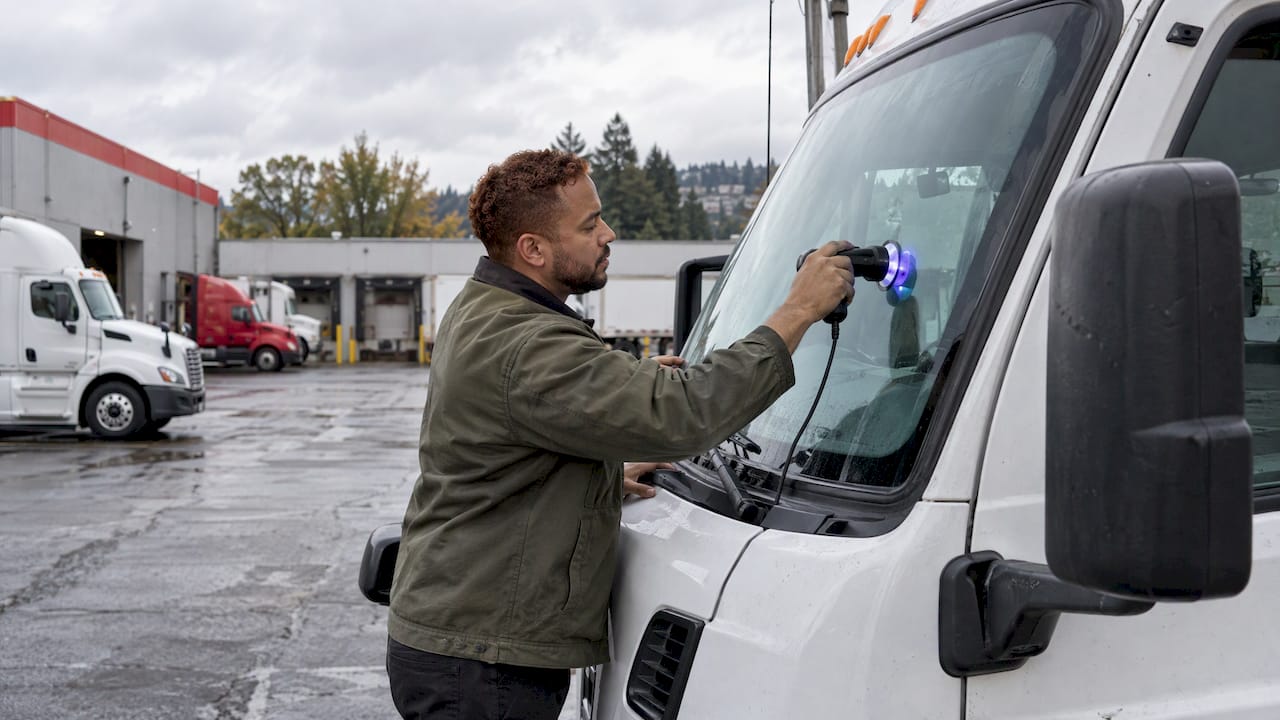
The technician vacuums air and moisture out of the break, injects resin, cures it with UV light, adds a denser resin to fill the pit, then scrapes the surface flush and buffs it. The process is quick enough to do in the yard during a loading window. Our page on rock chip repair explains what to expect in more detail.
When replacement is the right call
The same standard lists the conditions where replacement is recommended rather than repair:
- The damage goes through both layers of glass.
- Three or more long cracks run out from one impact point.
- The inner layer or the plastic interlayer is damaged.
- Pits are larger than 3/8 inch.
- An edge crack intersects more than one edge, or there is a stress crack.
- Damage in the driver’s primary viewing area is larger than 1 inch, or a new repair would sit within 4 inches of another one.
The driver’s primary viewing area in the standard is a zone 12 inches wide, centered on the driver and spanning the wiper sweep. Some states require replacement for any damage there, and Glass Doctor recommends replacing in that zone, per the same Fleet Maintenance article. On a tall cab with a long sightline, that zone is where a small chip matters most.
A practical rule for drivers: if the damage is in front of the driver, bigger than a coin, or has started to run, treat it as a replacement job and book it before the next dispatch.
Side and rear glass
Side and back windows are usually tempered, not laminated, so they are not repaired. When one breaks, it is replaced. We handle side window replacement and back window replacement for cars, trucks, RVs and commercial vehicles, and the same mobile visit can cover them alongside a windshield.
What federal rules mean for your trucks
If a truck is operated in interstate commerce, glass is part of the inspection routine, not just a maintenance item. Three rules matter day to day.
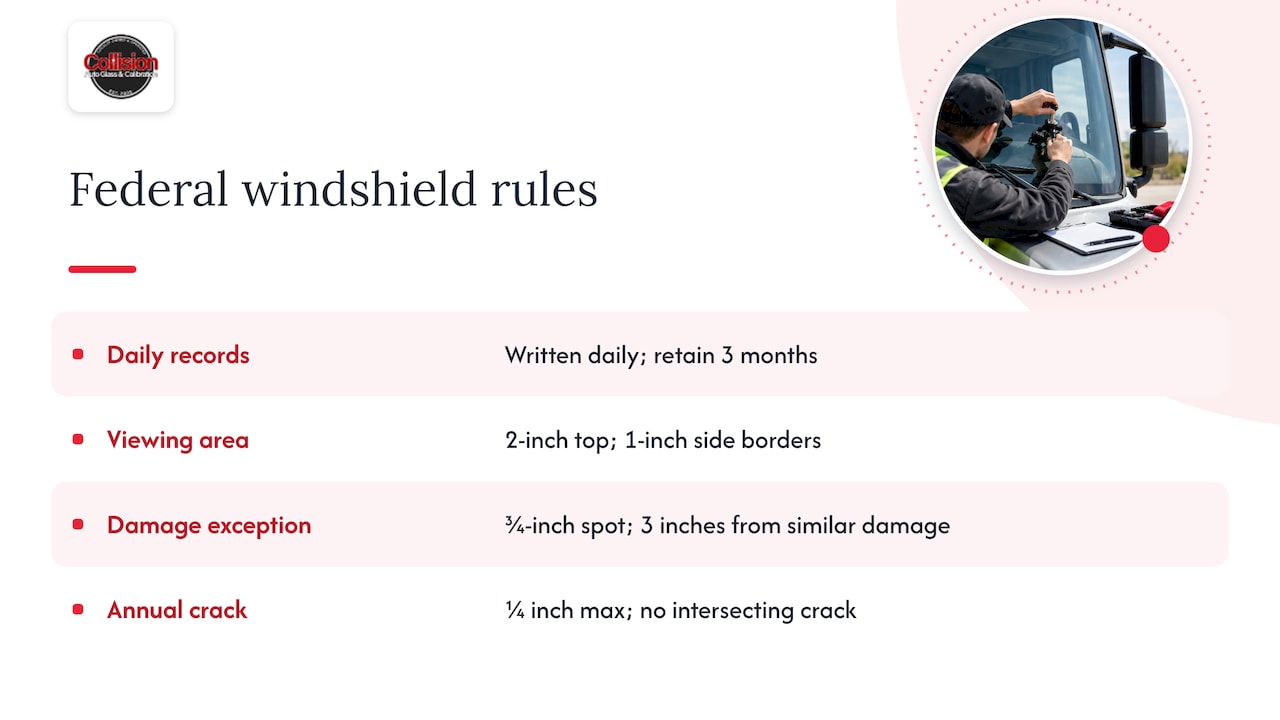
Daily driver reports. Under 49 CFR Part 396, drivers complete a written report at the end of each day covering the vehicle’s condition, including windshield wipers. Defects likely to affect safe operation must be repaired before the vehicle is operated again, and the reports are kept for three months.
The critical viewing area. FMCSA’s 49 CFR 393.60 defines an area of the windshield, starting at the top of the steering wheel and going up, with a 2-inch border at the top and 1-inch borders at the sides. As summarized by LegalClarity, that area must be free of damage except a single crack that does not intersect another, or a damaged spot that a 3/4-inch disc covers and that sits at least 3 inches from similar damage. A violation can lead to an out-of-service order at a roadside inspection.
Annual inspection. The periodic inspection standard in Appendix A to Part 396 is stricter than roadside. A windshield crack passes only if it is no wider than 1/4 inch and is not intersected by another crack, per the same Part 396 text.
The practical effect: a fleet that waits until a truck is flagged at a scale loses a whole day and may carry a violation on its record. A fleet that fills chips when they are reported spends a fraction of that. For RV owners, the same logic applies to safety even though the inspection regime differs, and our guide on RV windshield crack safety covers the federal and ADAS angles.
Calibration: the step that gets missed
Many newer trucks, vans and box trucks have a forward-facing camera mounted behind the windshield. It feeds lane departure warning, automatic emergency braking and similar features. When the glass is replaced, the camera is moved or removed and its aim changes slightly. Calibration resets that aim so the systems read the road correctly.
Two things to know:
- Calibration is a separate job from glass installation, and the vehicle should not go back into service until it is done. Our pages on calibration after windshield replacement and whether you need to recalibrate ADAS explain when it applies.
- Records matter. For a fleet, a calibration record per vehicle is part of your maintenance file, and an insurer may ask for it. We cover what a good record shows in our guide to ADAS calibration documentation.
We do ADAS calibration in-house, so the glass and the calibration are handled by one team and you do not coordinate a second vendor or move the truck between shops.
How long is a truck out of service?
Downtime is the number fleet managers care about most, and it has three parts: removal and installation, adhesive cure time, and calibration if needed.
A fleet glass guide puts a replacement on a vehicle without driver-assistance cameras at about 2 to 2.5 hours out of service: roughly 75 minutes to install and about 60 minutes for the urethane adhesive to reach safe drive-away strength. Calibration adds 30 to 90 minutes. Removal technique affects the first part: on a semi-truck, induction heating can take a windshield out in around 15 to 30 minutes, where knives or wires can take a couple of hours, according to Fleet Maintenance.
Cure time depends on the adhesive and the weather. Urethane generally needs ambient temperatures of about 40°F to 100°F for a proper bond, and safe drive-away times under industry guidelines range from 1 to 8 hours depending on the product and conditions, as Windshield Authority describes. Portland’s wet, cool months are inside that range, but a cold, damp morning is a reason to book a visit with time to spare before dispatch. Our own page on how long a windshield replacement takes gives the details for our process.
Once the new glass is in and the truck is back on the road, a ceramic coating on glass is one way some owners keep water beading off the windshield between washes. Wait until the adhesive has fully cured, and apply any product only after the installer confirms the glass is ready.
What it costs
We publish two prices. A windshield repair is $90. A windshield replacement is $200 to $500, depending on the vehicle and the glass. Side window, back window, RV window and ADAS calibration jobs are quoted per vehicle because they vary with the make, model and equipment.
For a detailed look at what drives replacement cost on larger vehicles, see our truck windshield replacement cost guide. Fleet managers running box trucks will find more in our box truck windshield replacement guide.
Insurance and billing
We bill insurers directly for covered repairs, so a driver or a fleet office does not need to pay up front and wait for reimbursement. Whether a particular repair is covered, and whether a deductible applies, depends on the policy. Our page on insurance coverage for rock chip repair explains how it usually works. Insurance agents who want a dependable shop for clients with commercial policies can send those clients to us for the glass and the calibration paperwork together.
Planning glass service for a fleet
The cheapest glass job is the one scheduled before it becomes an emergency. A routine that works for most fleets:
- Log damage the day it happens. The driver’s end-of-day report is the trigger. A chip noted on Tuesday should be filled by Thursday, not Friday of next month.
- Sort by location and size. Anything in front of the driver or larger than the repair limits goes to replacement. Everything else goes on the repair list.
- Batch the work. Mobile technicians can work through several vehicles in one visit at your yard, one after another. Glass is typically ordered by VIN a day or two ahead, per the fleet glass guide, so give your list early.
- Schedule off-hours. Overnight or weekend work means trucks are ready for the first route.
- Keep the calibration record. File it with the work order for each vehicle that has a camera.
We come to you at no charge for installations within the Portland area, and we offer same-day service. For a fleet, that means the truck stays where your people already are, and the glass is fixed while the vehicle would otherwise sit.
Our view on commercial glass
We see commercial glass as a safety and scheduling question first and a price question second. A chip that is filled quickly is a small job. A crack in front of the driver, or a camera that has not been reset, is a bigger one.
That is why we do the whole job under one roof: the glass, the adhesive work, and the ADAS calibration done in-house with our own equipment. A certified local team handles it, and a lifetime no-leak guarantee covers every installation. We have been family-owned and operated since 2008, and we know that a driver who is waiting on a truck wants a clear answer and a firm time.
Our approach for commercial customers is simple. Tell us the vehicle and the damage. We tell you whether it is a repair or a replacement, come to you, bill your insurer directly when the loss is covered, and give you the paperwork you need for your files.
Collision Auto Glass & Calibration
Book the work with one call
If you have a truck, van, box truck or RV with a chip, a crack or a broken window, we can look at it the same day and, in the Portland area, come to you for free. Choose windshield replacement when the damage is past the repair limits, or windshield repair when it is still a chip.
For RVs, see our RV window replacement page. For anything on a commercial vehicle you are unsure about, including heavy or construction vehicles, contact us through Collision Auto Glass & Calibration and tell us what you have.
FAQ
Can a crack in a commercial truck windshield be repaired?
Often yes, if it is a single crack up to 14 inches long and not in the driver’s primary viewing area or across more than one edge. The standard lists replacement for cracks that reach more than one edge or that penetrate both glass layers. We can tell you which applies when we see it.
Is a chipped windshield a violation on a commercial truck?
It can be. Federal rules limit damage in the critical viewing area to a single non-intersecting crack or a small spot covered by a 3/4-inch disc, and a violation can lead to an out-of-service order at roadside. Filling chips early keeps a truck inside those limits.
Do I need ADAS calibration after replacing a truck windshield?
If a camera is mounted behind the glass, yes. Replacement changes the camera’s position, and calibration resets it so safety systems read correctly. We perform it in-house, so it is part of the same job.
Will you come to my yard?
We offer free mobile installation within the Portland area, and same-day service. Send us the vehicle details and a photo of the damage so we can plan the visit.
Does insurance pay for commercial glass repair?
That depends on the policy. We bill insurers directly for covered repairs, so you do not have to carry the cost while a claim is processed.
Sources
- Repair of Laminated Auto Glass Standard, ANSI/AGSC/NWRD ROLAGS 002-2022
- Cracked windshield repair, Fleet Maintenance
- 49 CFR Part 396, Inspection, Repair, and Maintenance
- Windshield laws, compliance and penalties, LegalClarity
- Fleet windshield replacement guide, Windshield Estimate
- Mobile windshield replacement, Windshield Authority
Recommended
🎧 Listen to This Article
Share
Recent Posts

November 27, 2026
Commercial Truck Glass Repair: Repair, Replace, Stay Legal
Chip or crack in a commercial truck windshield? Learn when repair works, when to replace, the federal rules, downtime and ADAS calibration for...
November 26, 2026
Windshield Glare at Night: Causes, Fixes and When Glass Is to Blame
Why oncoming headlights smear and blind on your windshield at night, how to clean glass the right way, and when chips, scratches or...
November 25, 2026
RV Window Replacement in Portland: Types, Costs and Process
Planning RV window replacement in Portland? Learn which windows can be replaced, how fit and sealing work, and how our mobile service handles...