
Auto Glass Repair
If oncoming headlights turn into starbursts, halos or hazy streaks across your windshield, the glass itself is often part of the problem. Film on the inside, grime on the outside, worn wiper blades and small chips or scratches all scatter light toward your eyes. Most of it can be fixed in an afternoon with the right cleaning method. When the cause is damage in the glass, a quick inspection and repair keeps a small problem from becoming a replacement. We repair and replace auto glass in Portland, and we start every job by finding out which of those two situations you are in.
TL;DR
- Haze, streaks and a greasy film on the glass scatter headlight beams into your line of sight. Clean the inside and outside, in the shade, with an ammonia-free glass cleaner and two microfiber towels.
- Worn wiper blades smear light into bands and starbursts, and a blade that has worn down to its metal holder can scratch the glass permanently.
- Chips create halos and scratches create tails around bright lights. Chips are usually repairable if they are caught early.
- If glare comes with halos around lights even on clean glass, see an eye care professional too: it can be an eye issue rather than a glass issue.
- If you replace a windshield, ask about driver-assistance camera calibration afterward.
Table of Contents
- Why your windshield glares at night
- Clean it properly first
- Wipers and washer fluid: the quiet cause
- When chips, pits and cracks are the cause
- Other ways to cut headlight glare
- A simple night-glare routine
- Fleets, RVs and everyone who drives after dark
- Get the glass looked at in Portland
- Our view on night glare and glass
- FAQ
- Sources
Why your windshield glares at night
Glare is not the same as brightness. Researchers separate discomfort glare, which is annoying, from disability glare, which actually reduces what you can see. NHTSA’s report to Congress on nighttime glare explains that disability glare happens when light scatters inside the eye, lowering the contrast of objects on the road. The effect is stronger when the light is more intense and closer to where you are looking.
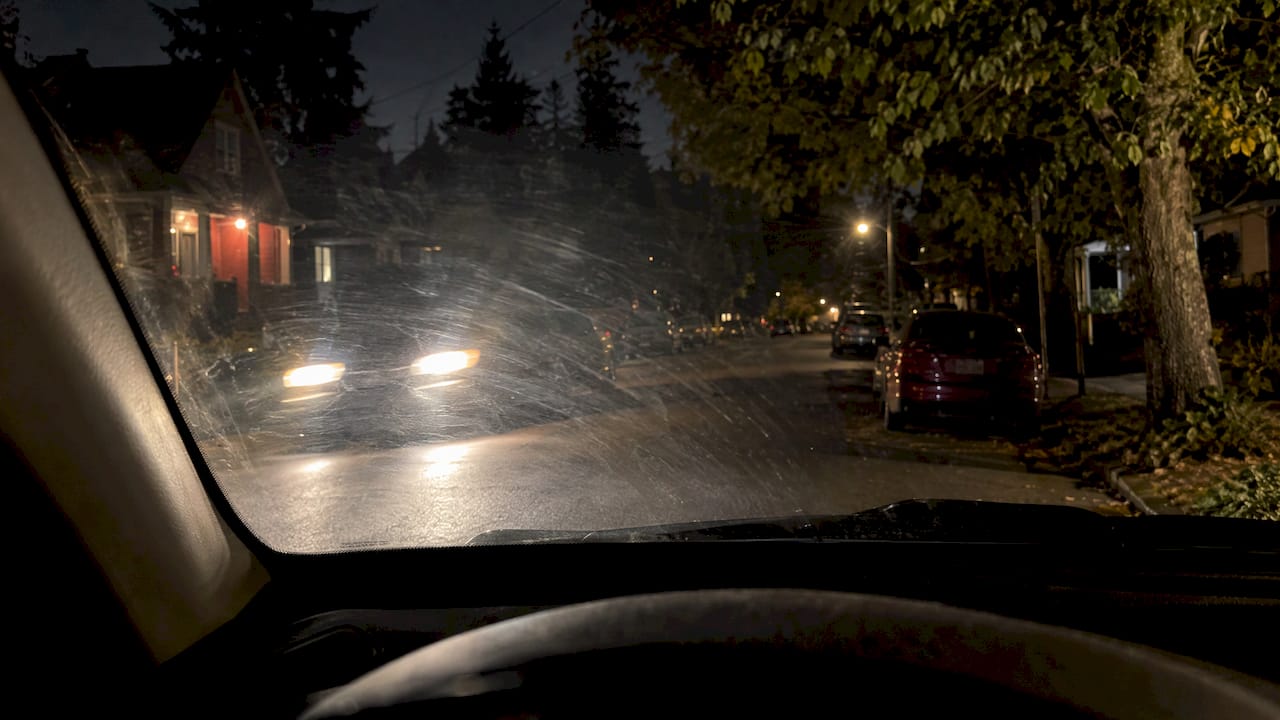
Your windshield adds to that scattering. A review by the Monash University Accident Research Centre describes how soiled or surface-damaged glass produces stray light: at night, oncoming beams hit the glass and are deflected into the driver’s eye. Small chips produce a halo around the light source, while scratches and grooves add one or two tails running perpendicular to the damage.
That gives you a simple way to read what you see:
| What you notice | Likely cause |
|---|---|
| Overall haze or a milky wash across the glass | Film from interior plastics, or road grime |
| Smeared bands that sweep across when wipers run | Worn or dirty wiper blades |
| A halo around lights in one spot | A chip or pit in the glass |
| Tails or lines streaking from lights | Scratches or wiper grooves |
| Halos around streetlights even on clean glass | Possibly your eyes, not the glass |
The film you cannot see in daylight
AAA’s glare brochure points out that smudges and road grime catch and refract light, and that chemicals from interior plastics build up on the inside of the windshield. That inner film is why glass that looks fine at noon can look foggy when a pair of headlights hits it at 9 p.m. It tends to be worst in vehicles with large dashboards and a steeply raked windshield, and in cars that sit in the sun, because heat helps the plastics release those chemicals.
Clean it properly first
Cleaning is the cheapest fix and the right first step. The American Optometric Association’s night-vision fact sheet lists a dirty, streaked or fogged windshield as a cause of glare and advises cleaning it inside and out. AAA recommends doing so at least monthly.
A method that works, based on AAA’s windshield-cleaning guidance:
- Work in the shade. Hot glass makes cleaner evaporate before you can wipe it, which leaves streaks.
- Use an ammonia-free, glass-specific cleaner and two microfiber towels, one to clean and one to buff dry.
- Remove bugs and sap first. Stubborn spots left behind will smear when you wipe over them.
- Spray the exterior and wipe it. Then spray the cleaner onto the cloth, not the glass, for the interior.
- Wipe the inside horizontally and the outside vertically. When streaks remain, the direction tells you which side they are on.
- Mind the amount. AAA Northeast notes that too much cleaner can itself cause smudging and streaking.
The interior is the part most people skip, and it is usually the part that matters at night. Reach into the corners where the dash meets the glass with a folded towel. If you want a deeper look at how film and grime build up on automotive glass and how to get a clean finish, this streak-free glass cleaning method walks through it.
Avoid wax and shine products on the glass and the dash area near it. They leave a film of their own and can make night glare worse.
Do not clean a cracked windshield in a hurry
AAA’s auto glass director cautions in the same guidance that large temperature differences between the glass and the water can crack a windshield. The advice is to get existing chips and cracks fixed before a major cleaning, so they do not spread. Never pour hot water on a cold windshield.
Wipers and washer fluid: the quiet cause
Worn blades do not just clear water poorly. They lay down a thin, uneven film that lights up like a screen when headlights hit it. The AOA fact sheet advises replacing wipers as necessary, and AAA advises replacing them at least once a year and checking washer fluid monthly.
Two habits protect the glass as well as your view:
- Replace blades before they shred. AAA’s windshield care guide warns that once rubber is gone, the metal blade holder can rub against the glass and scratch it permanently. Check that the rubber is still soft and pliable.
- Use washer fluid before wiping dry glass. Dry grit between blade and glass is what cuts fine scratches, and those scratches are the ones that throw tails of light at night.
A scratched windshield cannot be wiped clean, because the light is scattering inside the glass surface itself. If you have replaced blades, cleaned inside and out, and still see tails or hazing in the wiper sweep, the glass is the cause and it is worth having it looked at.
When chips, pits and cracks are the cause
AAA’s car maintenance overview advises inspecting the windshield and all vehicle glass regularly. Minor chips and very small cracks may be repairable, while significant damage calls for replacement, and a certified technician should assess a crack before it keeps growing. AAA’s 2021 night safety release also advises inspecting and replacing pitted windshields along with worn wiper blades.
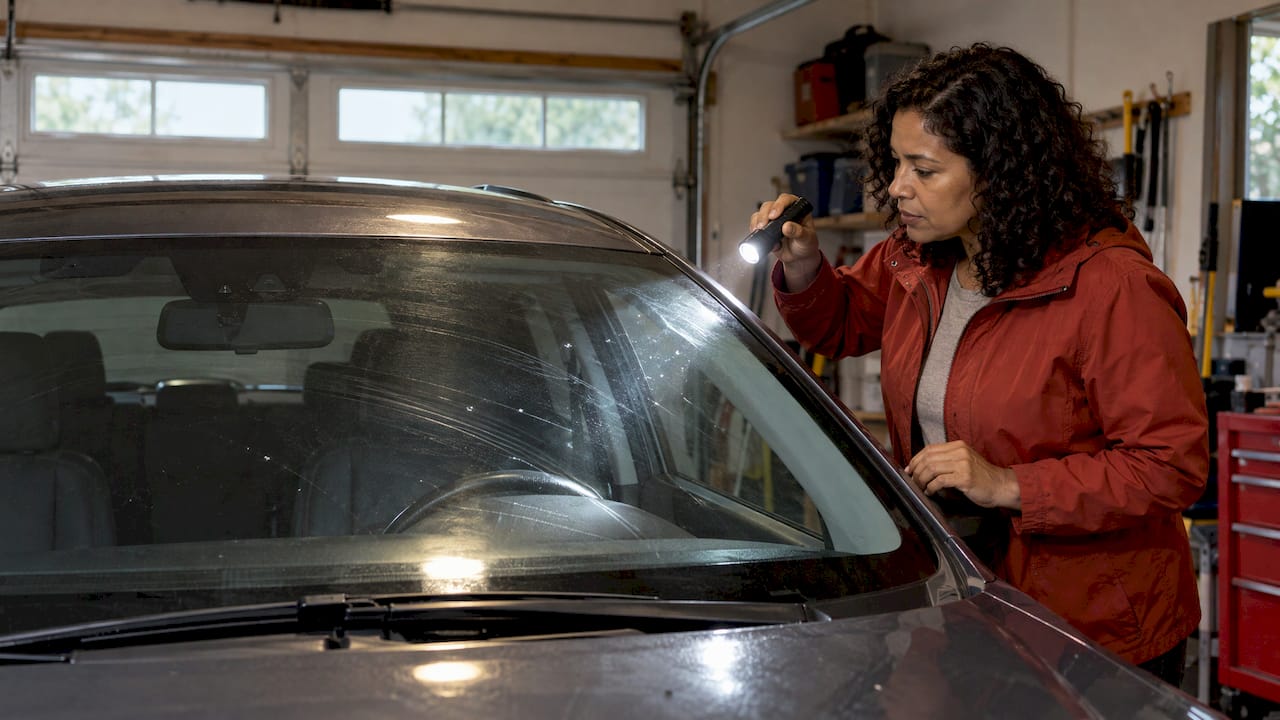
The tricky part is that damage is not always obvious. AAA’s windshield guide notes that some damage is not immediately noticeable, which is why it recommends checking the whole glass inside and out, plus the seal around the edge, rather than waiting for glare to tell you. Try this at dusk or in a dark garage with a flashlight held at an angle: chips, pits and wiper arcs show up as bright specks and lines.
Repair or replace?
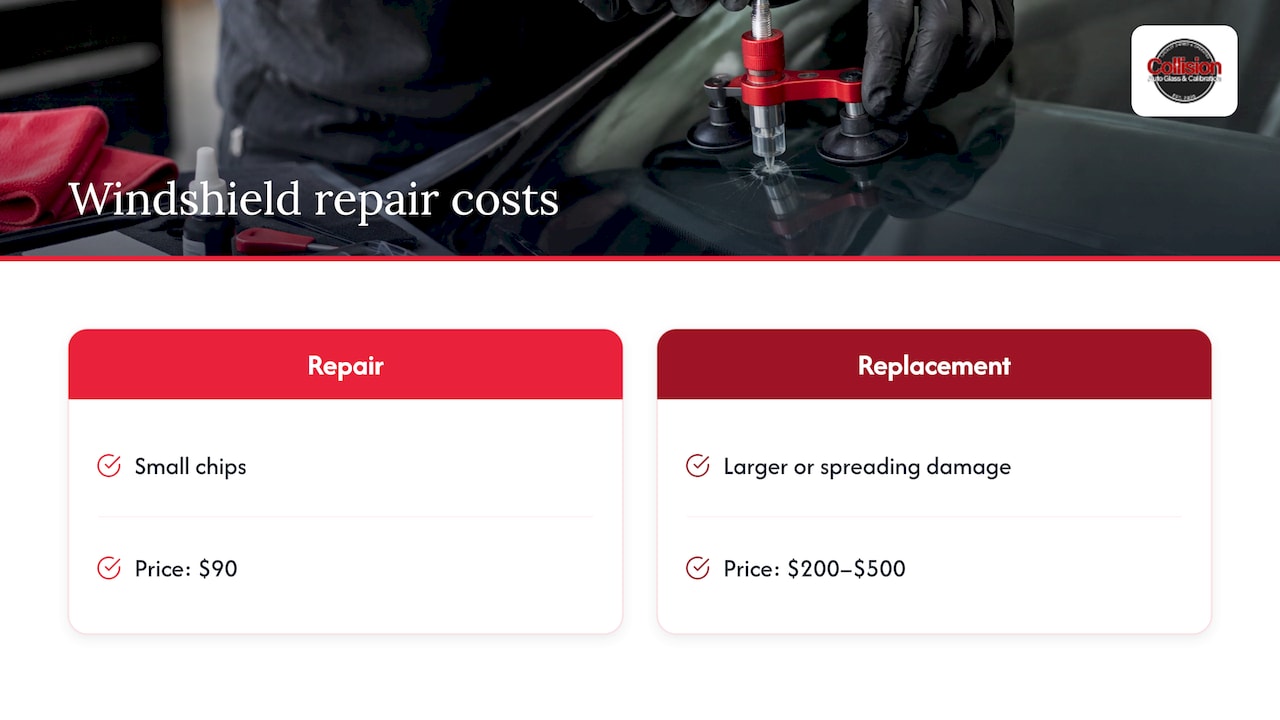
The general rule is that small chips are repaired and larger or spreading damage means replacement. Our pages on types of windshield chips and whether a chip repair is worth it explain how to tell which one you have. If you have found several chips, our guide to multiple windshield chips and repair criteria covers what a technician checks first.
Our published prices: windshield repair is $90, and windshield replacement ranges from $200 to $500 depending on the vehicle. Those numbers are one reason to act early: a repair costs a fraction of a replacement, and it stops a chip from turning into a crack that runs across your line of sight.
After a replacement, think about the cameras
Many newer vehicles carry a forward camera mounted on the windshield for lane-keeping and emergency braking. When the glass is replaced, that camera needs to be calibrated so it reads the road correctly. We do ADAS calibration in-house, and you can read what it involves on our page about what ADAS calibration is and what happens if ADAS is not calibrated.
Other ways to cut headlight glare
The glass is only one part of the picture. These steps come from traffic safety and eye care sources:
- Look to the lower right. If an oncoming driver does not dim their high beams, NHTSA’s guidance for older drivers and AAA both advise looking toward the right edge of the road or the painted edge line instead of into the lights. Slow down while you do it.
- Match your speed to your headlights. Georgia’s driver manual puts low beams at about 250 feet of visibility and high beams at roughly 350 to 500 feet.
- Keep your own headlights clean and aimed. AAA’s glare brochure says a thin layer of road grime on a headlight lens can block up to 90 percent of its light, and that headlights aimed even one degree too high make a big difference to oncoming drivers. Have aim checked at inspection.
- Skip “night driving” glasses. The American Academy of Ophthalmology reports that tinted or polarized night lenses limit light reaching the eye and make night driving harder. NHTSA likewise advises against sunglasses or tinted lenses at night. Keep your regular prescription current instead.
- Dim the dash and keep it clear. Items on top of the dashboard reflect into the glass at night.
When to see an eye professional
The American Academy of Ophthalmology’s Vision and Driving page lists glare or halos around oncoming headlights and streetlights as a red flag that warrants an appointment with an ophthalmologist. The AOA fact sheet adds that glare can seem worse with dry eye, cataracts, contact lens problems, age-related macular degeneration or diabetic retinopathy. If your windshield is spotless, your wipers are new and the halos persist, book an eye exam. A glass shop can rule out the windshield, but only an eye doctor can assess your eyes.
A simple night-glare routine
You do not need to overthink it. A routine that takes about 20 minutes a month:
- Clean the glass inside and out, in the shade, using the method above.
- Check the wiper rubber for cracking, chatter or streaks, and top off washer fluid.
- Inspect the glass at an angle with a flashlight for chips, pits and scratches in your line of sight.
- Wipe your headlight lenses.
- If glare remains after all four, have the glass inspected.
If the inspection turns up damage, you can read our FAQ on auto glass repair and replacement and our rock chip FAQ before you decide.
Fleets, RVs and everyone who drives after dark
Glare is a bigger issue for people who log night miles: delivery and service fleets, RV owners with a large, upright windshield, and commuters in the dark months. A short check of the glass belongs in a regular vehicle walk-around. For fleet managers, a chip found at a Monday inspection is a $90 repair in our price list, rather than a replacement that takes a vehicle off the road. We also handle RV window replacement and work on cars, trucks, RVs and commercial vehicles.
Get the glass looked at in Portland
If you have cleaned thoroughly and still see halos or tails in the glass, the next step is a quick look at the windshield. We offer same-day service with free mobile installation within the Portland area, so we can come to your home or workplace. Our work carries a lifetime no-leak guarantee on all installations, and we bill insurers directly for covered repairs. For chips, see our windshield repair page, and for larger damage, our windshield replacement page.

You can start from our home page to book or ask about your vehicle.
Our view on night glare and glass
We are a family-owned shop that has worked on Portland windshields since 2008, and the pattern is simple: drivers clean the outside, find it does not help, and live with the glare for months. The inside film and the damage in the glass are the two things most people never check.
Our advice is to treat the windshield as safety equipment, not just a window. Keep it clean inside and out, replace wipers on schedule, and look at it at an angle in the dark at least once in a while. A chip is cheapest to deal with when it is small, and our repair is designed to stop it from spreading before it reaches your line of sight.
When replacement is the right call, we do the job as a certified local team and calibrate driver-assistance cameras in-house with our own equipment, so the glass and the safety systems are handled together. Our mobile service is free within the Portland area, and our lifetime no-leak guarantee covers every installation.
Collision Auto Glass & Calibration
FAQ
Why does my windshield look hazy at night?
The most common reasons are a film on the inside of the glass from dashboard plastics, road grime outside, and worn wipers that smear. AAA’s glare brochure describes the interior film and the way smudges refract light. Cleaning both sides with an ammonia-free glass cleaner usually clears it.
Can a chip or scratch cause glare at night?
Yes. Monash University research describes small chips producing halos around lights and scratches producing tails. If glare stays after you clean the glass and replace your wipers, a chip, pit or scratch in your line of sight is a likely cause and worth an inspection.
What is the best way to reduce headlight glare while driving?
Slow down, look toward the right edge of the road instead of at the oncoming lights, and keep your windshield, mirrors and headlights clean. Have your headlight aim checked at inspection. Avoid tinted night-driving glasses, which reduce the light reaching your eyes.
Should I replace my windshield because of glare?
Not necessarily. Clean it and replace worn wipers first. If the glass is pitted, deeply scratched or has damage that will not repair, replacement is the answer, and we can quote your vehicle and tell you whether ADAS calibration is needed afterward.
When is glare an eye problem?
If halos around lights continue on a clean windshield, the American Academy of Ophthalmology advises seeing an ophthalmologist. Conditions such as cataracts or dry eye can make glare worse, so an eye exam is the right next step.
Sources
- Windscreens and Safety: A Review, Monash University Accident Research Centre
- Nighttime Glare and Driving Performance, report to Congress, NHTSA
- AAA Glare Brochure 2013
- How to Clean Your Car Windshield, AAA Via
- Night Vision Fact Sheet, American Optometric Association
- Car Maintenance for All Seasons, AAA Northeast
- Car Care: Windshields, AAA
- The What, When and Why of Car Maintenance, AAA Exchange
- AAA: Drivers Should Use Caution at the End of Daylight Saving Time
- Driving Safely While Aging Gracefully, NHTSA
- Section 2.11, Georgia Department of Driver Services
- Night Driving Glasses May Hurt, Not Help, American Academy of Ophthalmology
- Vision and Driving, American Academy of Ophthalmology
Recommended
- Tips On Caring For and Maintaining Your Car’s Glass
- Line of Sight Windshield Crack: Repair or Replace?
- Signs You Need Auto Glass Replacement
- 15 Minute Fix for Portland Drivers: Clear Windshield Water Spots
🎧 Listen to This Article
Share
Recent Posts
November 26, 2026
Windshield Glare at Night: Causes, Fixes and When Glass Is to Blame
Why oncoming headlights smear and blind on your windshield at night, how to clean glass the right way, and when chips, scratches or...

November 25, 2026
RV Window Replacement in Portland: Types, Costs and Process
Planning RV window replacement in Portland? Learn which windows can be replaced, how fit and sealing work, and how our mobile service handles...
November 24, 2026
Windshield Crack From Heat: Why It Happens and What to Do
Heat rarely cracks sound glass on its own. Learn why a chipped windshield splits in hot weather, when repair still works, and when...