
Auto Glass Repair
A rock chip within about one to two inches of the windshield edge usually means replacement, not repair, because edge damage threatens the structural bond that holds the glass in place. If the chip sits farther from the perimeter and stays under the standard size limits, a resin repair is often the right call. The decisive factors are distance to the edge, the type of damage, and its size, which is exactly what the checklist below walks you through.
TL;DR:
- Damage within one inch of the windshield edge generally requires replacement due to structural bond concerns, especially if near critical components like sensors or cameras.
- Chips or cracks exceeding standard size limits, such as 1 inch for bullseyes or 14 inches for cracks in repair screening, can usually be repaired if they are far from the edge and free of contamination.
- Damage that penetrates both glass layers, is contaminated, or overlaps sensors, heads-up displays, or heating elements must be replaced regardless of size.
- Small edge chips should be measured promptly, ideally within a day or two, as they tend to spread faster under normal driving stresses and temperature swings.
- Insurance often covers most repair costs, and booking a same-day, in-person inspection can prevent damage from worsening and avoid costly replacements.
Table of Contents
- Rock Chip Near Edge Repairable? Run This Checklist First
- Why Edge Damage Gets Treated Differently
- The Size Limits Technicians Actually Use
- When Replacement Is the Only Safe Option
- What Resin Repair Actually Fixes, and What It Doesn’t
- What a Chip Repair Costs and How Insurance Fits In
- What to Do Right Now
- Why Technician Judgment Still Matters Most
- Can a Rock Chip Near the Windshield Edge Be Repaired? Quick Diagnostic Checklist
- Get Your Edge Chip Checked Before It Spreads
- Sources
- FAQ
Rock Chip Near Edge Repairable? Run This Checklist First
Before you decide anything, grab a tape measure and take a hard look at the damage. Technicians use a version of this process on every inspection, and you can do a rough version yourself in under five minutes.
- Measure the distance to the edge. Damage less than one inch from the edge usually leads to replacement, while damage farther from the edge requires more detailed assessment including crack direction and glass condition.
- Identify the damage type. Bullseyes, stars, combination breaks, and simple cracks each behave differently. A crack that runs toward the edge is riskier than one running parallel to it.
- Check the size against screening limits. The Repair of Laminated Auto Glass Standard sets specific dimension ceilings by damage type, which the next section breaks down in full.
- Look for contamination. Dirt, moisture, or a cloudy interior layer inside the chip changes the calculation fast.
- Check whether it sits in the Driver’s Primary Viewing Area (DPVA). Damage here faces tighter rules regardless of size.
- Press gently around the chip. If you see movement, spreading, or hear a faint crackle, treat it as unstable and act immediately.
Pro Tip: Take a photo with a coin next to the chip for scale before you call anyone. It gives the shop a head start on sizing the damage and speeds up your rock chip diagnosis over the phone.
Why Edge Damage Gets Treated Differently
The windshield isn’t just a window. Its perimeter is bonded to the frame with urethane adhesive, and that bond contributes to roof strength in a rollover and helps the airbags deploy correctly. Damage near that bond line raises the odds that a repair won’t hold, or that the crack will run straight to the edge and compromise it.
A few specifics worth knowing:
- The DPVA is a 12-inch band centered on the driver’s line of sight, and it carries stricter repair limits than the rest of the glass.
- Resin repairs leave some optical distortion, which is far more dangerous directly in front of the driver than off to the side.
- Heat cycles and road vibration put more stress on glass near the edge, so small edge cracks tend to grow faster than damage in the middle of the windshield.
The Size Limits Technicians Actually Use
Auto glass technicians don’t eyeball repairability. They measure damage against published screening dimensions, most drawn from ROLAGS guidance, and match what they find to a size chart before making a call.
By the numbers: Bullseye chips up to 1 inch (25 mm), combination breaks up to 2 inches (50 mm), star breaks up to 3 inches (75 mm), and in some screening contexts cracks up to 14 inches (350 mm) are within repairable range under standard conditions.
Those numbers shrink fast inside the DPVA. Damage exceeding certain size limits or depth in critical viewing areas generally prompts technicians to recommend replacement rather than repair. None of these figures are guarantees. A technician still weighs contamination, the condition of the plastic interlayer beneath the outer glass, and any specific instructions from the vehicle manufacturer before signing off on a repair.
When Replacement Is the Only Safe Option
Some damage disqualifies itself from repair no matter how small it looks. These are the conditions that tell a technician to stop measuring and start scheduling a replacement:
- Cracks very close to the windshield perimeter or crossing multiple edges typically require replacement due to compromised structural integrity.
- Damage has penetrated both layers of glass or reached the interior plastic interlayer, not just the outer surface.
- Dirt, moisture, or discoloration has settled inside the chip and won’t come out with cleaning.
- The chip or crack overlaps a rain sensor, heads-up display, heating element, or camera bracket where a repair could interfere with function.
- Multiple long cracks radiate from a single impact point, or the damage is visibly spreading.
Any one of these findings overrides a passing size measurement. A star break at half an inch might screen as repairable on paper, but if it sits over a forward-facing camera used for driver-assist systems, replacement (with proper ADAS calibration afterward) is the safer route.
What Resin Repair Actually Fixes, and What It Doesn’t
A standard repair follows a fairly consistent process: the technician cleans the chip, pulls a vacuum to remove trapped air, injects clear resin into the void, cures it under UV light, then polishes the surface flush. It stops the damage from spreading and restores most of the glass’s strength at that point, but it does not re-bond the windshield’s structural perimeter, and it won’t make the chip disappear entirely.
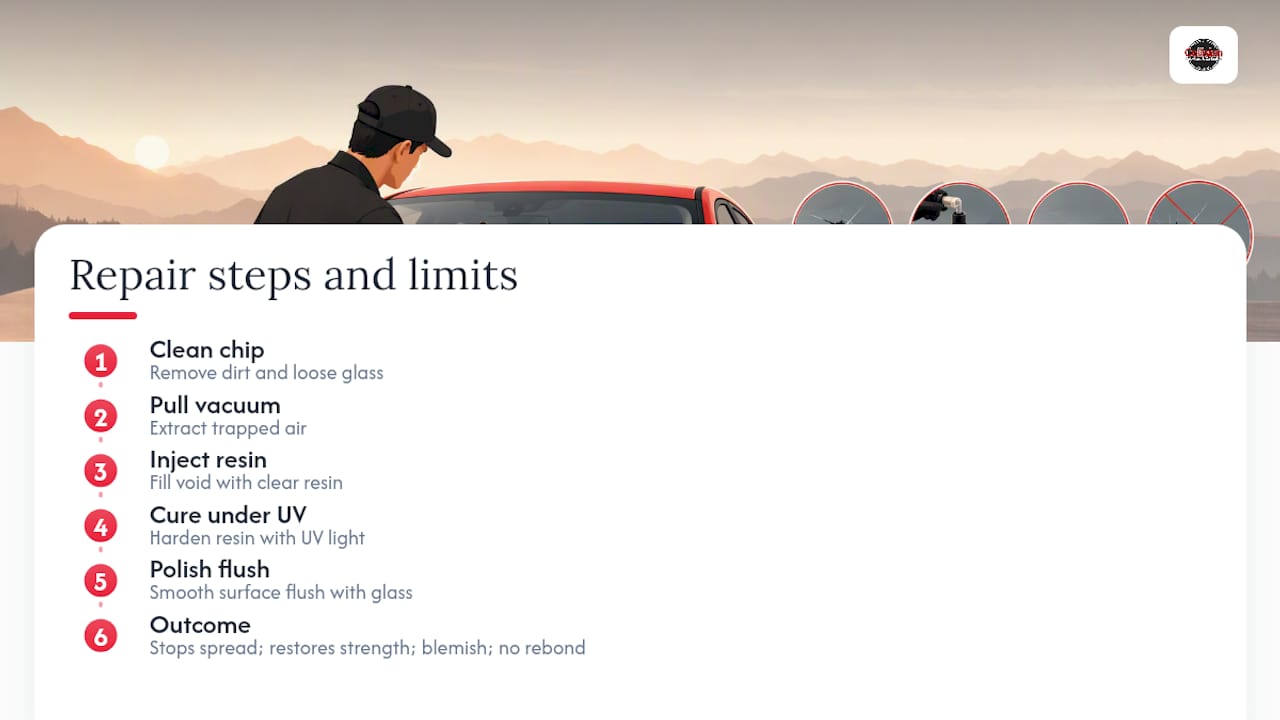
Expect a faint blemish, a small pit, or minor optical distortion around the repair site, even from a good technician. Acceptable results mean the pit sits flush, the wiper blade won’t catch on it, and the remaining distortion doesn’t interfere with clear vision. If a repair can’t meet those standards, especially near a sensor or coating, the technician should recommend replacement instead of forcing a fix that won’t hold up.
Pro Tip: Don’t expect a repair to look invisible. A faint mark where the resin sits is normal and doesn’t mean the job was done poorly.
What a Chip Repair Costs and How Insurance Fits In
Repairing a single small chip is one of the cheaper fixes you’ll make on a vehicle, while a full windshield replacement runs several times more, especially once ADAS calibration is factored in. Get a local quote before assuming either direction, since glass type and calibration needs vary by vehicle.
A few things worth checking before you commit:
- Many insurance policies waive the deductible entirely for small chip repairs, since insurers would rather pay a small amount now than a full replacement claim later.
- Ask your shop whether they bill your insurer directly so you’re not fronting the cost yourself.
- Waiting rarely helps. Temperature swings between a cold morning and a hot afternoon put real stress on glass, and a chip that’s repairable today can turn into a crack requiring full replacement within a week or two.
- Mobile repair services let you lock in the lower-cost fix without rearranging your whole day around a shop visit.
What to Do Right Now
If you’ve just noticed the chip, a few small steps protect it until you can get it looked at:
- Photograph the damage clearly, ideally with something for scale.
- Cover it with a small piece of clear tape to keep out dirt and moisture.
- Avoid blasting the defrost or AC directly on the glass, and skip the car wash for now.
- Drive gently and avoid slamming doors, which sends a pressure wave through the cabin and glass.
Skip the DIY resin kit if the chip sits near the edge, inside the DPVA, or anywhere close to a sensor. These kits aren’t built to handle the judgment calls that edge damage requires, and a botched attempt can turn a repairable chip into a mandatory replacement. If the damage is close to the edge or growing, call for an inspection rather than waiting to see what happens.
Why Technician Judgment Still Matters Most
Collision Auto Glass & Calibration has operated as a family-owned business since 2008, handling windshield replacement, rock chip repair, and ADAS calibration for everyday drivers and fleet vehicles alike. Same-day mobile installation, a lifetime no-leak guarantee, and direct insurance billing back every job. Screening dimensions and DPVA rules give a strong starting point, but a trained technician still has to weigh contamination, interlayer condition, and manufacturer guidance in person before calling a repair safe.
Can a Rock Chip Near the Windshield Edge Be Repaired? Quick Diagnostic Checklist
Most articles on this topic treat repairability as a pure math problem: measure the chip, compare it to a chart, done. That’s incomplete. The size limits from ROLAGS matter, but they’re a screening tool, not a verdict, and treating them as gospel leads plenty of drivers to either panic over a repairable chip or push for a repair that shouldn’t happen.
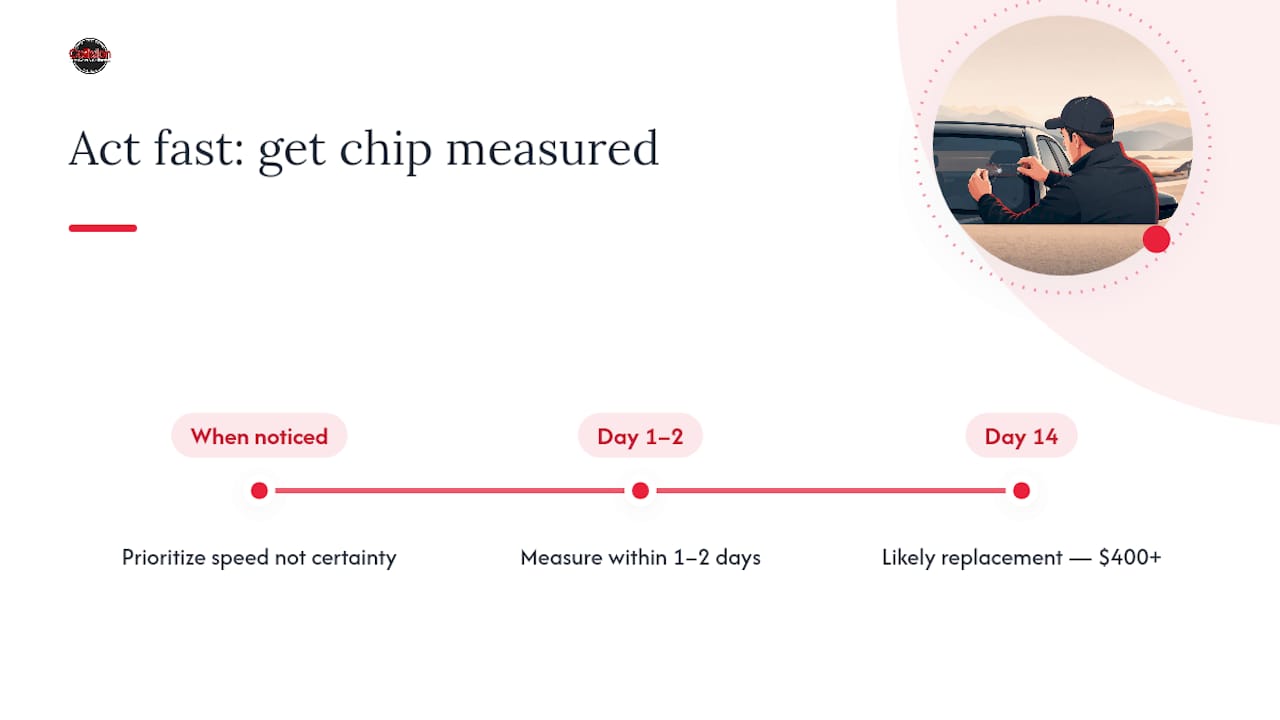
The bigger mistake we see is delay. Drivers notice a small edge chip, decide it “doesn’t look that bad,” and wait weeks to get it checked. Edge damage is precisely the kind that spreads fastest under normal driving stress, and a chip that would have taken fifteen minutes to repair on day one can become a $400+ replacement by day fourteen.
Prioritize speed over certainty. You don’t need to know for sure whether your chip is repairable before you call someone. You need to get it measured within a day or two, while the odds are still in your favor. The checklist above will tell you where you likely stand. A technician will tell you where you actually stand.
— Collision Auto Glass & Calibration
Get Your Edge Chip Checked Before It Spreads
Collision Auto Glass & Calibration gives Portland drivers a faster path to an answer than guessing at a size chart on your own: same-day mobile inspection at your home or office, so a technician measures the chip against ROLAGS and DPVA limits in person instead of you estimating from a phone screen.

Booking is straightforward. A technician inspects the damage against repair-dimension standards and OEM guidance, gives you a written estimate on the spot, and flags upfront whether ADAS calibration will be needed if replacement turns out to be the right call. Every installation carries a lifetime no-leak guarantee, and the team bills most insurers directly so you’re not paying out of pocket for a covered repair. If you’re within Portland and noticed the chip today, get a same-day auto glass repair quote before temperature swings turn a fifteen-minute fix into a full replacement.
Sources
- Repair of Laminated Auto Glass Standard
- Repair of Laminated Automotive Glass Standard ® (Updated draft)
- Crack repair limitations: size, location, and structural rules
- Windshield chip & crack repair guide
FAQ
How much does it cost to get rock chips repaired?
Chip repairs are one of the least expensive auto glass services available, with full replacements running several times higher, especially when ADAS calibration is required. Get a local quote since pricing depends on chip size and glass type.
Is it worth fixing rock chips?
Yes, in almost every case where the chip qualifies for repair. Fixing it early stops the damage from spreading into a crack that forces a full, far more expensive replacement.
Does Safelite fix rock chips for free?
Some insurance policies waive the deductible for small chip repairs regardless of which shop you choose, which can make the repair free to you out of pocket. Check your policy and ask the shop whether they bill your insurer directly before assuming any provider offers repairs at no cost.
How much does it usually cost to repair a chip in a windshield?
Small chip repairs typically cost a fraction of what a windshield replacement costs, though exact pricing varies by chip size, location, and glass type. A technician can give you an exact estimate once they’ve inspected the damage in person.
Can a rock chip near the edge always be repaired?
No. Chips or cracks within roughly one inch of the windshield perimeter usually require replacement because they compromise the structural bond between the glass and the vehicle frame.
Recommended
Share
Recent Posts
September 5, 2026
$20–$1,000+: DIY or Pro for Windshield Molding Replacement
Decide whether to DIY windshield molding replacement or call a pro. See parts costs ($20–$150), shop quotes to $1,000+, plus rust, encapsulation, and...

September 4, 2026
Static First, Dynamic Confirm: ADAS Calibration for Technicians
ADAS guide for technicians: when to run static before dynamic calibration. Includes a shop checklist and one visit workflow....

September 3, 2026
Portland Mobile Windshield Costs: $60 to $800 and When Insurance Pays
Portland mobile windshield costs, from $60 chip repairs to $300–$800 replacements. See when Oregon insurance covers glass and get a free mobile quote....