Auto Glass Repair
Most windshield urethane reaches safe drive-away strength in 1 to 3 hours under normal shop conditions, with fast-cure formulas sometimes hitting that mark in 30 to 60 minutes. Full structural cure, when the adhesive reaches its maximum bonding strength, can take 24 hours or longer. The exact number depends on the adhesive product, the temperature and humidity at installation, and the installer’s own procedures, so always follow the specific minimum drive-away time your technician gives you in writing.
TL;DR:
- Safe drive-away time usually ranges from 30 minutes to 3 hours for most adhesives, but full curing can take 24 hours or longer depending on conditions.
- Temperature and humidity significantly influence cure times, with colder or drier environments delaying safe drive-away thresholds.
- The drive-away strength is not the final cure; full strength requires more than 24 hours and is crucial for long-term safety.
- Certified shops must provide written confirmation of the exact SDAT, adhesive lot number, and how environmental factors affect curing.
- Avoid driving, sudden door slamming, or washing the vehicle before the adhesive reaches full cure and SDAT, to prevent compromising the bond.
Table of Contents
- What Safe Drive-Away Time Actually Means
- How Long Windshield Adhesive Actually Takes to Cure
- Why Temperature and Humidity Change Everything
- Reading a Manufacturer’s Cure-Time Chart
- What AGRSS Rules Require Your Installer to Tell You
- Aftercare: What to Avoid Before Your Windshield Fully Cures
- Red Flags That Mean You Should Call the Shop
- Our Take on Cure Time and Why We Don’t Cut Corners
- Book an Installation That Tells You Exactly When It’s Safe to Drive
- Sources
- FAQ
What Safe Drive-Away Time Actually Means
Safe drive-away time (SDAT) is the point at which the urethane bonding your windshield to the frame has reached enough strength to hold the glass in place during a crash, not the point where it’s finished curing completely. Those are two different milestones, and confusing them is where a lot of vehicle owners get into trouble.
The windshield isn’t just a window. It’s a structural component that helps the roof resist crushing in a rollover and gives the passenger-side airbag something solid to bounce off during deployment. If the adhesive hasn’t reached minimum strength and the glass shifts or pops loose in a collision, the airbag and restraint system can’t do their job the way FMVSS 208 and 212 crash standards assume they will.
That’s why SDAT isn’t a suggestion. Under the ANSI/AGSC/AGRSS 005-2022 standard, certified shops are required to use adhesive systems that meet a minimum drive-away strength and to tell you, specifically, how long to wait before driving. A few things every installer should confirm before handing you the keys:
- The exact SDAT for the adhesive used on your vehicle, not a generic estimate
- Whether ambient temperature or humidity at the time of install pushed that number higher
- Written confirmation of the drive-away time, not just a verbal mention
How Long Windshield Adhesive Actually Takes to Cure
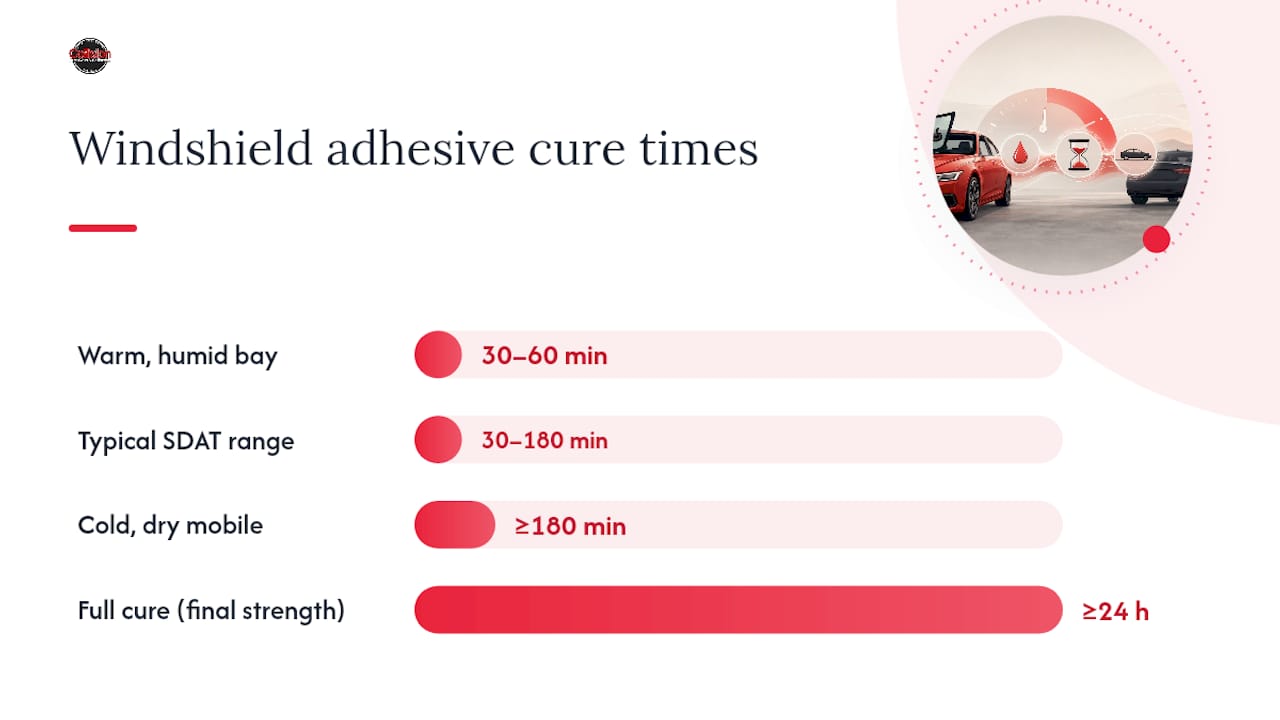
Trade data on windshield adhesive curing breaks into two numbers you should keep separate. The first is SDAT, generally 30 minutes to 3 hours depending on the product and conditions. The second is full cure, the point of maximum cross-linking and strength, which typically runs 24 hours or more.
The gap between those numbers comes down to “green strength” versus final strength. Green strength is the early-stage bonding force the urethane needs to survive a crash safely, and manufacturers test it against specific overlap-shear values. Final strength is what the adhesive reaches once the chemical reaction finishes running its course, well after you’re already back on the road.
Typical scenario comparison:
- A warm, humid shop bay (around 73°F, moderate humidity) with a fast-cure urethane: SDAT often lands in the 30 to 60 minute range.
- A cold, dry mobile installation (below 50°F): SDAT can stretch past 3 hours, even with a fast-cure product, because the chemical reaction slows down without warmth and moisture.
According to 3M’s technical data, the time needed to reach a specified shear strength can shift dramatically between a warm, humid bay and a cooler one, even using the exact same tube of urethane.
Why Temperature and Humidity Change Everything
Windshield urethane is a moisture-cure adhesive, meaning it pulls water vapor from the air to trigger the chemical reaction that hardens it. That single fact explains almost every variable in cure time.
Temperature has an outsized effect. As a rough rule, every 15 to 18°F drop in temperature can double the cure time for a standard moisture-cure urethane. Most shops avoid bonding below roughly 40°F without switching to a winter-grade fast-cure product or moving the job indoors.
Humidity works the opposite direction but just as strongly. Since the adhesive needs moisture to cure, air that’s too dry slows the reaction to a crawl. Air that’s too wet, or a surface with standing water on it, can cause adhesion failures instead of a faster cure.
A few conditions that change your actual wait time:
- Rain or surface moisture during a mobile install, which can compromise the bond if the installer doesn’t follow a wet-weather procedure
- Cold adhesive straight out of a truck versus urethane that’s been warmed to room temperature before application
- A climate-controlled shop bay versus an outdoor mobile install in winter
- Whether primer was applied correctly and given time to flash off before the urethane bead goes down, since skipping this step affects both adhesion and cure behavior
Pro Tip: If you’re booking a mobile installation during cold or wet weather, ask the technician directly whether they’re using a cold-weather urethane formula. A standard summer adhesive applied at 35°F can leave you waiting far longer than the shop originally quoted.
Reading a Manufacturer’s Cure-Time Chart
Manufacturer SDAT charts are the single most reliable source for how long a specific adhesive needs, because they’re built from lab testing rather than rule-of-thumb estimates. Every chart is organized around the same two axes: temperature on one side, relative humidity on the other, with the resulting time to reach a defined strength threshold in the middle.
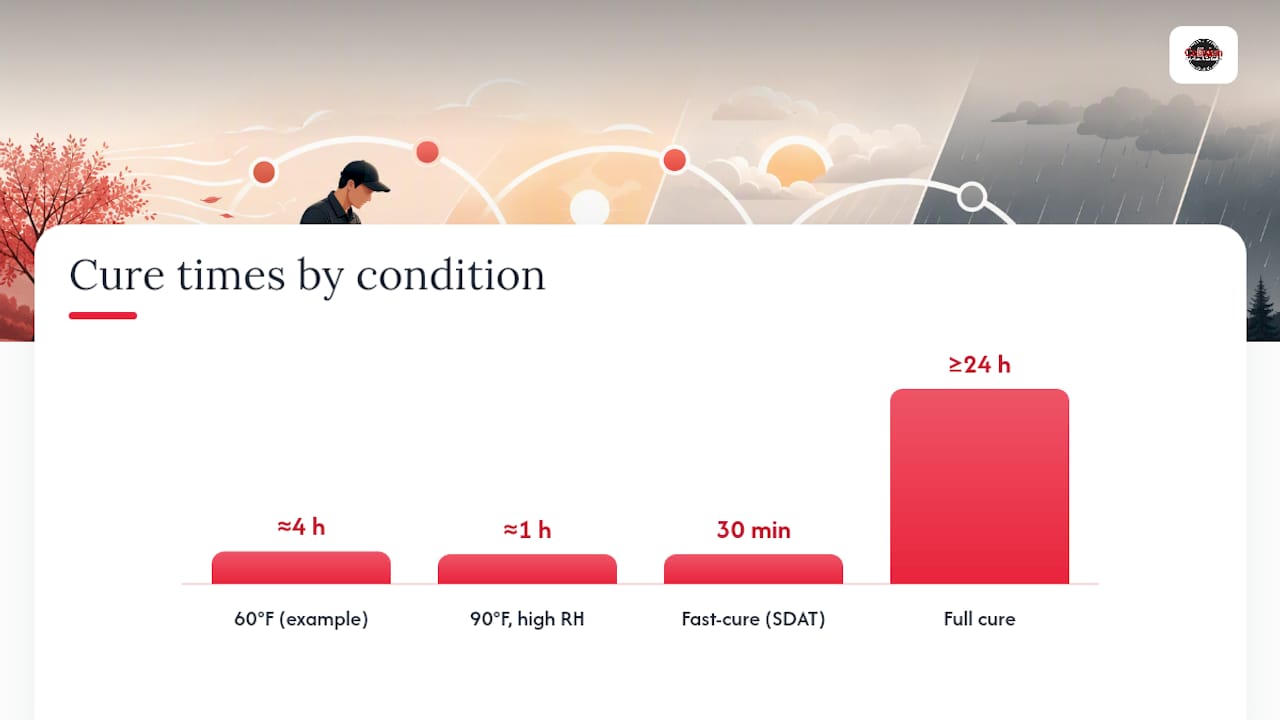
3M’s cure-time tables show that raising either temperature or humidity shortens the time needed to hit a given shear-strength number, sometimes by hours. A urethane that needs four hours at 60°F might reach the same strength in one hour at 90°F with high humidity.
Sika’s published SDAT charts go a step further for their fast-cure line, listing drive-away times in minutes under warm, humid conditions. That’s why some fast-cure products can legitimately offer a 30-minute SDAT, but only when the chart’s stated conditions are actually met on-site.
This is also why experienced shops lean toward fast-cure formulas or indoor bays whenever a customer needs their vehicle back quickly. It isn’t guesswork. It’s matching the product to the chart.
What AGRSS Rules Require Your Installer to Tell You
The AGRSS standard isn’t just a technical guideline for shops. It’s a consumer protection built specifically around SDAT disclosure and traceability, so you have a paper trail if anything about the installation is ever questioned.
Here’s what a properly certified shop owes you:
- A specific, written SDAT for the adhesive used on your vehicle, not a rounded-off verbal estimate.
- Adhesive identification and lot numbers, which AGRSS treats as traceability items in case of a recall or warranty claim.
- An explanation of how conditions affected your number, since a 90°F afternoon and a 40°F morning can produce two very different SDATs from the same tube.
The reasoning behind all of this traces back to crashworthiness testing under FMVSS 208 and 212. Documentation matters beyond the day of installation too. If you ever file an insurance claim or a warranty dispute, having the adhesive name and lot number on record is what lets a shop or manufacturer verify what was actually used.
Aftercare: What to Avoid Before Your Windshield Fully Cures
The SDAT window is when you need to be most careful, but good habits should carry through the full cure period too. A few rules matter more than people expect:
- Don’t drive, move the vehicle, or let doors slam shut until the stated SDAT has fully elapsed, since the pressure change from a slammed door can stress an uncured bond.
- Skip carrying passengers, especially in the front seat, until your installer’s clock runs out.
- Hold off on rolling down windows or running the vehicle through a power washer for 24 to 72 hours after installation, which is the general shop guidance for full cure protection.
- If your mobile install happened in the rain, confirm with the installer that an approved wet-weather procedure was used, or ask to reschedule.
Pro Tip: Keep a hand towel handy and skip the automatic car wash entirely for a few days. If you must clean the exterior, a gentle two-bucket hand wash avoids the water pressure that a drive-through wash throws directly at the fresh seal.
Red Flags That Mean You Should Call the Shop
A properly cured windshield shouldn’t leak, whistle, or shift. If any of these show up after your SDAT window has passed, don’t wait it out:
- Visible gaps between the glass and the frame, or water leaking in after rain
- New wind noise at highway speed that wasn’t there before the replacement
- Glass that feels loose or shifts slightly when you press near the edges
- ADAS warning lights, lane-assist errors, or forward-collision alerts behaving oddly, which usually means the ADAS calibration needs to be redone
Any of these should trigger a call back to the shop with your adhesive lot number in hand so they can pull the record and honor the warranty.
Our Take on Cure Time and Why We Don’t Cut Corners
Vehicle owners get frustrated with cure-time windows, and we understand why. Nobody wants to sit in a parking lot for an hour after paying for a windshield. But the SDAT clock exists because a windshield that shifts in a crash before the bond sets isn’t a minor cosmetic issue. It’s a restraint system failure waiting to happen.
We follow manufacturer-specific SDAT charts on every job rather than defaulting to a single “safe” number across all conditions, and we tell customers the actual wait time before we ever pick up a urethane gun. Our 24 to 72 hour washing guidance reflects the same conservative logic: full cure takes longer than SDAT, so we’d rather you wait a day too many than risk the seal.
— Collision Auto Glass & Calibration
Book an Installation That Tells You Exactly When It’s Safe to Drive
Collision Auto Glass & Calibration gives you the specific SDAT for your vehicle in writing, before you drive away, not a rounded-off guess. That’s the real gap between a shop that treats cure time as paperwork and one that treats it as a safety number worth getting right.
We handle windshield repair starting at $90 for chips and cracks that haven’t spread, and full windshield replacement for $200 to $500 depending on your vehicle and glass type. Every replacement includes free mobile installation across the Portland area, direct insurance billing, and a lifetime no-leak guarantee, backed by in-house ADAS calibration so your safety systems are recalibrated correctly the same day. When you book, ask us for your adhesive’s stated SDAT in writing, we’ll give it to you before the job starts. Request a quote to get a same-day appointment and a clear answer on when it’s safe to get back on the road.
Sources
- ANSI/AGSC/AGRSS 005-2022 (AGRSS standard)
- 3M™ Fast Cure Auto Glass Urethane (High Viscosity) TDS
- NHTSA crashworthiness research
FAQ
Does Windshield Urethane Harden Completely?
Yes, windshield urethane hardens through a moisture-cure chemical reaction that continues well past the point when it’s safe to drive. Full hardening, or maximum cross-linking strength, typically takes 24 hours or longer%20Charts.pdf) after installation, even though the vehicle is safe to drive much sooner.
How Many Tubes of Urethane Are Needed for a Windshield?
Most standard passenger vehicle windshields need one to two tubes of urethane, depending on the size of the glass and the bead width the technician applies. Larger windshields, trucks, and RVs sometimes require additional cartridges to maintain a continuous, properly sized bead around the entire perimeter.
Does Windshield Urethane Need Primer?
Primer is often required on the pinch weld and sometimes on the glass edge, depending on the adhesive system and whether the original factory coating was disturbed during removal. Skipping primer when the manufacturer’s procedure calls for it can weaken the bond and affect both adhesion and cure performance.
How Long Does It Take for 3M Windshield Urethane to Cure?
3M’s fast-cure urethane can reach a safe drive-away strength in as little as an hour under warm, humid shop conditions, based on the manufacturer’s published cure-time tables. Colder or drier conditions push that number higher, which is why the technician’s specific SDAT for your installation day matters more than a general product average.
When Can I Drive After a Windshield Replacement?
You can typically drive within 1 to 3 hours after a standard installation, or as little as 30 to 60 minutes with a fast-cure adhesive in warm, humid conditions. Always follow the written minimum drive-away time your installer provides rather than a general rule, since your specific adhesive and weather conditions determine the real number.
Recommended
- 60–90 Minute Rule: Windshield Replacement in Rain for Drivers
- 7 Signs Your Windshield Needs Repair Before It Spreads
- How to Properly Care for a New Windshield
🎧 Listen to This Article

Share
Recent Posts

October 15, 2026
Auto Glass Claims: Choose a U.S. Shop Before ADAS Billing Surprises
See how U.S. drivers can choose an auto glass shop for an insurance claim, confirm ADAS calibration, protect their rights, and prevent billing...
October 14, 2026
Fleet Windshield Maintenance: A 20 Minute Repair Can Prevent Days Down
Catch chips early, log the VIN and photos, and require part number and ADAS calibration records to keep fleet vehicles moving and avoid...
October 13, 2026
Calibration After Collision Repair: Ask for Scans Before You Drive
Learn when collision repairs require ADAS calibration, how shops verify the work, and which scan records and paperwork to request before driving....