Auto Glass Repair
TL;DR:
- Whether a cracked windshield passes inspection depends on state-specific damage size, location, and type requirements. Inspectors evaluate damage within the driver’s view, near the frame, and for intersecting cracks, often requiring repair or replacement before inspection. Failure to address damage can lead to citations, insurance issues, or unsafe driving conditions, emphasizing proactive care.
Whether a cracked windshield will pass inspection depends on your state and the damage’s size, location, and type. Some states have no formal windshield inspection item at all; others will fail your vehicle on the spot for a crack longer than a few inches in the wrong place. The top rejection triggers are damage in the driver’s primary sight line, cracks that exceed state-specific length thresholds, chips or fractures near the frame edge, and intersecting cracks that signal structural compromise. If your damage falls into any of those categories, address it before your inspection date — not after.
Table of Contents
- Do state inspections actually check your windshield?
- What inspectors look for: size, location, and type of damage
- Chips vs. cracks: when repair works and when you need replacement
- Why ADAS calibration matters after windshield replacement
- What to do before your inspection: a quick checklist
- Typical costs and how long repairs or replacements take
- How to check your state’s rules and what the examples show
- Key Takeaways
- Our perspective on proactive windshield care
- Ready to get your windshield inspection-ready?
- FAQ
- Useful sources for state-specific rules
Do state inspections actually check your windshield?
Many states require some form of periodic vehicle inspection that may include windshield condition. That leaves more than a dozen states where no annual inspection exists, but that does not mean cracked glass is consequence-free.
Enforcement works two ways:
- Inspection-station enforcement (proactive): In states with mandatory inspections, a failed windshield item can bar your registration renewal until the vehicle passes re-inspection.
- Traffic-stop enforcement (reactive): In states without inspections, officers can still issue citations for vision-impairing damage under equipment laws. Texas removed the windshield from its formal annual inspection checklist, yet Texas police can still cite a driver whose cracked glass creates a significant visibility hazard. Arizona, Florida, and South Carolina follow a similar model — no periodic inspection, but equipment laws remain on the books.
- Registration and insurance exposure: A citation for defective equipment can affect your driving record and, in some cases, complicate an insurance claim if an accident occurs while the damage was documented.
Pro Tip: Relying on the absence of a state inspection program is a short-term gamble. A windshield that would fail a safety inspection is a safety hazard regardless of whether your state requires one — and your insurer may use pre-existing damage against you after a claim.
What inspectors look for: size, location, and type of damage
Inspectors evaluate windshield damage along several axes. Understanding them lets you self-assess before the inspector does.
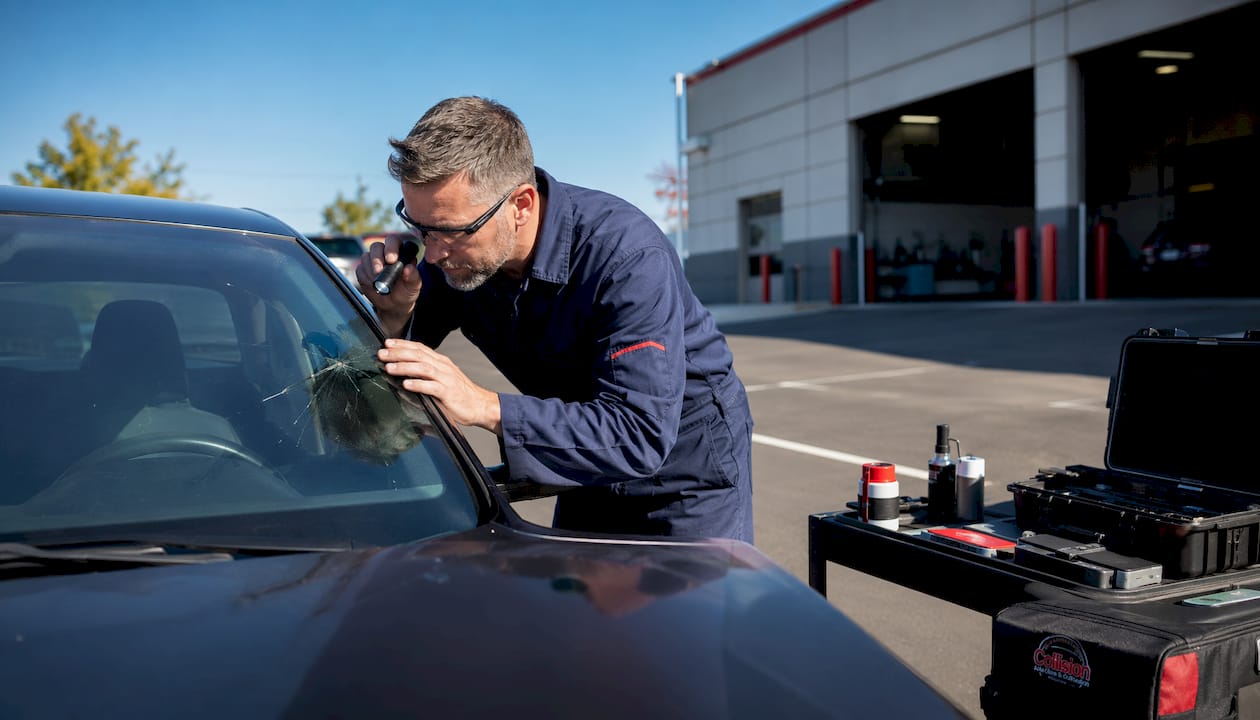
Driver’s primary viewing area. Most state manuals define this as the area within the windshield wiper sweep, or a measured zone above the bottom of the glass. Missouri’s inspection code references the wiper sweep area and a specific measurement from the bottom of the windshield when defining the driver’s vision zone. Damage here is the fastest path to a rejection sticker.
Crack length thresholds. States set their own numeric limits, and the variation is significant. Maryland’s code rejects damage in the acute area when a single nick, pit, chip, or star break exceeds ¼ inch in diameter or length. Virginia’s inspection manual rejects pits, chips, or star cracks larger than 1½ inches above the 3-inch line at the bottom of the windshield.
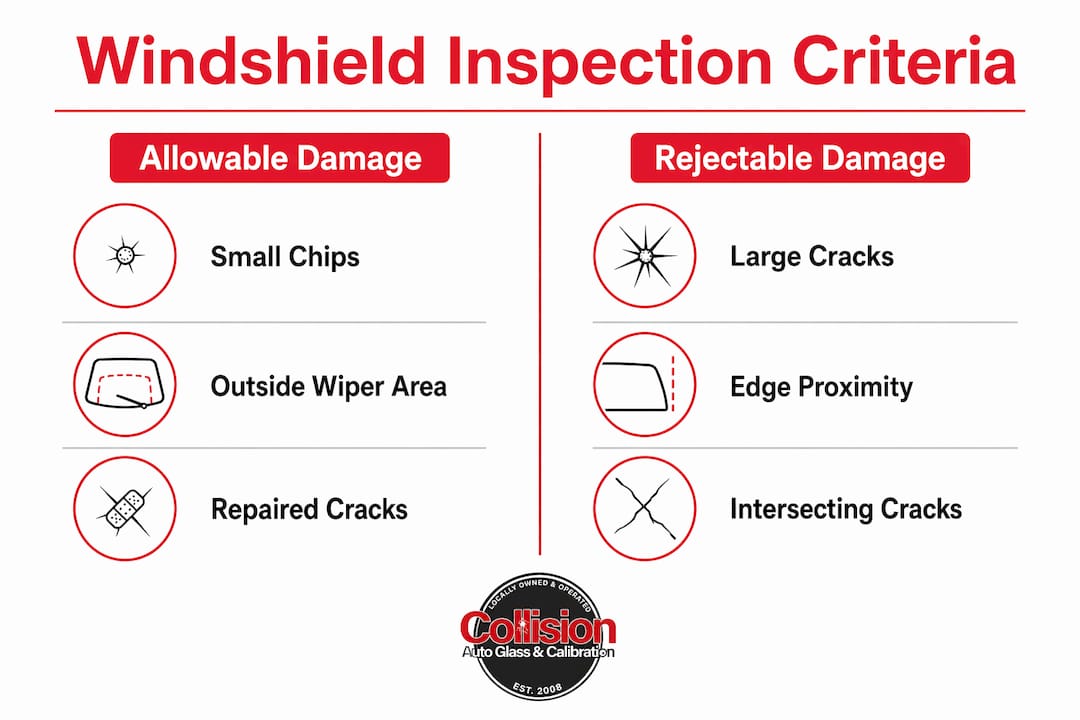
Edge proximity. Cracks within roughly 2–3 inches of the frame are commonly rejected because they weaken the urethane adhesive bond and compromise the windshield’s structural role in a rollover.
Intersecting cracks. Inspectors treat these as immediate rejects in many manuals. Two cracks meeting at a point indicate likely structural failure and can expand suddenly under thermal stress.
| State | Threshold / Rule | Zone |
|---|---|---|
| Virginia | Rejects chips/star cracks larger than 1½ inches | Above the 3-inch line from the bottom |
| Maryland | Rejects damage exceeding ¼ inch in the acute area | Driver’s acute vision area |
| Texas | Windshield not a formal inspection item | Visibility hazard still citable |
| Missouri | Wiper sweep area defines the driver’s vision zone | Wiper sweep / measured from bottom |
| Commercial vehicles (FMCSA) | Cracks longer than 11 inches or any sight-line damage | Full windshield |
Pro Tip: Photograph the damage next to a ruler before your inspection. Dated photos and repair receipts serve as evidence at the inspection station or in traffic court if you need to contest an assessment.
Chips vs. cracks: when repair works and when you need replacement
Not every piece of windshield damage requires a full replacement. The distinction between repairable and non-repairable damage is worth understanding before you schedule service.
Repairable damage typically includes:
- Single rock chips or star cracks smaller than roughly 1 inch in diameter, outside the driver’s primary sight line
- Pits or bull’s-eye chips where the outer layer is broken but the inner laminate is intact
- Damage that has not spread or developed secondary fractures
Replacement is usually required when:
- The crack runs longer than the thresholds set by your state (see the table above)
- The damage sits within the driver’s wiper-sweep zone and causes optical distortion
- The crack is within 2–3 inches of the frame edge, where structural integrity is at stake
- Multiple cracks intersect, or a single crack has branched into a spider-web pattern
The repair process itself involves injecting a clear resin into the break, curing it under UV light, and polishing the surface. Done correctly, it restores structural strength and reduces visual distortion. The limitation: resin fill does not make the damage invisible, and an inspector can still reject a repaired windshield if residual distortion falls in the sight line or if multiple repairs cluster in the driver’s vision area. For a deeper look at what chip repair can and cannot fix, the options depend heavily on crack length and location.
Edge cracks almost always require replacement rather than repair. The adhesive bond in that zone is load-bearing during a collision or rollover, and resin fill does not restore the bond strength that an edge crack has already compromised.
Why ADAS calibration matters after windshield replacement
Modern vehicles increasingly rely on forward-facing cameras and radar sensors mounted at or near the windshield. Lane-keeping assist, automatic emergency braking, and adaptive cruise control all depend on those sensors being precisely aligned. Replace the windshield without recalibrating, and those systems can malfunction — sometimes silently.
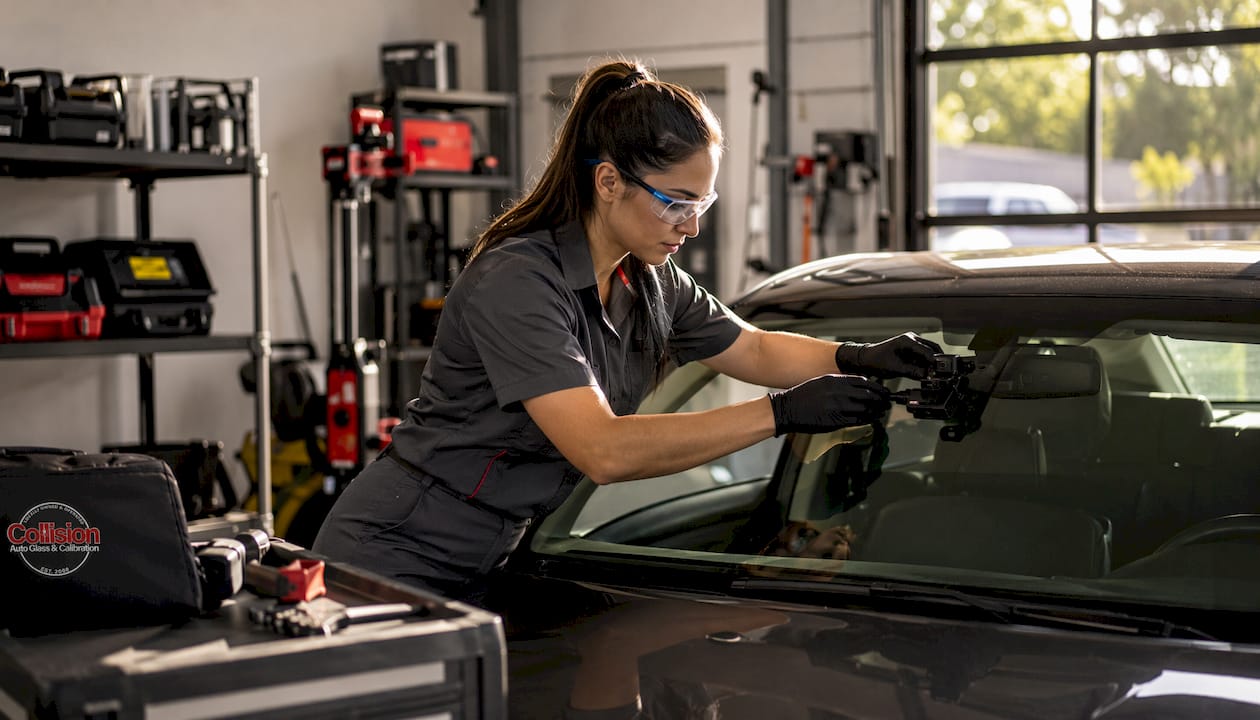
Calibration is required any time a full windshield replacement disturbs the camera or sensor mount. Even a fraction of a degree of misalignment can cause a lane-departure system to trigger incorrectly or an automatic braking system to react too late. The ADAS calibration process uses a target board and OBD pass-through tools to reset the sensor’s reference angles to factory specification.
When selecting a shop, ask specifically about in-house calibration capability. A shop that sends your vehicle to a dealer for calibration adds time and a second point of failure. You want documented proof — a calibration report with before/after readings — that you can present if a system warning light appears later. Calibration also affects your inspection readiness: some states flag active dashboard warning lights as a separate fail item, so an uncalibrated ADAS system can create a second reason to fail even after the glass itself is replaced.
What to do before your inspection: a quick checklist
Getting ahead of the inspection takes less than 15 minutes. A complete pre-inspection checklist covers the full vehicle, but for windshield-specific prep, work through these steps in order:
- Photograph the damage next to a ruler or coin for scale. Note the date.
- Measure the crack length from tip to tip and note whether it falls within the wiper-sweep zone.
- Check edge proximity. Is the damage within 2–3 inches of the frame? If yes, plan for replacement.
- Remove any stickers or suction-cup mounts that obstruct the driver’s view — these are independent fail items in most states.
- Test wipers and the defroster. A crack that causes the wiper blade to skip or lose contact is a separate inspection failure in Texas and other states.
- Gather receipts for any recent repairs. Bring them to the inspection station.
- Schedule repair or replacement at least 24–48 hours before your inspection so urethane adhesive has time to cure fully.
If you have already had the windshield repaired, bring the invoice. Inspectors in many states accept documented repair as evidence that damage was addressed, even when faint residual marks remain outside the critical zone.
Typical costs and how long repairs or replacements take
Cost and timing vary by vehicle make, model, and whether ADAS calibration is needed — but here are realistic ranges to plan around.
- Rock-chip or small-crack repair: Generally completed in 30–60 minutes. Resin repair is the lower-cost option and is often covered at no out-of-pocket cost under a comprehensive insurance policy’s glass rider.
- Full windshield replacement: Typically takes 1–3 hours for the glass work itself, plus a cure window of at least one hour before the vehicle should be driven. ADAS-equipped vehicles add calibration time on top of that.
- ADAS calibration: Can be completed the same day at a shop with in-house equipment. A shop that outsources calibration may require an additional appointment, adding a day or more to your timeline.
- Insurance: Many comprehensive policies cover glass repair or replacement with no deductible, particularly for rock chips. Full replacement may carry a deductible depending on your policy. Direct insurance billing removes the paperwork burden from you entirely.
If your inspection deadline is close, same-day mobile repair is often the most practical path. A qualified shop can come to your location, complete the repair or replacement, and handle billing directly with your insurer. Delaying repairs tends to cost more in the long run — a repairable chip that spreads into a full crack requires replacement instead.
How to check your state’s rules and what the examples show
The fastest way to find your state’s exact windshield criteria is to search “[your state] vehicle inspection manual” or “[your state] DMV inspection requirements” and look for the official state police, DMV, or Department of Public Safety page. Once you have the manual, search within it for “windshield,” “glazing,” or “glass” to find the relevant section. Look for definitions of “driver’s vision area” or “wiper sweep” — those terms define the critical zone where thresholds are strictest.
A few representative examples from official sources:
| State | Official Source | Key Rule |
|---|---|---|
| Virginia | Virginia State Police inspection FAQ | Rejects chips/star cracks over 1½ inches above the 3-inch line |
| Texas | Texas DPS inspection FAQ | Windshield not a formal item; visibility hazard still citable |
| Maryland | Maryland Code of Regulations 29.02.01 | Rejects acute-area damage exceeding ¼ inch |
| Missouri | Mo. Code Regs. tit. 11 § 50-2.270 | Wiper sweep defines the driver’s vision zone |
| Utah | Utah Admin. Code R714-161-13 | Rejects when driver’s vision is obscured or light transmittance falls below 70% |
These examples illustrate the variation — not a complete ruleset for any state. Rules also change: Texas’s removal of the windshield from its formal checklist is a recent example of how inspection scope shifts over time. Always verify against the current official manual for your state.
Commercial vehicle owners face a separate layer of rules. FMCSA regulations set explicit numeric and location thresholds for glazing defects in commercial motor vehicles that are stricter than most passenger-vehicle inspection standards. Fleet managers should consult both the FMCSA glazing rules and their state’s commercial vehicle inspection requirements.
Key Takeaways
Whether a cracked windshield passes inspection depends on your state’s rules, the crack’s location relative to the driver’s sight line, its length, and its proximity to the frame edge.
| Point | Details |
|---|---|
| State rules vary widely | Roughly 37 states inspect windshields; others enforce equipment laws through traffic stops instead. |
| Sight line is the critical zone | Damage within the wiper-sweep area triggers rejection in nearly every state that inspects windshields. |
| Edge cracks usually mean replacement | Cracks within 2–3 inches of the frame weaken the structural bond and rarely qualify for resin repair. |
| ADAS calibration may be required | Full windshield replacement on a camera-equipped vehicle requires recalibration to restore lane-keeping and braking systems. |
| Collision Auto Glass & Calibration | Offers same-day repair or replacement with in-house ADAS calibration and direct insurance billing in the Portland area. |
Our perspective on proactive windshield care
The most common mistake we see is waiting. A driver notices a chip, decides it is small enough to ignore, and by the time the inspection rolls around, a 1-inch chip has become a 6-inch crack that runs straight through the wiper-sweep zone. At that point, repair is off the table and replacement is the only path forward — at significantly higher cost and with a calibration requirement if the vehicle has a forward-facing camera.
What the standard advice misses is the structural argument. Most articles focus on visibility as the reason inspectors reject cracked windshields. That is accurate, but the edge-proximity rule exists for a different reason entirely: the windshield is a load-bearing component. In a rollover, it supports up to 60% of the roof’s weight on the driver’s side. A crack within 2 inches of the frame has already compromised the urethane adhesive bond that transfers that load. An inspector who rejects your vehicle for an edge crack is not being pedantic — they are flagging a genuine crash-safety issue.
The practical takeaway: treat any crack that is spreading, any chip within the wiper sweep, or any damage near the frame as time-sensitive. Collision Auto Glass & Calibration has been a family-owned operation since 2008, and the pattern we see consistently is that early repair costs a fraction of what delayed replacement does. Our lifetime no-leak guarantee and in-house ADAS calibration mean you leave with documented proof of a properly completed job — exactly what you need if an inspector or insurer asks questions later.
Ready to get your windshield inspection-ready?
A cracked windshield that sits in the driver’s sight line or near the frame edge is not a “wait and see” situation. Collision Auto Glass & Calibration handles same-day repair and full replacement for cars, trucks, RVs, and commercial vehicles, with free mobile installation throughout the Portland area. Every replacement includes a lifetime no-leak guarantee, and ADAS-equipped vehicles get in-house calibration with a documented report — the kind of paperwork an inspection station or insurer actually accepts.
Direct insurance billing means you do not have to chase reimbursement. If you are unsure whether your damage qualifies for repair or requires full replacement, the windshield replacement cost guide breaks down pricing by vehicle type and ADAS configuration. To get a quote or book a same-day appointment, visit Collision Auto Glass & Calibration or request a mobile service call before your next inspection deadline.
FAQ
Will I fail my inspection if my windshield is cracked?
Maybe — it depends on your state and the damage’s size and location. Cracks in the driver’s wiper-sweep zone, edge cracks within 2–3 inches of the frame, or intersecting fractures are the most common rejection triggers.
Can I pass an inspection with a cracked windshield in Texas?
Texas no longer lists the windshield as a formal inspection item, but a crack that creates a significant visibility hazard can still result in a failed inspection or a traffic citation.
Can a 12-inch crack in a windshield be repaired?
Resin repair is generally limited to chips and short cracks well under the length thresholds set by states, which often reject cracks longer than several inches, requiring full windshield replacement.
Can you pass an inspection with a cracked windshield in New Jersey?
New Jersey conducts periodic safety inspections, and windshield condition is evaluated. Damage that obstructs the driver’s vision or falls within the critical sight-line zone will typically result in a rejection — consult the New Jersey MVC inspection manual for the current numeric thresholds.
Useful sources for state-specific rules
Official state inspection manuals and federal regulations are the only reliable source for current windshield criteria. Here are the most useful starting points:
- Virginia State Police Vehicle Inspection FAQs — Includes numeric rejection criteria for chips, star cracks, and sight-line damage. A useful model for understanding how detailed state manuals can be.
- Texas DPS FAQ — Items of Inspection — Confirms the windshield is not a formal Texas inspection item and explains the wiper and visibility exceptions that still apply.
- Utah Admin. Code R714-161-13 — Covers the full inspection criteria for glazing, including the 70% light transmittance standard and vision-obstruction rules.
- Maryland COMAR 29.02.01.11 — Detailed glazing defect rules for the acute vision area, with specific size thresholds.
- Missouri Code of Regulations tit. 11 § 50-2.270 — Defines the driver’s vision zone by wiper sweep and measurement from the bottom of the windshield.
- FMCSA glazing regulations — Commercial vehicle operators should consult the Federal Motor Carrier Safety Administration’s rules directly for the stricter numeric thresholds that apply to trucks and buses.
Save screenshots or PDFs of the relevant manual pages, and keep repair invoices with dates. Both are useful if you need to contest a citation or demonstrate compliance at a re-inspection.
Recommended
- The Hazards of Driving With a Cracked Windshield – Collision Auto Glass & Calibration
- Is It Illegal to Drive with a Cracked Windshield in Portland, Oregon? – Collision Auto Glass & Calibration
- How to Avoid Windshield Damage – Collision Auto Glass
- Common Misconceptions about Auto Glass Repair – Collision Auto Glass & Calibration
Share
Recent Posts
September 25, 2026
8 Steps: Safe Tempered Glass Cleanup for Drivers, When to Call a Pro
Follow OSHA backed, driver focused steps to clear shattered tempered glass safely. Covers protective gear, tape and vacuum timing, disposal, door cavity…...

September 24, 2026
15 Minute Fix for Portland Drivers: Clear Windshield Water Spots
Clear most windshield water spots with a 1:3 vinegar to distilled water mix and a microfiber towel. Follow safe DIY steps and learn...
September 23, 2026
Installer Backed 60–90 Minute Rule: Rain After Windshield Replacement
Installer backed timeline and technician rules for rain after a windshield replacement. Learn the 60–90 minute rule, when to skip wipers or washes,...