
Auto Glass Repair
Truck ADAS calibration is the procedure that re-aims a truck’s forward camera and radar sensors to factory specification after anything that could have moved them: a windshield replacement, a front-end repair, a suspension or alignment job, or a sensor replacement. Skip it and collision warnings, emergency braking and lane-keeping can read the road wrong. At Collision Auto Glass & Calibration we calibrate in-house for cars, trucks, RVs and commercial vehicles, and we can bring the glass work to you anywhere in the Portland area, so the glass and the calibration are handled as one job.
TL;DR
- ADAS calibration points a truck’s cameras and radar the right way again. It is needed after a windshield replacement, collision repair, alignment or suspension work, or any sensor service.
- Methods differ by make: static (targets in a shop), dynamic (a road drive), or both. Your truck’s manufacturer procedure decides which.
- Typical time is 30 minutes to 2 hours for one system, and more than 3 hours when several systems are involved.
- Published US cost ranges for trucks run roughly $300 to $800 per calibration event, depending on the systems and tooling.
- A finished job should end with a clean post-scan, a passed road test and a written record tied to your VIN.
Table of Contents
- What truck ADAS actually does
- Why a few degrees matter on a truck
- Which repairs make calibration necessary
- Static, dynamic or both
- How long it takes
- What truck ADAS calibration costs
- What a finished job should show
- Signs a truck needs a second look
- Our perspective
- Get the glass and the calibration done together
- FAQ
- Sources
What truck ADAS actually does
ADAS stands for advanced driver assistance systems: the cameras, radar and software that warn the driver or act on the truck’s behalf. On commercial trucks, forward-looking radar measures the distance, relative speed and position of objects ahead, cameras read lane markings, vehicles, pedestrians and signs, and side radar watches the lanes next to the cab or trailer. These inputs feed features such as adaptive cruise control, collision mitigation, automatic emergency braking and lane departure warning.
Calibration is the step that tells those sensors exactly where they are pointing. It is different from programming, which loads software into a module. If you want the distinction in detail, see what each one does.
Why a few degrees matter on a truck
A radar beam is narrow. According to a trade report, even a few degrees of misalignment can send the beam far off target a few hundred feet ahead. At highway speed, a few hundred feet is the distance that decides whether the system brakes for the right vehicle.
Cameras have the same sensitivity. A fleet-maintenance publication reports that a 2-degree change in thrust line alignment can make a forward camera look in the wrong direction, and describes one case in which a poorly calibrated camera mistook an overpass for an obstruction and triggered warnings and emergency braking. That is the failure to worry about: not only a system that does nothing, but one that acts when it should not.
The FMCSA, the federal agency that regulates motor carriers, says on its sensor performance research page that sensors on automated commercial vehicles must be calibrated and maintained to perform adequately, and that dirt, rain, snow, bugs and object strikes can all affect them.
Which repairs make calibration necessary
The short rule: anything that can change a sensor’s position, the cab’s ride height, or how a sensor performs. The Technology & Maintenance Council’s recommended practice for ADAS technician training says exactly that and recommends a diagnostic scan before every repair. A Mitchell 1 product director told Heavy Duty Trucking that moving a sensor even a very small amount can require recalibration.
In practice, these are the common triggers:
- Windshield replacement. The forward camera usually sits behind the glass, so a new windshield means a new camera position. Our guides explain calibration after windshield replacement and answer whether you need to recalibrate at all.
- Collision repair. Front-end work can shift radar brackets, bumper covers and the camera mount. See calibration after collision repair.
- Alignment, tires, suspension and chassis work. ZF’s OnGuardMAX manual, as reported by Fleet Equipment, requires a service alignment after maintenance affecting tires, chassis, windshields, camera or radar sensors, or front body components.
- Sensor repair, adjustment or replacement. Bendix service information, cited in the same report, says radar alignment is critical and that after a collision the radar may need realignment or replacement. Implementations vary by truck manufacturer.
Motorhomes and other large RVs often carry the same camera and radar hardware. If yours has had body or glass work, RV collision repair that touches the front end belongs in the same conversation as calibration, because both can change where a sensor sits.
Static, dynamic or both
There are two ways to calibrate, and the manufacturer, not the shop, decides which one your truck needs.
Static calibration is done with the truck parked. Brand-specific targets or a radar alignment reference are placed at measured distances and heights relative to the truck’s thrust line and centerline. According to a tooling publisher, it is the dominant method for heavy-duty camera and many radar calibrations.
Dynamic calibration happens on the road. The system learns from lane markings and traffic while the truck is driven. Some systems, such as WABCO OnLane and ZF OnGuardACTIVE, calibrate automatically as the truck is driven, and a replaced radar can be calibrated by installing it and taking a road drive.
Both. Some systems run a static camera calibration through the manufacturer’s software and then require a road test. One example from a calibration-tool publisher is Detroit Assurance, where a static camera calibration is followed by a five to ten minute road test.

For a step-by-step view of the process, read how ADAS calibration works.
The conditions that make a calibration valid
A calibration is only as good as the starting conditions. The same tooling publisher lists them: alignment and thrust line must be correct, ride height and load must follow manufacturer conditions, tire pressures must be right, the floor must be level, and the camera or radar must be mounted to the brand-specific template. This is why calibration is a controlled in-shop procedure, not a quick reset, and why a fault code left unresolved before the work starts is a common cause of redoing it.

How long it takes
Plan on the lower end for a single system and set aside more for complex trucks. A shop-software publisher puts a single-system static calibration at one to two hours from setup to post-scan verification, dynamic procedures at up to an hour or more, and multi-system jobs at more than three hours.
| Job type | Typical time |
|---|---|
| Single-system static | 30 minutes to 2 hours |
| Dynamic | 30 minutes to 1 hour |
| Several systems on one truck | Can exceed 3 hours |
| Static plus dynamic on a complex truck | Budget 2 to 4 hours |
What stretches the clock: fault codes that need clearing first, target setup, a level floor and enough space, road and weather conditions for the dynamic drive, access to the manufacturer’s software, and the condition of earlier repairs. The verification at the end, a system scan, a road test and the paperwork, can add roughly 35 to 50 minutes on its own.
For a fleet, time is money. Doing the calibration in the same visit as the glass work, rather than sending the truck to a second location, is the simplest way to keep a truck from sitting idle. Same-day service and free mobile installation within the Portland area are how we cut that delay on the glass side.
What truck ADAS calibration costs
Prices vary with the number of radar and camera systems, whether the manufacturer calls for static, dynamic or both, and the truck’s make and complexity. Two published ranges for trucks:
- A freight-industry publication reports that calibration after windshield replacement or front-end collision repair on trucks runs $300 to $800 per event, depending on the system and the shop’s tooling.
- A heavy-duty equipment publisher puts shop charges at $300 to $600 per calibration.
For reference on the windshield side, AAA’s 2023 study found that replacing ADAS components with a new windshield and performing the necessary calibration averaged $360.00, or 25.4% of the $1,439.78 average repair estimate. That figure comes from passenger vehicles, but it shows how much of a glass repair bill calibration can be.
Our windshield replacement is listed at $200 to $500, and ADAS calibration is quoted per vehicle because it depends on the systems your truck carries. If your claim is covered, we bill your insurer directly.
What a finished job should show
Calibration is not done when the target is packed away. The Collision Industry Electronic Commerce Association’s calibration workflows say a vehicle should have a clean post-repair scan with no unresolved fault codes for the calibrated system, a scan-tool report confirming the calibration completed, and a road test showing the ADAS features engage and behave normally. The vehicle is ready to return to its owner only when all three are met.
For your records, a complete file ties these items to the truck’s VIN:
- The pre-scan showing baseline fault codes.
- The manufacturer procedure followed and the calibration type (static, dynamic or both).
- The post-scan confirming codes cleared and no new faults.
- A pass or completed status for each system, with date, shop and technician.
- The road-test result with the ADAS features engaged.
The workflow also calls for step photos and times. Fleet managers should keep this file with the work order. If a truck is ever in an incident, it shows the system was correctly set up after the last repair.
Signs a truck needs a second look
Warning lights after glass or collision work, lane-keeping that drifts or tugs at the wheel, or a collision warning that fires with nothing ahead all point to a sensor that is not aiming correctly. Our guide to signs your calibration is off lists what to watch for, and what happens if ADAS is not calibrated explains the risks.
Our perspective
Most calibration problems start before the calibration. A truck comes in with a cracked windshield, the glass gets swapped, and nobody asks where the camera sits now. We treat the glass and the calibration as one job because the camera lives behind the glass.
That is why we calibrate in-house. When the same team installs the windshield and calibrates the system, there is no hand-off between shops, no second appointment, and no question about who is responsible for the result. Our lifetime no-leak guarantee covers every installation, and the calibration is what makes the new glass safe to drive on, not just watertight.
For fleet managers, the math is simple: a truck waiting on a second appointment is a truck not earning. For insurance agents, direct billing means your policyholder gets one point of contact instead of two. For RV owners, a motorhome windshield is often as sensor-dependent as a car’s, and it deserves the same care.
We have been family-owned and operated since 2008, and our approach has not changed: do the job once, document it, and get you back on the road.
Collision Auto Glass & Calibration
Get the glass and the calibration done together
If your truck, van, RV or fleet vehicle needs a windshield or has had front-end work, our ADAS calibration service is built for this: in-house calibration, same-day service, free mobile installation within the Portland area and direct insurance billing.
If the windshield is the first problem, start with windshield replacement, or a rock chip repair at $90 if the damage is caught while it is still small. You can also see our side window and back window services.
FAQ
Does every truck need ADAS calibration after a windshield replacement?
Not every truck, but any truck with a windshield-mounted camera does. The manufacturer’s procedure for your make and model decides whether calibration is required and which method applies. If a camera sits behind the glass, treat calibration as part of the replacement.
How long does truck ADAS calibration take?
A single system usually takes 30 minutes to 2 hours, including verification. Trucks with several systems, or those needing both static and dynamic procedures, can take 3 hours or more. Unresolved fault codes and setup conditions add time.
How much does it cost to calibrate a truck?
Published US ranges run about $300 to $800 per calibration event, with multi-system work toward the higher end. The price depends on how many cameras and radars are involved and which procedure the manufacturer requires. Contact us for a quote on your specific truck.
Can the truck be calibrated by driving it?
Some systems calibrate dynamically, learning from lane markings and traffic during a road drive. Others require static targets first, then a road test. Your truck’s manufacturer procedure determines which one applies.
What should I get when the job is finished?
A record tied to your VIN showing the pre-scan, the procedure used, a clean post-scan, a pass status for each system and the road-test result. Fleet managers should file it with the work order.
Sources
- How Commercial Truck Safety Systems Work
- FMCSA: Research on Sensor Performance for Automated Commercial Motor Vehicles
- Truck News: What to know about ADAS repair and recalibration
- Fleet Equipment: Preventing unintended consequences from routine service on trucks
- TMC Recommended Practice 548: Technician Training for ADAS
- Heavy Duty Trucking: How to Maintain and Calibrate ADAS on Trucks
- Fleet Equipment: When Routine Truck Service Becomes an ADAS Checkpoint
- Truck Parts & Service: As ADAS gets more advanced, calibration gets more important
- Truck & Fleet ADAS Calibration Tools
- ADAS Calibration for Trucks & Fleets
- How long should an ADAS calibration take
- How to Charge for ADAS Diagnostic Time
- Carrier Atlas: Which ADAS features actually cut your insurance premium
- Truck ADAS Calibration: Tools & Equipment
- AAA: Cost of Advanced Driver Assistance Systems Repairs (2023)
- CIECA Calibration Workflows
- Motorhome Collision Repair
Recommended
- What Happens If ADAS Is Not Calibrated?
- What Is The ADAS Calibration?
- How ADAS Calibration Works, Step by Step
- ADAS Calibration Cost in Portland, OR: 2026 Guide
🎧 Listen to This Article
Share
Recent Posts
November 16, 2026
In-House ADAS Calibration: Why It Matters After Glass Work
What in-house ADAS calibration means, how it compares with dealer and mobile options, what it costs, and how to confirm it was done...
November 15, 2026
Fleet Rock Chip Policy: What to Write, Who Signs Off
Build a fleet rock chip policy that sets inspection triggers, repair-or-replace rules, approvals, ADAS recalibration and records, so small chips never sideline a...
November 14, 2026
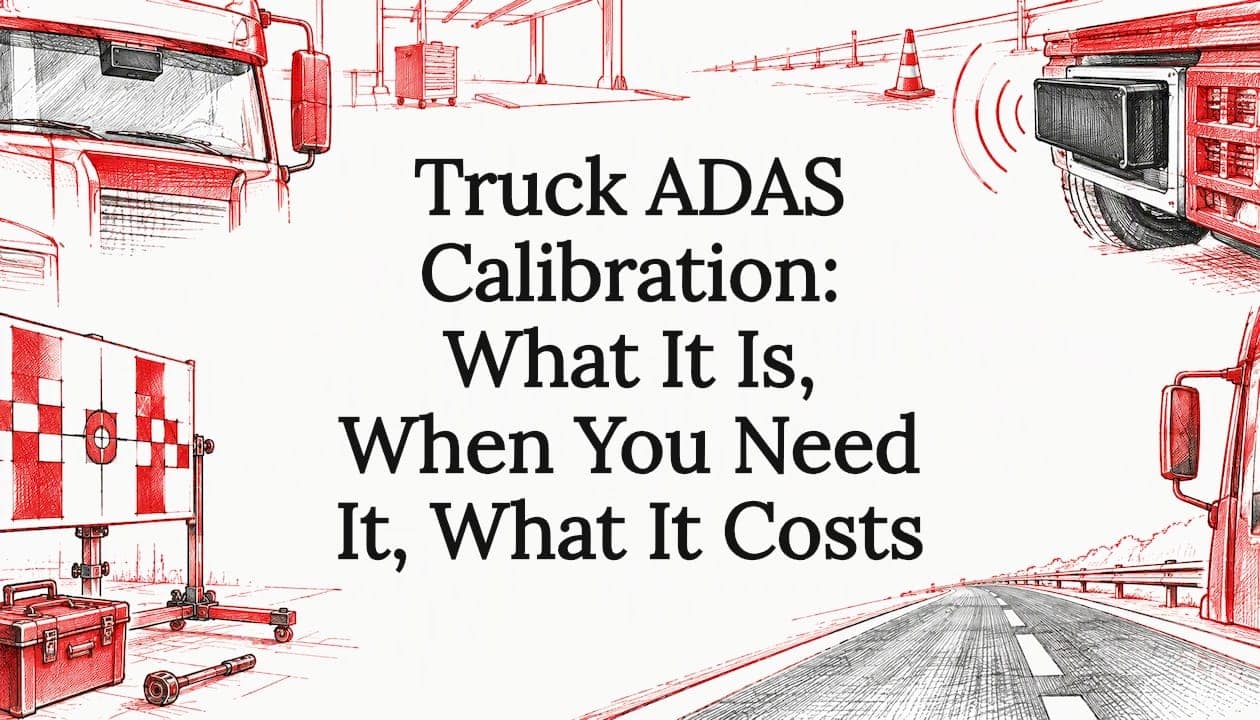
Truck ADAS Calibration: What It Is, When You Need It, What It Costs
Truck ADAS calibration explained: which repairs trigger it, static vs. dynamic methods, typical time and cost, and what a finished job should show....