
Auto Glass Repair
A rain-sensing windshield uses an infrared-based optical sensor mounted behind the mirror to detect water on the glass and automatically turn on or vary the speed of the wipers. It saves you the constant fiddling with wiper controls during unpredictable weather and keeps your view clearer in a sudden downpour. One caution worth remembering: a windshield replacement, a layer of grime, or a worn gel pad can knock the whole system offline or make it misread the weather entirely.
TL;DR:
- A rain sensor uses an infrared module behind the mirror to detect water, but dirt, grime, or incorrect installation can cause false triggers or failure.
- Replacing a windshield with a rain sensor requires the correct glass, gel pad, and often ADAS calibration to ensure the system functions properly.
- Visual clues like a small module or gel patch behind the mirror can confirm sensor presence, but camera-based detection lacks a distinct puck and needs different checks.
- Dirt, residues, or aging components can impair sensor performance, making cleaning and proper maintenance essential for accurate rain detection.
- Professional installation with calibration and replacement of the gel pad is crucial to preserve safety features and avoid costly mistakes.
Table of Contents
- How Does a Rain-Sensing Windshield Detect Rain?
- How Do I Know if My Windshield Has a Rain Sensor?
- Why Do Rain Sensors Fail or Misfire?
- What Happens to the Sensor When You Replace the Windshield?
- What Are the Safety Benefits and Limits of Automatic Wipers?
- What Technicians Actually Check During Rain Sensor Service
- What Most Guides Get Wrong About Rain Sensors
- Get Your Rain Sensor Windshield Replaced the Right Way
- Sources
- FAQ
How Does a Rain-Sensing Windshield Detect Rain?
The sensor works on a principle called total internal reflection. An infrared emitter and receiver sit inside a small module behind your rearview mirror, angled at roughly 45 degrees against the inside of the glass. When the windshield is dry, nearly all of that emitted infrared light bounces straight back into the receiver. Water sitting on the outside surface changes the way light behaves at that boundary, scattering it instead of reflecting it cleanly. The sensor picks up the resulting drop in reflected intensity and tells the wiper module to turn on.
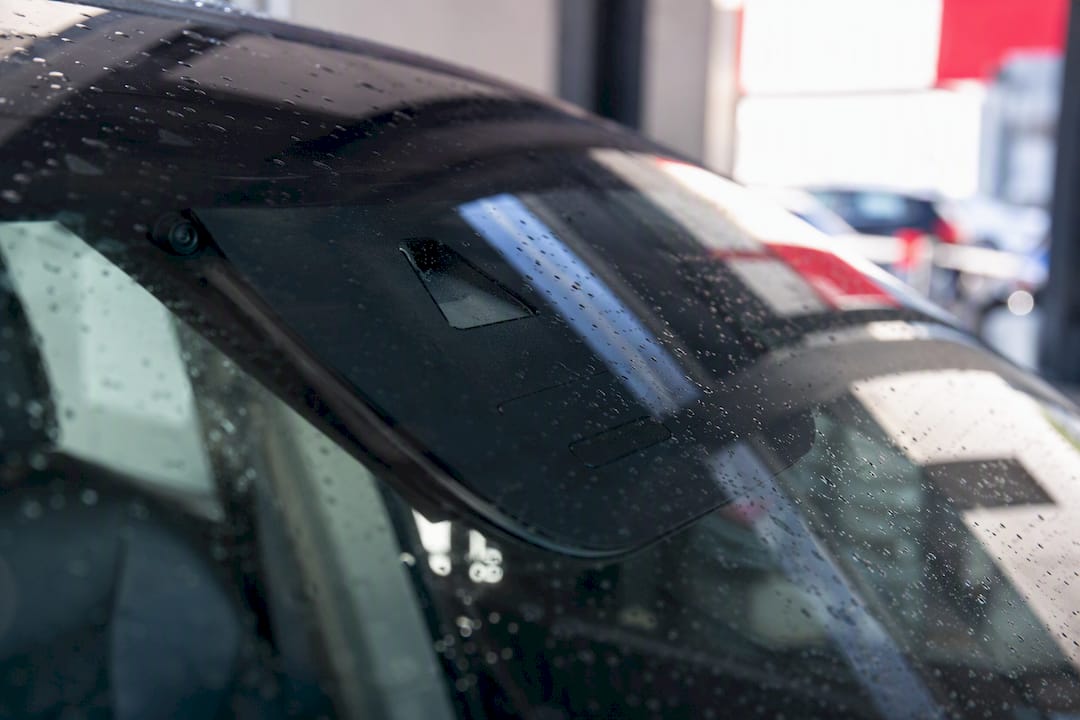
It’s not a simple on/off switch, either. The system reads how much light scatters and translates that into wiper speed. A light mist triggers an occasional sweep. A heavy downpour ramps the wipers up to near continuous motion, adjusting again as the rain lets up. That real-time feedback loop is what makes automatic windshield wipers feel almost intuitive once you get used to them.
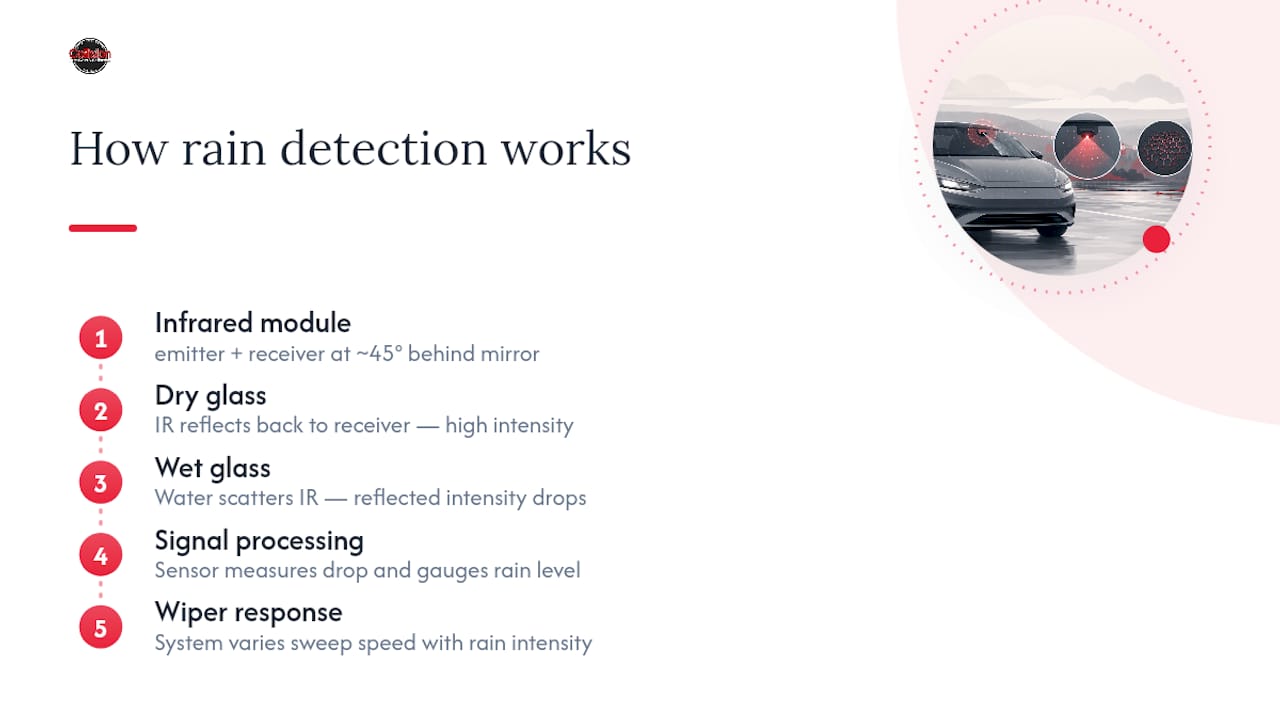
Most vehicles on the road use this discrete optical puck design, but some newer models skip the dedicated module entirely and rely on the forward-facing camera already installed for lane-keeping and collision warning systems to estimate rainfall instead. Both approaches fall under the umbrella of rain detection technology, but they behave differently when it comes to servicing and calibration, which matters more than most owners realize.
The technology has come a long way. Early rain-sensing attempts in the 1980s and early 1990s tried cruder methods, including monitoring wiper motor current draw to estimate resistance from water. GM’s Rainsense system, introduced in the mid-1990s, helped popularize the infrared refraction approach that’s now standard across nearly every major automaker.
How Do I Know if My Windshield Has a Rain Sensor?
You don’t need a diagnostic scanner to find out. A few visual checks and quick tests will tell you almost everything.
- Look directly behind your rearview mirror mount. A sensor-equipped car usually has a small black module, a clear gel patch, or a distinct lens visible through the frit (the dotted black border around the glass edge).
- Check your wiper stalk for an “AUTO” position, sometimes paired with a sensitivity dial or collar that lets you adjust how quickly the wipers respond.
- Run a damp cloth or misting bottle over the sensor area with the ignition on and wipers set to AUTO. A working sensor should trigger a wipe within a few seconds.
- Pull up your VIN or trim specification, or check the owner’s manual, for a definitive answer if the visual check is inconclusive.
Confirming the module’s location before scheduling glass work saves you a surprise later. One caveat: if your vehicle uses camera-based rain detection instead of a discrete sensor, you won’t see a separate puck at all, and the test above won’t apply the same way.
Why Do Rain Sensors Fail or Misfire?
Most rain sensor problems trace back to something simpler than a wiring fault. Dirt, road film, oily residue, or leftover wax on the windshield’s exterior surface can scatter infrared light the same way rain does, causing false activations on a dry, sunny day. On the flip side, a heavily soiled sensor window can also mute the signal enough that the wipers ignore actual rain.
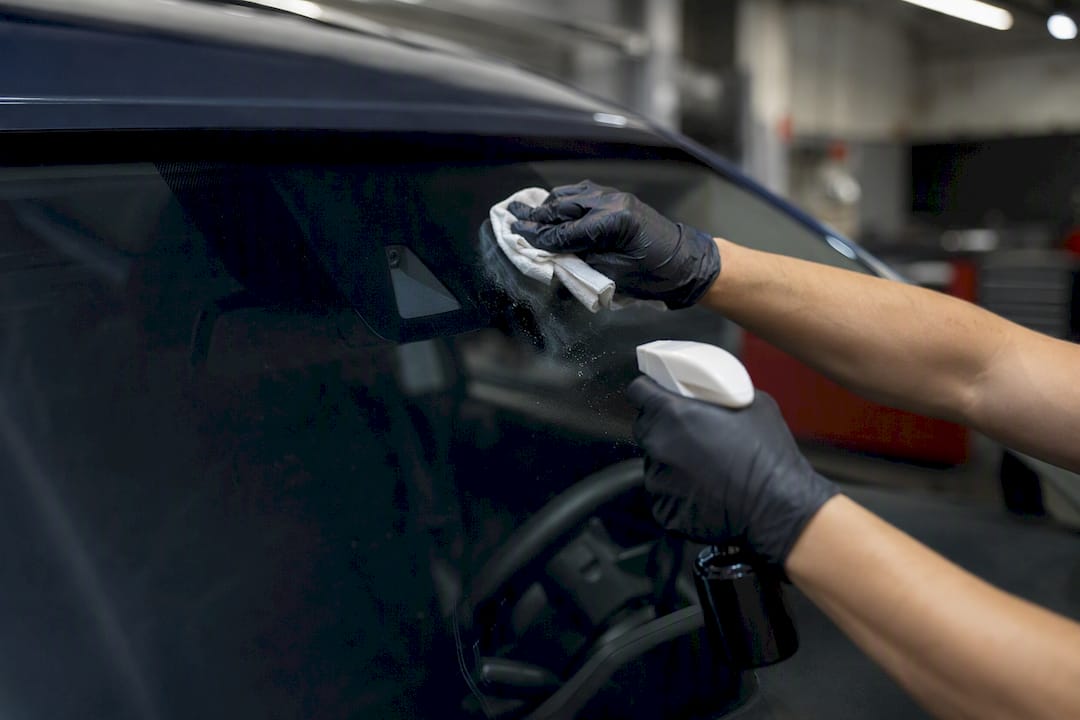
Inside the glass, a thin optical gel pad couples the sensor to the windshield so infrared light passes cleanly between the module and the glass surface. That pad is a wear item, and age, heat cycling, or improper reinstallation can cause it to degrade or separate, throwing off the whole detection process.
Watch for these signals before you assume the worst:
- No response at all when AUTO is selected and water hits the glass
- Wipers triggering with no rain present
- Inconsistent behavior between light drizzle and heavy spray
- Delayed or sluggish response compared to how the system used to behave
Before booking a shop visit, verify AUTO is actually selected, clean the exterior glass over the sensor with plain water and a microfiber cloth, and check that wipers aren’t stuck in a service or park mode. If those steps don’t help, the gel pad or sensor module likely needs professional attention.
Pro Tip: Skip ammonia-based glass cleaners and follow this streak-free method for UK owners for the sensor area. Those residues build up on the very spot the infrared beam needs to travel through cleanly, and they’re one of the most common causes of false triggers we see.
What Happens to the Sensor When You Replace the Windshield?
Replacing a windshield on a sensor-equipped vehicle isn’t a matter of swapping any piece of glass that fits the opening. The glass has to include the correct frit pattern and mounting area for the sensor bracket, and installing non-sensor glass by mistake will disable the feature entirely, even if everything else about the install goes perfectly.
The gel pad usually gets replaced rather than reused, since removing the old windshield often damages or contaminates it. The bracket itself is typically preserved and reused if it’s undamaged, but that depends on the vehicle and how the original glass separates during removal.
There’s a second layer to this. If your windshield houses a forward-facing camera for lane departure warning, automatic emergency braking, or adaptive cruise control, in addition to or instead of a rain sensor, that camera almost always needs ADAS recalibration after the glass is replaced. Even a millimeter of difference in camera angle can throw off how the vehicle reads lane lines or following distance.
A short checklist to hand your installer before the job starts:
- Confirm the replacement glass is sensor-compatible, not a generic equivalent
- Ask whether the gel pad will be replaced and whether the original bracket will be reused
- Ask directly whether your vehicle requires ADAS calibration after the swap, and whether that’s done in-house or outsourced
- Request documentation showing what was replaced and what was calibrated
What Are the Safety Benefits and Limits of Automatic Wipers?
The core safety benefit is straightforward: automatic wipers keep both hands on the wheel and your attention on the road instead of on a stalk, especially in stop-and-go traffic where rain intensity changes every few minutes. Paired with speed-sensitive wiping logic, the result is more consistent visibility with less manual adjustment.
The limitations are worth knowing before you rely on the system completely. Road grime, oily film, or bug residue can cause false activations, and sensitivity varies noticeably between manufacturers, so a system that feels responsive in one car might feel sluggish in another. No rain sensor eliminates the need to glance at your windshield and adjust manually when conditions get strange, like sleet or heavy fog.
Consumer Reports recommends checking whether your vehicle links rain-sensing wipers with automatic headlights, since that combination catches situations where a driver might forget to turn on lights during a sudden downpour. It’s a detail worth asking about if you’re comparing vehicles or trims. One more thing: rear wipers on hatchbacks and SUVs are almost always manual, even on vehicles with a fully automatic front system, so don’t expect the back glass to keep up on its own in wet road conditions.
What Technicians Actually Check During Rain Sensor Service
Collision Auto Glass & Calibration has been family-owned and operated in Portland since 2008, backed by a lifetime no-leak guarantee and in-house ADAS calibration. A properly trained technician inspects the sensor mounting area, replaces or re-seats the gel pad, confirms AUTO function before handing back the keys, and runs calibration if the camera or sensor was disturbed.
The most common mistakes we see from lower-quality installs: non-sensor glass installed by mistake, gel pads skipped to save time, and ADAS calibration left undone entirely. Ask your shop what glass they’re ordering and whether calibration documentation comes with the job.
What Most Guides Get Wrong About Rain Sensors
Most explainers treat the rain sensor as a stand-alone gadget, something separate from the rest of the windshield. That framing misses the point. The sensor, the gel pad, the bracket, and increasingly the ADAS camera are one interconnected system built into a single piece of glass. Treat any part of it as an afterthought during a repair, and the whole thing stops working the way it’s supposed to.
The conventional advice, “just get any replacement windshield and see if the sensor still works,” is where most owners get burned. It’s not a matter of luck. It’s a matter of ordering the correct part number and confirming the technician actually replaces the gel pad instead of reusing a compromised one.
If there’s one thing to prioritize, it’s asking direct questions before the work starts rather than troubleshooting after the fact. A five-minute conversation about glass compatibility and calibration saves you a return trip and, more importantly, keeps a safety feature functioning the way it was designed to.
— Collision Auto Glass & Calibration
Get Your Rain Sensor Windshield Replaced the Right Way
Collision Auto Glass & Calibration handles sensor-compatible windshield replacement, correct gel-pad handling, and in-house ADAS calibration under one roof, so you’re not stuck coordinating between a glass shop and a separate calibration center. Same-day service and free mobile installation across Portland mean your rain sensor gets back to working order without you rearranging your whole week.
Reach out if your wipers stopped responding after a recent glass job, if you’re seeing false triggers that cleaning hasn’t fixed, or if you just want a straight answer before scheduling a replacement. Every installation comes backed by a lifetime no-leak guarantee, and the team bills most insurance carriers directly so you’re not stuck chasing paperwork. Get a windshield replacement quote and ask specifically about sensor compatibility and calibration when you book.
Sources
- Rain sensor — Wikipedia
- How Rain-Sensing Windshield Wipers Work – Consumer Reports
- Does Your Windshield Have a Rain Sensor? How to Check in Minutes — TP Auto Repair
FAQ
How does a rain-sensing windshield work?
An infrared emitter and receiver behind the mirror measure how much light reflects off the inside of the glass. Water on the exterior scatters that light, and the drop in reflected intensity tells the wipers to activate.
What is a rain sensor for a windshield?
It’s a small optical module, usually mounted behind the rearview mirror, that detects moisture on the glass and automatically controls wiper activation and speed without you touching the stalk.
How do I know if my windshield has a rain sensor?
Look for a small module or clear gel patch behind the mirror, check for an AUTO setting on the wiper stalk, and test it with a damp cloth or mist to see if the wipers respond within a few seconds.
Can you replace a rain sensor windshield with a regular windshield?
Yes, but doing so disables the rain sensor entirely, since regular glass lacks the correct frit area and mounting for the sensor and gel pad. Always confirm sensor-compatible glass with your installer before replacement.
Does fog or snow affect rain sensor accuracy?
Yes. Heavy fog, frost, or snow buildup can interfere with the infrared beam and cause inconsistent or no response, which is a normal limitation rather than a sign of a broken sensor.
Recommended
- How Long Does a Windshield Replacement Take?
- Top 5 Myths About Windshield Replacement Debunked
- Frequently Asked Questions About Auto Glass Replacement & Repair
- 5 Tips on Choosing the Best Auto Glass Shop to Fix Your Windshield
🎧 Listen to This Article

Share
Recent Posts
September 20, 2026
When Drivers Can Drive After Windshield Urethane: 1–3 Hours, SDAT & Charts
Find exactly when you can drive after windshield urethane. Learn AGRSS SDAT rules, how to read manufacturer cure charts, and simple aftercare. Often...

September 19, 2026
Windshield Frit Explained for Drivers: How Black Dots Protect the Seal
How the screen printed, baked ceramic band and dot matrix on fixed auto glass give urethane adhesive a textured grip, block UV, prevent...
September 18, 2026
Drivers: Heated Windshield Cuts Frost to 5 Minutes with 48V, ADAS Tips
Why heated windshields matter: 48V metal coating can clear frost in five minutes. Learn repair, replacement, and ADAS calibration steps owners should request....