Auto Glass Repair
TL;DR:
- Radar sensors require calibration after front-end repairs to ensure ADAS features operate correctly. Proper calibration involves precise static or dynamic procedures, with thorough pre- and post-scans, to prevent safety risks from misaligned sensors. Collision Auto Glass & Calibration offers OEM-compliant calibration services in Portland, with documentation, mobile options, and insurance billing.
If your vehicle had windshield replacement, bumper work, or any front-end repair, your radar sensors almost certainly need calibration before your ADAS features can be trusted. This is not a judgment call — OEM repair procedures are the definitive trigger source, and they flag calibration requirements for dozens of common repairs that most drivers never connect to their radar system. The right next step is a pre-scan diagnostic, followed by OEM-compliant calibration if triggers are confirmed.
Before your appointment, have these ready:
- Your VIN and vehicle year, make, and model
- A brief repair history (what was replaced or repaired, and when)
- Proof of insurance if you plan to use direct billing
- Any ADAS warning messages currently showing on your dashboard
Collision Auto Glass & Calibration performs in-house ADAS calibration in Portland using factory-level diagnostic tools, with same-day mobile service available and direct insurance billing to keep the process straightforward.
Table of Contents
- When does your vehicle need radar calibration?
- What radar sensor calibration actually involves
- How to prepare your vehicle for a calibration appointment
- How much does radar calibration cost, and how long does it take?
- How to choose a qualified radar calibration technician
- What happens when calibration is skipped or done wrong?
- How Collision Auto Glass & Calibration handles ADAS radar calibration
- How radar sensors fit into your vehicle’s ADAS network
- Signs your radar sensor may be out of calibration
- Environmental and vehicle factors that affect calibration accuracy
- Key Takeaways
- The mistake most Portland drivers make after a repair
- Portland’s local option for OEM-compliant ADAS calibration
- Useful sources
- FAQ
When does your vehicle need radar calibration?
The biggest misconception about radar calibration is that it only matters when the sensor itself is physically damaged. In reality, changes to the surrounding geometry during routine repairs are often the actual trigger. A bumper reinstall, for example, shifts the mounting plane the radar sits behind, which can alter its detection angle even if the sensor was never touched.
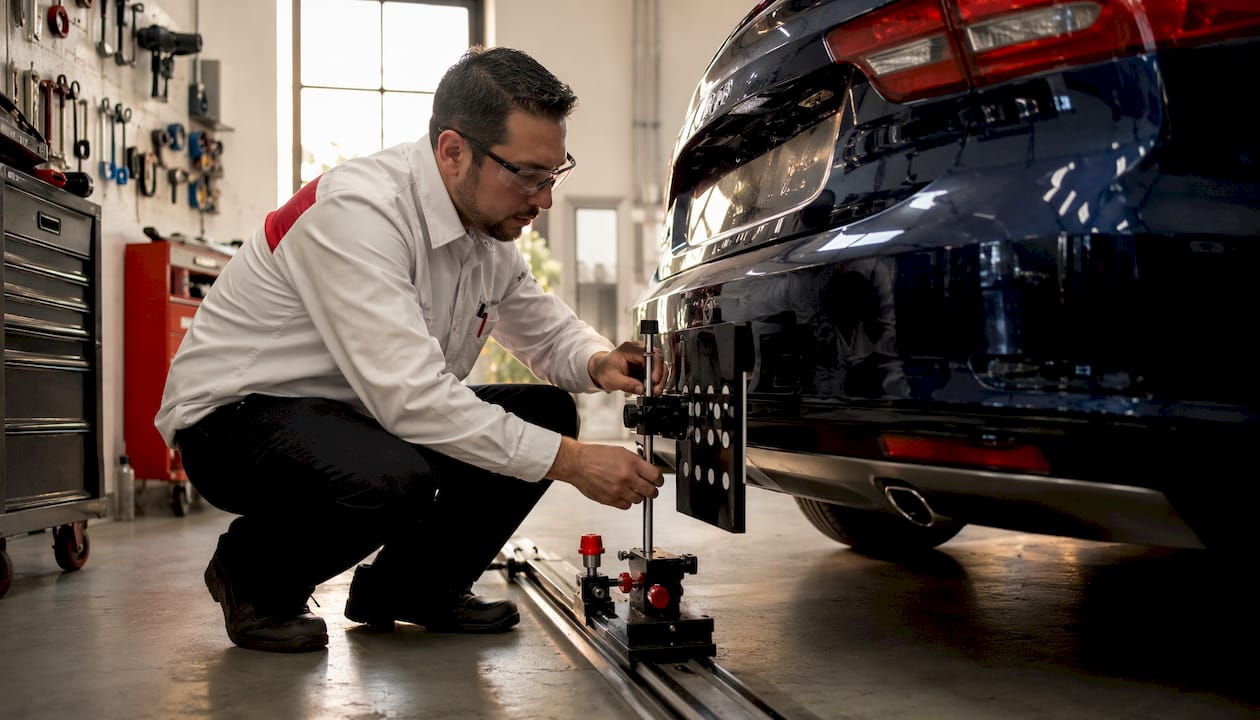
Common triggers include windshield replacement (especially when a forward-facing camera is integrated), bumper removal or reinstallation, radar or camera module replacement, front-end collision repairs, steering or suspension work, wheel alignment adjustments, and airbag deployment. ADAS fault codes appearing on your dashboard are another clear signal — they often indicate the system has detected a sensor discrepancy it cannot self-correct.
Wheel alignment and suspension work deserve special attention here. Changes to ride height or steering geometry alter the physical relationship between the vehicle’s centerline and the radar’s field of view. If you’ve had alignment work done recently and your adaptive cruise control is behaving erratically, that connection is worth investigating. OEM procedures are vehicle-specific, so what triggers calibration on a 2022 Toyota RAV4 may differ from a 2023 Ford F-150. Assumptions are dangerous — always consult the manufacturer’s documented procedure for your exact vehicle.
What radar sensor calibration actually involves
Radar calibration falls into two categories: static and dynamic. Understanding the difference helps you know what to expect from your appointment and why the process takes the time it does.
Static vs. dynamic calibration
| Feature | Static Calibration | Dynamic Calibration |
|---|---|---|
| Location | In-shop, controlled environment | On-road drive cycle |
| Equipment | Calibration targets, factory scan tool, level surface | Factory scan tool, specific road conditions |
| Environment needs | Large area, free of metal objects | Clear lane markings, dry pavement, specific speeds |
| Completion time | Typically takes a few hours | Typically requires a moderate driving duration after setup |
| Common use | Forward radar, front camera systems | Adaptive cruise, some rear radar systems |
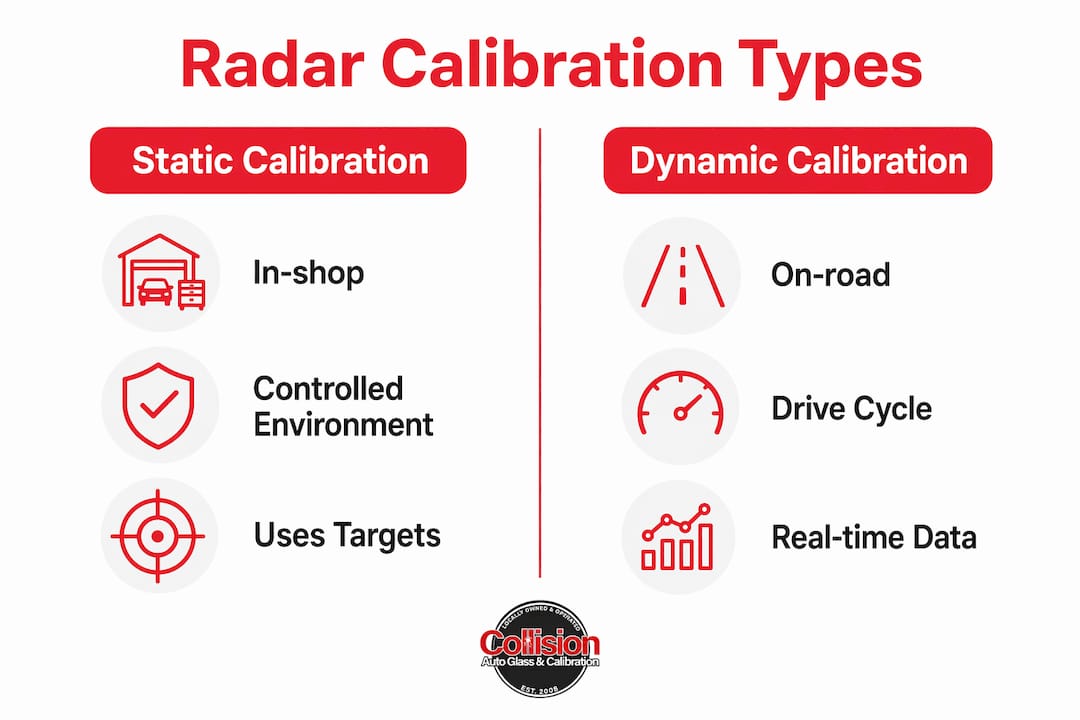
Static calibration requires a large, level area clear of metal objects because nearby metal distorts radar reflections and produces inaccurate aiming results. Technicians position calibration targets at precise distances and angles in front of the vehicle, then use a factory-level scan tool to read sensor output and adjust calibration parameters until the sensor’s detection field aligns with the vehicle’s actual geometry.
Dynamic calibration works differently. The technician drives the vehicle through an OEM-specified drive cycle, which may require following another vehicle at a set speed on a straight road with clear lane markings. Poor weather, faded road markings, or heavy traffic can prevent the system from completing the learn procedure, forcing a second attempt.
Pro Tip: Ask your shop which calibration method your vehicle requires before booking. Some vehicles need both static and dynamic procedures in sequence, which affects total appointment time.
The full workflow for a typical calibration job runs as follows:
- Pre-scan: technician reads all stored fault codes and documents current sensor status
- Setup: targets are positioned (static) or drive route is planned (dynamic)
- Calibration: factory scan tool executes the OEM calibration routine
- Post-scan: technician confirms fault codes are cleared and calibration values are within spec
- Verification test drive: a short drive confirms ADAS features respond correctly in real conditions
Why does precision matter so much? Fractions of a degree of angular deviation in a radar sensor can produce false collision alerts, disable adaptive cruise control, or cause the system to miss a real obstacle entirely. The margin for error is genuinely that small. Setup precision is equally critical on the static side — slight misalignment of the calibration plate or an uneven shop floor can force the entire procedure to restart from scratch.
How to prepare your vehicle for a calibration appointment
Preparation on your end directly affects whether the calibration succeeds on the first attempt. A few straightforward steps before you arrive can save time and prevent a return visit.
Clean the radar sensor area and front bumper. Dirt, ice, or debris on or around the sensor housing can interfere with the calibration routine. Remove any roof racks, tow balls, or aftermarket accessories that alter the vehicle’s ride height or weight distribution, since static calibration procedures assume the vehicle is at its standard, unloaded height. Check that all four tires are inflated to the OEM-specified pressure — low or uneven tire pressure changes ride height and can throw off the calibration geometry.
When you check in, the shop will need to know exactly what repairs were performed and when. Bring documentation if you have it: repair orders, insurance claim numbers, or a simple written note of what was replaced. Let the technician know about any ADAS warning lights that appeared after the repair, even if they cleared on their own. That history helps the technician decide which modules to scan and which OEM calibration procedure applies to your vehicle.
How much does radar calibration cost, and how long does it take?
Calibration costs vary widely depending on many factors; obtaining a quote from a qualified shop is recommended. Costs tend to increase with additional sensors, combined static and dynamic procedures, or module programming requirements. Always ask for an itemized estimate before authorizing work.
On timing: a pre-scan takes 20–30 minutes. Static calibration setup and execution typically runs 1–2 hours. Dynamic calibration adds 30–60 minutes of drive time on top of setup. A full appointment covering pre-scan, calibration, post-scan, and verification drive can reasonably take 2–4 hours depending on vehicle complexity and whether the first attempt succeeds.
Factors that commonly extend time or cost include:
- Hard-to-access sensor locations (some rear or corner radar units)
- Multiple calibrations required in a single visit
- Dynamic calibration attempts that fail due to weather or road conditions
- Required software updates before calibration can proceed
How to choose a qualified radar calibration technician
Not every shop that offers ADAS calibration follows OEM procedures or uses factory-level equipment. Choosing the wrong provider can leave your radar system appearing calibrated while still operating outside spec.
Ask these questions when you call:
- Do you follow OEM repair procedures for this specific vehicle?
- Do you use factory-level or OEM-equivalent scan tools?
- Will you perform both a pre-scan and a post-scan, and provide written documentation?
- Do you offer a warranty on the calibration work?
Strong trust signals include documented access to OEM repair procedures, I-CAR or manufacturer-specific training certifications, photo documentation of the calibration setup, and a written warranty on the calibration itself. Technicians should document calibration steps and provide verification records — this protects you if a warranty or insurance question arises later.
Red flags worth walking away from: vague answers about which tools or procedures they use, no mention of pre- or post-scans, quotes that are unusually low without a clear explanation, and any reluctance to provide written proof of calibration. Calibration triggers and methods are highly vehicle-specific, so a shop that gives you a one-size-fits-all answer about procedures is telling you something important about how they work.
For owners who also need to evaluate auto glass shop quality alongside calibration, the same documentation and OEM-procedure questions apply.
What happens when calibration is skipped or done wrong?
The consequences of miscalibrated radar sensors range from annoying to genuinely dangerous. A sensor that is off by even a small angular margin can trigger phantom braking on the highway, fail to detect a vehicle merging into your lane, or disable adaptive cruise control entirely without displaying a warning.
Concrete outcomes of miscalibration include:
- False collision alerts that cause unexpected braking
- Missed obstacle detection, leaving collision mitigation inactive when needed
- Incorrect distance monitoring in adaptive cruise control
- Blind-spot detection failures
- Persistent ADAS fault codes that prevent other systems from operating
From a liability and warranty standpoint, documentation matters. If your vehicle is involved in an accident and ADAS failure is a factor, the repair history and calibration records become relevant. OEM procedures and documented post-scan verification are the standard of care — shops that skip them expose both themselves and their customers to avoidable risk. Keep your calibration records the same way you keep oil change receipts.
If you suspect a problem after calibration, return to the shop immediately and request the pre- and post-scan reports. If the issue is unresolved, escalate to the vehicle manufacturer’s customer service line or a dealership service department. Delaying that conversation only extends the period your safety systems are unreliable. The risks of driving with compromised auto glass or sensors apply equally to uncalibrated radar systems.
How Collision Auto Glass & Calibration handles ADAS radar calibration
Collision Auto Glass & Calibration provides a complete calibration workflow: pre-scan diagnostics, OEM-compliant static or dynamic calibration, post-scan verification, and documentation delivered to the customer. Every calibration follows manufacturer-specified procedures for the vehicle’s exact year, make, and model.
Key service details:
- Family-owned and operated in Portland since 2008
- In-house ADAS calibration using factory-level diagnostic equipment
- Same-day mobile service available throughout the Portland area
- Lifetime no-leak guarantee on all glass installations
- Direct insurance billing, with no paperwork burden on the customer
- Pre- and post-scan reports provided with every calibration
Booking is straightforward. Call or use the online quote form, provide your VIN and a brief description of the recent repair, and the team will confirm which calibration procedure applies and schedule your appointment. For vehicles that had windshield replacement alongside calibration, the two services are coordinated in a single visit when possible.
How radar sensors fit into your vehicle’s ADAS network
Modern vehicles use radar sensors as one layer in a broader ADAS architecture that typically also includes forward-facing cameras, ultrasonic sensors, and sometimes lidar. Radar sensors use radio waves to detect objects across short, medium, and long ranges, making them the primary input for adaptive cruise control, automatic emergency braking, and blind-spot monitoring. Cameras handle lane-keeping and traffic sign recognition; radar handles distance and velocity measurement.
The systems are interdependent. A miscalibrated radar sensor does not just affect one feature — it can cascade across multiple ADAS functions that rely on the same sensor input. For a deeper look at how these systems connect, ADAS calibration basics explains the full sensor network in plain language.
Signs your radar sensor may be out of calibration
Dashboard warning lights are the most obvious indicator, but they are not the only one. Radar systems that are slightly out of spec sometimes operate without triggering a fault code, especially if the deviation is small enough to stay within the system’s self-monitoring threshold.
Watch for these behavioral signs:
- Adaptive cruise control that brakes unexpectedly or fails to maintain a set following distance
- Blind-spot alerts that trigger with no vehicle present, or fail to trigger when one is clearly there
- Automatic emergency braking that activates on open road
- Collision warning alerts that seem inconsistent or poorly timed
- Any ADAS feature that was working before a repair and stopped working after
A post-repair pre-scan is the only reliable way to confirm whether calibration is needed. Behavioral symptoms alone are not a substitute for diagnostic data, because some miscalibration conditions produce no visible symptoms until a critical moment.
Environmental and vehicle factors that affect calibration accuracy
Even with a skilled technician and proper equipment, certain conditions can compromise calibration accuracy or prevent completion entirely.
For static calibration, the shop environment is the primary variable. Metal shelving, nearby vehicles, or a floor with even a slight grade can distort radar reflections during the procedure. A shop that does not have a dedicated, cleared calibration bay is working against itself from the start.
For dynamic calibration, weather and road conditions are the controlling factors. Rain, snow, glare, and faded lane markings can all prevent the OEM drive cycle from completing. Some manufacturers require the vehicle to follow another vehicle at a specific speed for a set distance — conditions that are genuinely difficult to replicate in heavy Portland traffic or during wet winter weather. When a dynamic procedure fails to complete, the technician must restart the drive cycle, which adds time and occasionally cost.
Vehicle condition also plays a role. Incorrect tire pressure, a suspension component that is worn or recently replaced, or a vehicle that is loaded with cargo will all affect the geometry the calibration assumes. Arriving at your appointment with the vehicle in its normal, unloaded state and tires at spec gives the calibration the best chance of succeeding on the first attempt.
Key Takeaways
Radar sensor calibration is required after many common repairs, and skipping it leaves ADAS features unreliable — the only safe path is a pre-scan followed by OEM-procedure calibration from a documented, qualified shop.
| Point | Details |
|---|---|
| Many repairs trigger calibration | Windshield replacement, bumper work, alignment, and suspension changes all commonly require radar recalibration. |
| Fractions of a degree matter | Even tiny angular deviations can cause false alerts, missed detections, or disabled ADAS features. |
| Static vs. dynamic methods differ | Static calibration happens in-shop with targets; dynamic requires an OEM drive cycle under specific road conditions. |
| Always get pre- and post-scans | Diagnostic scans before and after calibration are the only way to confirm the procedure succeeded. |
| Collision Auto Glass & Calibration | Portland’s family-owned ADAS calibration provider since 2008, offering OEM-compliant procedures, same-day mobile service, and direct insurance billing. |
The mistake most Portland drivers make after a repair
The pattern Collision Auto Glass & Calibration sees most often is straightforward: a driver gets a windshield replaced at a shop that does not offer calibration, drives away assuming everything is fine, and then notices their automatic emergency braking activating on clear highway stretches a week later. By the time they connect the behavior to the windshield replacement, they have been driving with unreliable ADAS for days.
The second most common mistake is accepting a low calibration quote without asking what it includes. A quote that does not mention pre- and post-scans, OEM procedures, or documentation is almost certainly a quote for something less than a complete calibration. The price difference between a documented OEM-procedure calibration and a shortcut is real, but so is the difference in what you actually get.
One representative scenario: a vehicle owner had front-end collision repairs completed at a body shop, which did not include calibration. The radar system appeared to function normally for several weeks. A pre-scan performed at Collision Auto Glass & Calibration later revealed stored fault codes and an out-of-spec calibration value that the system had not flagged visibly. After OEM-compliant recalibration and a verified post-scan, the fault codes cleared and adaptive cruise control returned to normal operation.
The straightforward way to avoid this outcome: any time your vehicle has front-end work, bumper removal, windshield replacement, or suspension service, request a pre-scan before you drive away. If calibration is needed, get it done by a shop that follows OEM procedures and hands you documentation when the job is complete.
Portland’s local option for OEM-compliant ADAS calibration
Collision Auto Glass & Calibration is Portland’s direct answer for drivers who need radar and ADAS calibration done right the first time, without the dealership wait or the uncertainty of a shop that treats calibration as an afterthought.
The shop handles the full sequence: pre-scan diagnostics, OEM-compliant static or dynamic calibration, post-scan verification, and written documentation you can keep for your records. Mobile service is available throughout Portland at no extra charge, and direct insurance billing means you are not fronting costs and waiting for reimbursement. For vehicles that need both windshield replacement and calibration, both services are coordinated in a single appointment.
To get a quote or book your pre-scan, visit collisionautoglass.com or use the ADAS calibration service page to confirm which procedure your vehicle requires. If you have questions about windshield replacement costs that may accompany your calibration, the windshield replacement cost guide covers what to expect.
Useful sources
The following resources informed the guidance in this article and offer additional detail for owners who want to go deeper on specific topics.
-
When Is ADAS Calibration Required? — asTech: Covers the full range of repair triggers that require calibration, including many that are not intuitive. Recommended reading for shop owners and informed vehicle owners alike.
-
Best Practices: Radar Calibration — ADAS Project: Explains why angular precision is so critical and what technicians should verify during and after the calibration process.
-
ADAS Calibration Requirements — TheFixCar: Reinforces the vehicle-specific nature of calibration triggers and the importance of consulting OEM procedures for each repair scenario.
-
Typical Calibration Requirements for Forward Radar Sensors — I-CAR / RTS: Industry-standard guidance on static calibration environment requirements, including the metal-free area rule.
-
Quick Tip: GM Radar Sensor Recalibration — Snap-on Diagnostics: Practical technician-level detail on dynamic calibration drive cycles and the environmental conditions that can prevent completion.
-
ADAS Service Diagnostics and Calibration — Vehicle Service Pros: Covers documentation standards, training requirements, and why factory equipment matters for repeatable calibration results.
-
Calibrating Forward-Facing Radar Sensors — Vehicle Service Pros: Practitioner-level insight on static setup errors and how shop environment affects calibration success rates.
-
ADAS Radar Sensors: A Guide to Calibration — Revv: Plain-language overview of how radar sensors function within the broader ADAS network and why recalibration is required after qualifying events.
If you want certified documentation for your specific vehicle, ask your repair shop to provide the OEM procedure reference number for the calibration performed. That reference ties the work done to the manufacturer’s published standard.
FAQ
How much does radar sensor calibration cost?
Calibration costs vary widely depending on many factors; obtaining a quote from a qualified shop is recommended. Always request an itemized estimate that includes pre- and post-scan fees.
How do you calibrate a radar sensor in a car?
Technicians perform either static calibration (positioning targets in a metal-free shop environment and using a factory scan tool) or dynamic calibration (an OEM-specified road drive cycle), followed by a post-scan and verification test drive to confirm the sensor is within spec.
How much does lane assist calibration cost?
Lane-keeping assist calibration, which typically involves the forward-facing camera rather than the radar sensor, generally falls in a similar range to radar calibration; when both systems require calibration in the same visit, shops often bundle the procedures, which can affect total pricing.
Does Collision Auto Glass & Calibration handle radar calibration in Portland?
Yes. Collision Auto Glass & Calibration performs OEM-compliant ADAS radar calibration in Portland, with pre- and post-scan documentation, same-day mobile service, and direct insurance billing available.
Recommended
- Need a New Windshield? Don’t Forget Calibration – Collision Auto Glass & Calibration
- What Is The ADAS Calibration? – Collision Auto Glass & Calibration
- Common Causes of Car Door Glass Damage and How to Prevent Them – Collision Auto Glass & Calibration
- Tips for Preventing Auto Theft – Collision Auto Glass & Calibration
Share
Recent Posts
October 15, 2026
Auto Glass Claims: Choose a U.S. Shop Before ADAS Billing Surprises
See how U.S. drivers can choose an auto glass shop for an insurance claim, confirm ADAS calibration, protect their rights, and prevent billing...
October 14, 2026
Fleet Windshield Maintenance: A 20 Minute Repair Can Prevent Days Down
Catch chips early, log the VIN and photos, and require part number and ADAS calibration records to keep fleet vehicles moving and avoid...
October 13, 2026
Calibration After Collision Repair: Ask for Scans Before You Drive
Learn when collision repairs require ADAS calibration, how shops verify the work, and which scan records and paperwork to request before driving....