Auto Glass Repair
A long crack in your windshield can often be repaired, but not always. The industry standard that governs this decision in the United States is ROLAGS (Repair of Laminated Auto Glass Standard), which defines a long crack as any crack exceeding 6 inches (150 mm) and sets a hard dimensional ceiling of 14 inches (350 mm) for crack repairs. If your crack falls within that range and passes a few additional checks, a certified technician may be able to restore it. If it doesn’t, replacement is the safer call.
Run through this quick screening checklist before you do anything else:
- Length: Is the crack longer than 14 inches (350 mm)? If yes, replacement is required.
- Edge involvement: Does the crack reach the edge of the glass? Edge cracks compromise the windshield’s structural role and are a replacement trigger.
- Inner-layer penetration: Has the crack pushed through both glass lites? Any inner-layer damage means replacement.
- Number of legs: Three or more long cracks originating from a single impact point require replacement under ROLAGS.
- DPVA (Driver’s Primary Viewing Area): A crack running through the area directly in front of the driver’s line of sight faces stricter limits and may not be repairable.
- Contamination: Dirt, moisture, or debris embedded in the crack can prevent proper resin bonding and may disqualify repair.
If your crack is under 14 inches, involves only the outer lite, stays away from the edge and the DPVA, and has fewer than three legs, a professional inspection is your next step. If it fails any single criterion, call a shop and ask about windshield replacement rather than repair.
Table of Contents
- How do pros decide whether a long crack can be repaired?
- How does a long-crack repair actually work?
- When does a long crack require full windshield replacement?
- What does long-crack repair or replacement cost, and how long does it take?
- What does a certified shop actually do, step by step?
- What questions should you ask before booking a repair shop?
- Key Takeaways
- The honest truth about long-crack repair decisions
- Professional long-crack repair and replacement in Portland
- Primary sources and standards to consult
- FAQ
How do pros decide whether a long crack can be repaired?
The formal framework U.S. technicians use is ROLAGS, published by the National Windshield Repair Division (NWRD) and adopted as an ANSI/AGSC standard. It draws a clear line between short cracks (6 inches or under) and long cracks (over 6 inches), and it caps the maximum repairable length at 14 inches (350 mm). Beyond that ceiling, no amount of skill or resin makes a repair structurally or optically acceptable.
ROLAGS also defines specific “Clause 7” replacement triggers that apply regardless of length:
- Inner-layer (inner lite) damage of any kind
- Cracks that originate at or run to the glass edge
- Three or more long cracks from a single impact
- Contamination that cannot be removed before resin injection
- Cracks that violate DPVA limits for the specific vehicle
- ADAS camera or sensor field obstructions
Technicians don’t just measure length. A proper inspection involves viewing the crack from both inside and outside the vehicle, tracing every leg to its tip, checking for delamination or moisture, and consulting OEM documentation for that vehicle’s sensor and camera placement. NWRD guidance is explicit that ROLAGS functions as a decision framework, not a mechanical checklist. Technician judgment, OEM instructions, and ADAS considerations all factor into the final call.
| Screening Criterion | Repair Allowed | Conditional | Replace Required |
|---|---|---|---|
| Length ≤ 6 in. (short crack) | ✓ | ||
| Length 6–14 in. (long crack) | ✓ (if other criteria pass) | ||
| Length > 14 in. | ✓ | ||
| Edge crack (any length) | ✓ | ||
| Inner-lite penetration | ✓ | ||
| 3+ long cracks, one impact | ✓ | ||
| DPVA involvement | ✓ (technician judgment) | ||
| Contamination present | ✓ (if removable) | ✓ (if not removable) |
How does a long-crack repair actually work?
Professional long-crack repair follows a controlled sequence that differs significantly from what a DIY kit can replicate. The goal is to remove air from the break, fill it with a cured resin that closely matches the glass’s refractive index, and produce a result that passes a driver’s-seat optical inspection.
The repair sequence
A technician begins by cleaning the crack with a vacuum or compressed air to remove loose debris, then uses a drill or bridge tool to access the crack’s entry point. Air removal is the most critical step. Vacuum-based systems draw air out of the crack channel before resin is introduced; pressure-based systems push resin in under controlled force. Many professional systems use a combination of both, cycling between vacuum and pressure to work resin into every leg and tip of the crack.
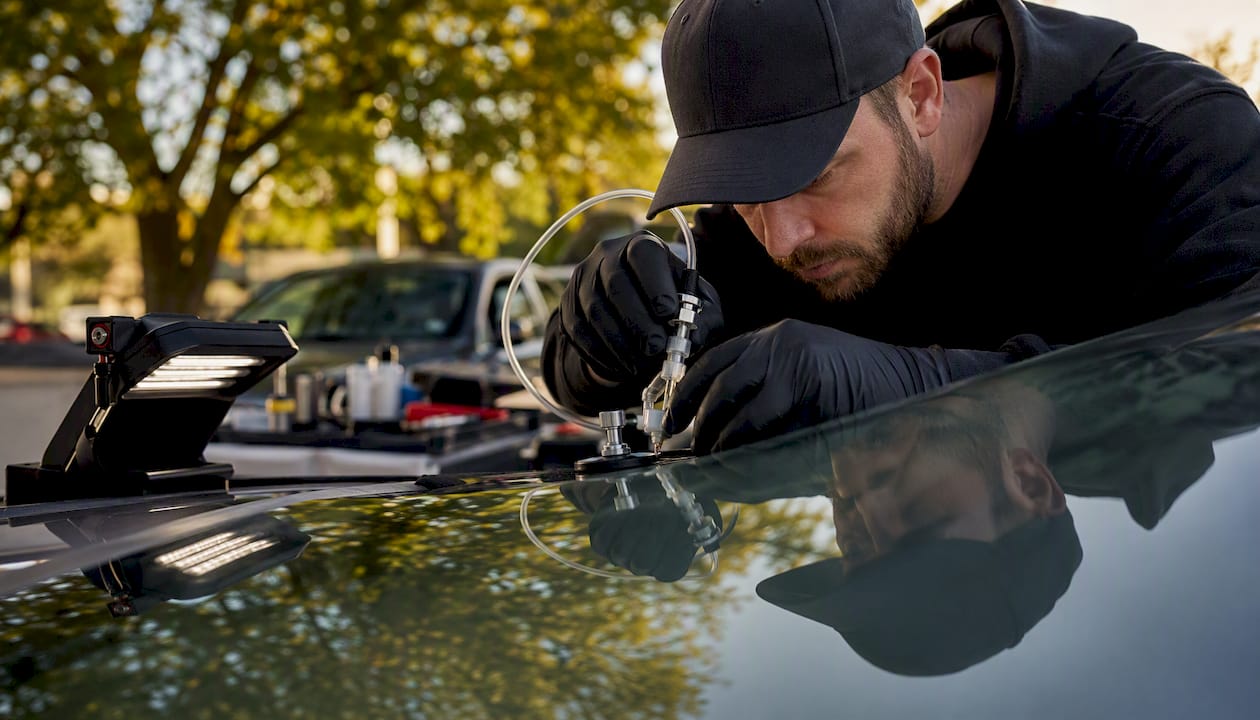
Resin selection matters more than most car owners realize. Crack resins are formulated differently from chip resins. They have lower viscosity to flow through narrow channels and are matched to specific UV curing lamps. Using the wrong resin or lamp for a given system produces incomplete curing, voids at leg tips, or optical distortion that can’t be corrected after the fact. This is why technician-level repair guidance consistently emphasizes following system-specific instructions rather than mixing components from different kits.
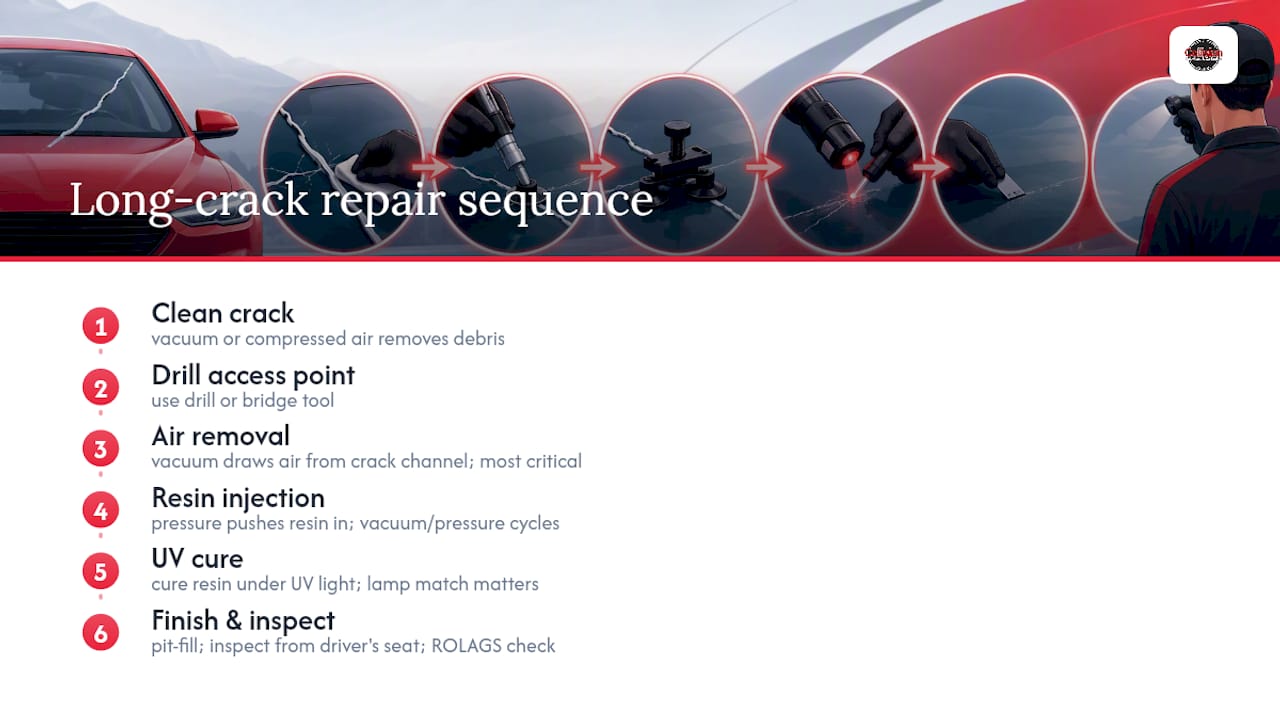
After injection, the resin is cured under UV light, the surface is finished with a pit-fill compound, and the technician inspects the result from the driver’s seated position. ROLAGS requires that repaired samples meet a specific arc-shift threshold for optical distortion, a lab-level standard that professional resin systems are tested against.
Pro Tip: A properly executed long-crack repair restores optical clarity and seals the break against moisture and debris. It does not fully restore the original tensile strength of laminated glass. That distinction matters for how you think about the repair’s purpose: it’s a structural and visual stabilization, not a return to factory condition.
Resin fills the crack and prevents it from spreading, but the glass has been permanently altered. Shops that represent a repair as making the windshield “as good as new” are overstating what the process delivers.
When does a long crack require full windshield replacement?
Some damage leaves no room for a repair decision. Replacement is required when the crack fails any of the ROLAGS screening criteria, but several specific scenarios come up most often in real shops.
ADAS and sensor fields are a growing replacement driver. Modern vehicles mount forward-facing cameras, rain sensors, and lane-departure systems directly to or near the windshield. A crack that runs through the camera’s optical field, even a short one, can distort the sensor’s input and produce false readings from systems like automatic emergency braking or lane-keep assist. ADAS calibration is required after any windshield replacement, and a crack near a sensor mount is almost always a replacement trigger rather than a repair candidate.
“Repair of a windshield that has been damaged in a way that affects its compliance with Standard No. 205 would not be a ‘rendering inoperative’ violation if the repair is performed after the vehicle’s first sale.” However, NHTSA is clear that federal safety standards still govern the glazing’s performance, and that installing noncompliant glazing can violate federal law. Shops remain responsible for ensuring their work does not leave a vehicle’s glass out of compliance with FMVSS 205.
Edge cracks are a structural issue that resin cannot fix. The windshield’s urethane bond to the vehicle frame is part of the roof’s crush resistance in a rollover. A crack that reaches the edge compromises that bond zone, and resin injected into an edge crack does not reliably restore structural integrity. Replacement is the only correct answer.
State inspection laws add another layer. Progressive’s state-law summary notes that many states treat windshield damage that obstructs the driver’s view as an inspection or non-moving violation. A repaired crack that leaves visible distortion in the DPVA can still result in a failed inspection or a citation, even if the repair was technically performed.
Automatic replacement triggers include:
- Any crack penetrating both glass lites
- Edge cracks intersecting the glass perimeter
- Three or more long cracks from one impact point
- Stress cracks with no clear impact origin
- Contamination that cannot be fully removed before resin injection
- Cracks within ADAS camera or sensor optical fields
What does long-crack repair or replacement cost, and how long does it take?
DIY kits retail for roughly $10–$25 at auto parts stores. The low price reflects what they’re designed for: small chips and short cracks. For a long crack, the kit is rarely the right tool, but it’s the cheapest entry point if you’re assessing options.
Professional long-crack repair typically runs less than a full replacement, though pricing varies by market, crack complexity, and whether the vehicle has ADAS components. Replacement costs depend on whether OEM or aftermarket glass is used, the vehicle make and model, and whether ADAS recalibration is required afterward. For a detailed breakdown of what replacement costs in your situation, Collision Auto Glass & Calibration’s cost guide covers the main pricing variables.
Insurance coverage is often the deciding factor. Comprehensive glass endorsements, which many drivers carry, typically cover both repair and replacement with little or no out-of-pocket cost. Insurance coverage for windshields varies by policy, but repair is almost always covered when the damage qualifies. Replacement coverage depends on whether you carry comprehensive and whether your deductible applies. Some states require insurers to waive the deductible for glass repairs specifically.
On timing: a professional crack repair takes roughly 30–60 minutes once the technician begins work. The vehicle is typically drivable immediately after, though technicians advise against car washes or high-pressure water for at least 24 hours. Replacement takes longer, usually 60–90 minutes for installation, plus additional time if ADAS calibration is performed on-site. A shop that offers same-day service and mobile installation can complete both repair and replacement at your location, which eliminates the need to leave your vehicle at a shop.
What does a certified shop actually do, step by step?
Understanding the professional process helps you evaluate whether a shop is doing the job correctly. Here’s what a thorough long-crack repair looks like from intake to final sign-off:
- Driver’s-seat optical check — The technician sits in the driver’s position and inspects the repaired area against the light. ROLAGS requires this check, and a result with visible distortion or voids is not an acceptable finished repair.
Pro Tip: Ask your shop whether they perform the driver’s-seat optical check as a formal step. A shop that skips it is skipping the most important quality control in the entire process.
If the technician discovers inner-lite damage or unacceptable optical distortion mid-repair, the correct response is to stop and recommend replacement. A good shop will tell you this before you leave, not after.
What questions should you ask before booking a repair shop?
Choosing the right shop matters as much as choosing repair over replacement. These five criteria separate shops that follow professional standards from those cutting corners.
Qualifications to verify:
- Technician training in ROLAGS-based inspection and repair procedures
- Use of a certified crack-resin system with documented resin and lamp specifications
- ADAS calibration capability, either in-house or through a verified partner
- Mobile service option for repairs at your location
- Written warranty on completed work
Questions to ask directly:
- Do you inspect from both inside and outside the vehicle before deciding on repair or replacement?
- Which resin system do you use, and is it matched to the crack type?
- Will you perform a driver’s-seat optical check before signing off on the repair?
- Do you provide photos and written documentation of the inspection and finished work?
- If you find inner-layer damage during the repair, what happens next?
Red flags that suggest a shop is not following proper procedure:
- Promises to repair any crack regardless of length or location
- No mention of inspection steps before quoting
- No written warranty offered
- Unable to explain which resin system they use
- Unwilling to show you the finished result from the driver’s seat
Key Takeaways
A long crack is repairable only when it passes every ROLAGS screening criterion: under 14 inches, outer-lite only, no edge involvement, fewer than three legs, and no ADAS field obstruction.
| Point | Details |
|---|---|
| ROLAGS sets the ceiling | Cracks longer than 14 in. (350 mm) require replacement; 6–14 in. cracks are conditionally repairable. |
| Any single failure triggers replacement | Edge cracks, inner-lite damage, three or more legs from one impact, and ADAS field involvement each require replacement regardless of length. |
| DIY kits have real limits | Kit-based repairs on long cracks frequently leave voids and optical distortion; a failed DIY attempt can complicate a later professional repair. |
| Insurance often covers both | Comprehensive glass endorsements typically cover repair at no cost; replacement coverage depends on your deductible and policy terms. |
| Collision Auto Glass & Calibration | Offers certified crack repair, same-day windshield replacement, in-house ADAS calibration, and direct insurance billing in the Portland area. |
The honest truth about long-crack repair decisions
Most car owners approach a long crack hoping for the cheaper answer. That’s understandable. But the most important thing a shop can do is give you an honest assessment rather than a convenient one.
The ROLAGS standard exists because resin injection, done correctly, is a legitimate repair for a specific range of damage. It is not a universal fix. Cracks longer than the maximum repairable length, or those that run to the edge, or are directly in front of camera mounts cannot be safely repaired with resin, regardless of technician skill. Shops that promise otherwise are prioritizing a smaller ticket over your safety.
What’s often underestimated is the ADAS dimension. Drivers who have never had a forward-collision warning or lane-keep system fail on them tend to think of calibration as an optional add-on. It isn’t. A miscalibrated camera can fail to detect a vehicle braking ahead of you. That’s not a theoretical risk. It’s the reason replacement plus recalibration is the correct answer when a crack intersects a sensor field, even if the crack itself is short.
The other thing worth saying plainly: a repair that passes the driver’s-seat optical check is a good repair. One that doesn’t is not acceptable, regardless of how much resin was injected or how long the process took. If a shop won’t show you the finished result from the driver’s position, find a different shop.
Professional long-crack repair and replacement in Portland
Collision Auto Glass & Calibration handles the full range of long-crack decisions: certified crack repair for damage within ROLAGS limits, full windshield replacement for damage that requires it, and in-house ADAS recalibration so your safety systems are accurate after the work is done. Same-day mobile service is available throughout the Portland area, which means a technician comes to you rather than the other way around.
Direct insurance billing is handled in-house, so you don’t have to navigate the claims process yourself. Every installation carries a lifetime no-leak guarantee. If you’re not sure whether your crack qualifies for repair or replacement, an inspection is the right starting point. Get an estimate or schedule service through the auto glass repair page and a technician will assess the damage, walk you through the options, and give you a straight answer.
Primary sources and standards to consult
These are the authoritative references used throughout this article. Bringing this list to a shop gives you a consistent basis for asking inspection questions.
- Repair of Laminated Auto Glass Standard
- The Right Repairs at the Right Time | National Windshield Repair Division
- NHTSA interpretation 8033
- NHTSA interpretation 2875yy
- Windshield Chip and Crack Repair
- Crack Repair Limitations: Size, Location, and Structural Rules | Auto Glass
- Cracked windshield laws | Progressive
- How to Fix Small Windshield Cracks – AutoZone
FAQ
Can a long crack in a windshield be fixed?
Yes, if it meets ROLAGS screening criteria: under 14 inches (350 mm), limited to the outer glass lite, no edge involvement, fewer than three legs from one impact, and no ADAS field obstruction. Any crack that fails a single criterion requires replacement.
How long of a crack can a shop repair?
The ROLAGS standard sets the maximum repairable crack length at 14 inches (350 mm). Cracks longer than that are not repairable under the industry standard, regardless of location or damage type.
How do you fix a 12-inch crack in a windshield?
A 12-inch crack falls within the ROLAGS repairable range, but only a professional inspection can confirm eligibility. A certified technician uses a vacuum-pressure resin injection system, cures the resin under UV light, and verifies the result with a driver’s-seat optical check. DIY kits are not equipped to handle a crack of that length reliably.
Will insurance cover a long windshield crack repair?
Comprehensive glass coverage typically covers both repair and replacement, often with no out-of-pocket cost for repairs. Coverage for replacement depends on your deductible and policy terms. Direct insurance billing, as offered by Collision Auto Glass & Calibration, simplifies the process so you don’t have to manage the claim yourself.
What makes an edge crack different from other long cracks?
An edge crack runs to or originates at the perimeter of the glass, where the windshield bonds to the vehicle frame. That bond is part of the vehicle’s structural integrity in a rollover. Resin cannot reliably restore it, which is why edge cracks are an automatic replacement trigger under ROLAGS regardless of their length.
Recommended
- 7 Signs Your Windshield Needs Repair Before It Spreads – Collision Auto Glass & Calibration
- Why Windshield Crack Spreading Happens and How to Stop It
- How Long Can I Leave A Cracked Windshield? – Collision Auto Glass & Calibration
- How to Avoid Windshield Damage – Collision Auto Glass
🎧 Listen to This Article
Share
Recent Posts
October 15, 2026
Auto Glass Claims: Choose a U.S. Shop Before ADAS Billing Surprises
See how U.S. drivers can choose an auto glass shop for an insurance claim, confirm ADAS calibration, protect their rights, and prevent billing...
October 14, 2026
Fleet Windshield Maintenance: A 20 Minute Repair Can Prevent Days Down
Catch chips early, log the VIN and photos, and require part number and ADAS calibration records to keep fleet vehicles moving and avoid...
October 13, 2026
Calibration After Collision Repair: Ask for Scans Before You Drive
Learn when collision repairs require ADAS calibration, how shops verify the work, and which scan records and paperwork to request before driving....