
Auto Glass Repair
TL;DR:
- You can receive a cracked windshield ticket in the United States if the damage appears to obstruct your vision. Most tickets are correctable fix-it citations that can be dismissed with proof of repair within about 30 days. Prompt repair, proper documentation, and submitting proof to the court help avoid higher fines and registration issues.
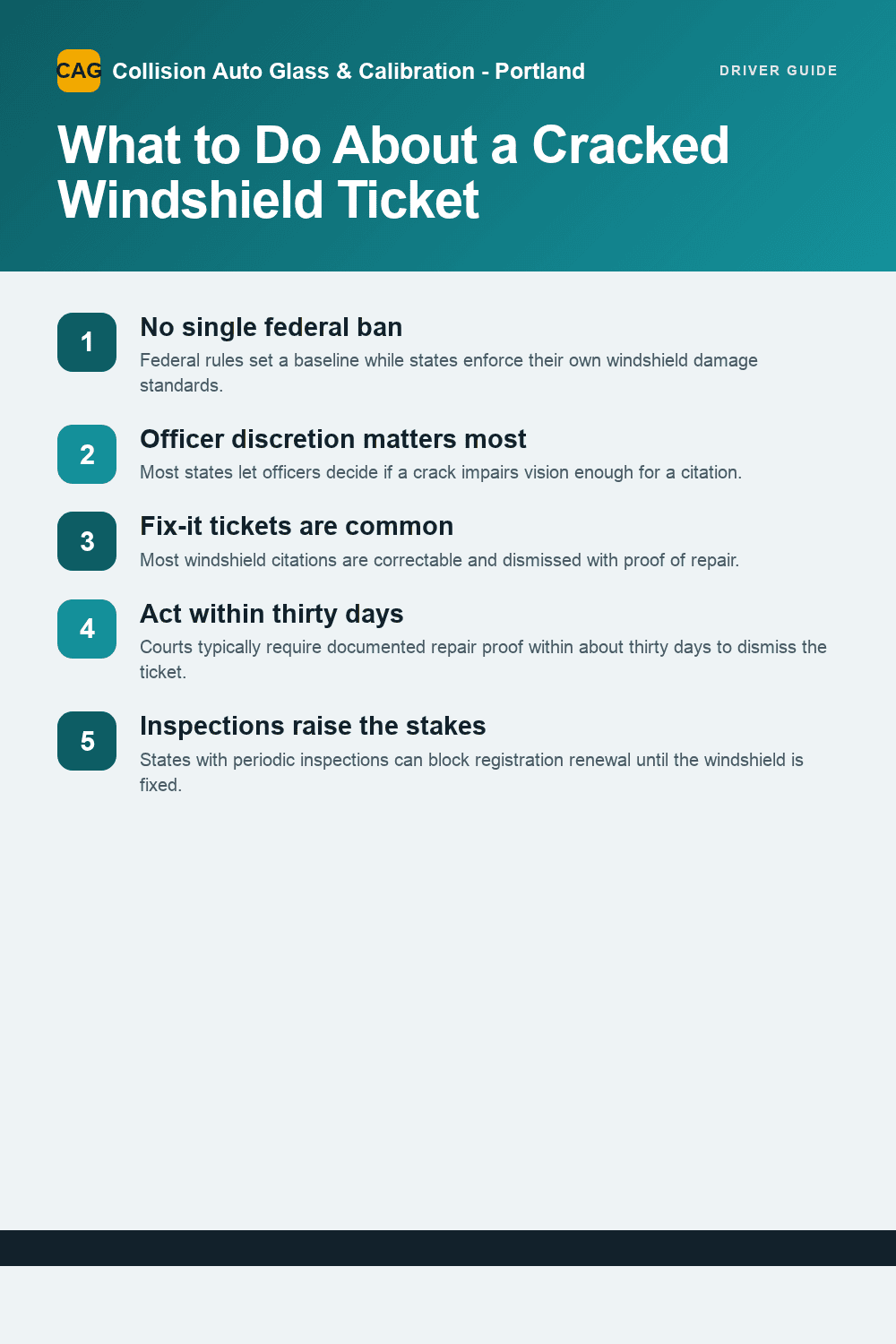
Yes, you can receive a cracked windshield ticket in the United States. A police officer can legally pull you over in any U.S. state if they can articulate that the damage appeared to obstruct or impair your vision. The formal term for this is a “windshield obstruction violation,” though most drivers know it simply as a ticket for broken windshield damage. Base fines typically run in a moderate range, but court fees commonly increase the total cost significantly. The good news: most of these citations are correctable “fix-it” tickets that courts will dismiss once you show documented proof of repair, usually within about 30 days. Repair promptly, keep your receipt, and submit proof to the court before the deadline.
Table of Contents
- Can you get a cracked windshield ticket? Federal baseline and state rules
- State-by-state examples: what drivers can expect in common jurisdictions
- How officers issue fix-it tickets vs. standard citations
- What the fines and out-of-pocket costs actually look like
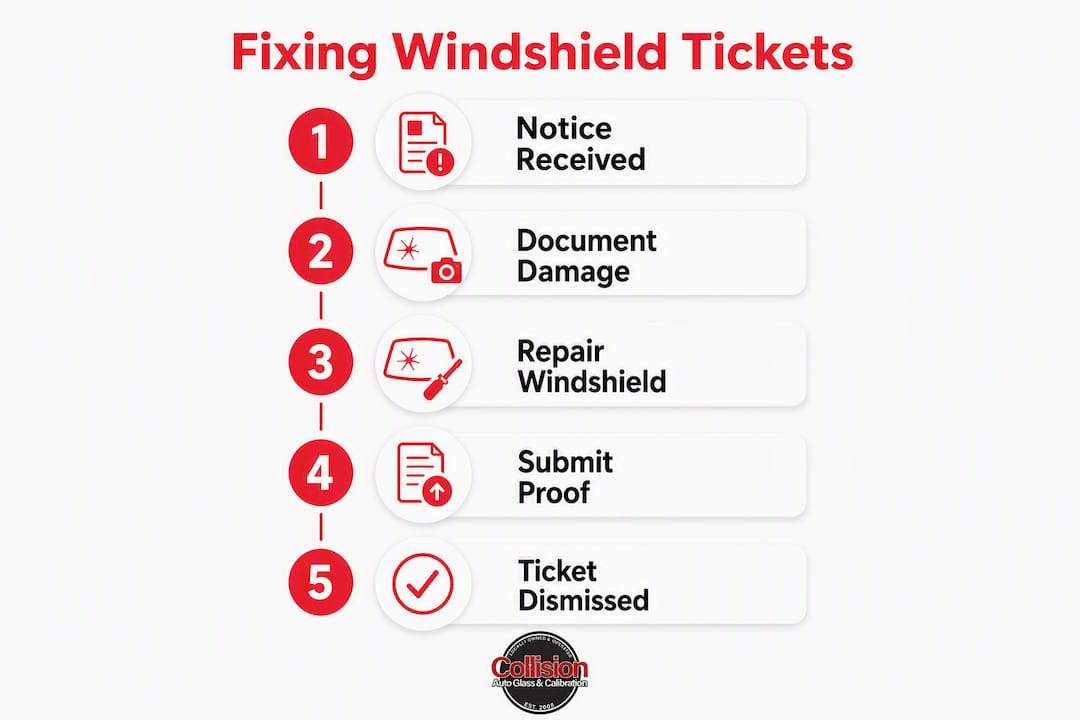
- What to do after you receive a windshield ticket: step by step
- How windshield damage affects safety and insurance coverage
- Practical steps to avoid a windshield ticket in the first place
- When a windshield ticket is worth consulting an attorney
- Key Takeaways
- The real cost of waiting: a perspective from Collision Auto Glass & Calibration
- Fast, documented windshield repair in Portland: Collision Auto Glass & Calibration
- Useful sources for state statutes and federal guidance
- FAQ
Can you get a cracked windshield ticket? Federal baseline and state rules
There is no single federal statute that bans cracked windshields outright. Federal authority sets a floor, not a ceiling. Under 49 CFR § 393.60, commercial motor vehicles must maintain windshields free of discoloration or damage in the critical viewing area extending upward from the top of the steering wheel, with a 1-inch border on each side excluded. FMVSS No. 205 governs the glazing material itself. For passenger vehicles, states carry the enforcement weight.
The model code concept most states draw from is the “material obstruction” standard, derived from the Uniform Vehicle Code. Under this standard, a crack is legally problematic when it materially impairs the driver’s ability to see the road clearly. States then implement this concept in one of two ways.
Some states translate it into numeric thresholds: a crack longer than a defined measurement within the wiper-swept area, or damage within a specific distance of the driver’s line of sight, triggers a violation. Other states leave the determination to officer discretion, meaning a crack that scatters light into your eyes on a sunny morning can produce a citation even if it would pass a numeric test in another state.
Pro Tip: Before driving across state lines, address any visible windshield damage. What passes officer scrutiny in your home state may not pass in the next jurisdiction, and out-of-state tickets carry the same fix-it deadlines.
State-by-state examples: what drivers can expect in common jurisdictions
Rules and consequences vary enough by state that knowing your jurisdiction matters. The table below shows how enforcement typically plays out in five commonly cited states. These figures are illustrative examples; always verify current statutes with your state DMV or highway patrol before relying on them.
| State | Enforcement Approach | Typical Base Fine | Fix-It Ticket Available | Inspection/Registration Consequence |
|---|---|---|---|---|
| California | Officer discretion + Vehicle Code § 26710 | $25–$197 base; typical total $100–$300 with court fees | Yes (common) | Smog/safety inspection failure possible |
| New York | Periodic safety inspection criteria + officer discretion | typical base fine range | Yes | Inspection failure blocks registration renewal |
| Texas | Officer discretion, broad obstruction standard | $100–$200 base; typical total $100–$300 with court fees | Yes | Inspection failure can block registration |
| Florida | Officer discretion, no periodic inspection | typical base fine range | Yes | No periodic inspection; citation only |
| Virginia | Periodic inspection criteria + officer discretion | typical base fine range | Yes | Inspection failure prevents registration renewal |
When an officer stops you in any of these states, the typical on-scene request is straightforward: license, registration, and proof of insurance. The officer will note the damage location and, in most cases, issue a correctable citation rather than a standard fine-only ticket. In California, for example, the officer may write the citation under Vehicle Code § 26710, which specifically addresses windshields that impair the driver’s view. In Texas, the broad obstruction standard gives officers wide latitude, so a crack anywhere in your direct sightline is fair game.
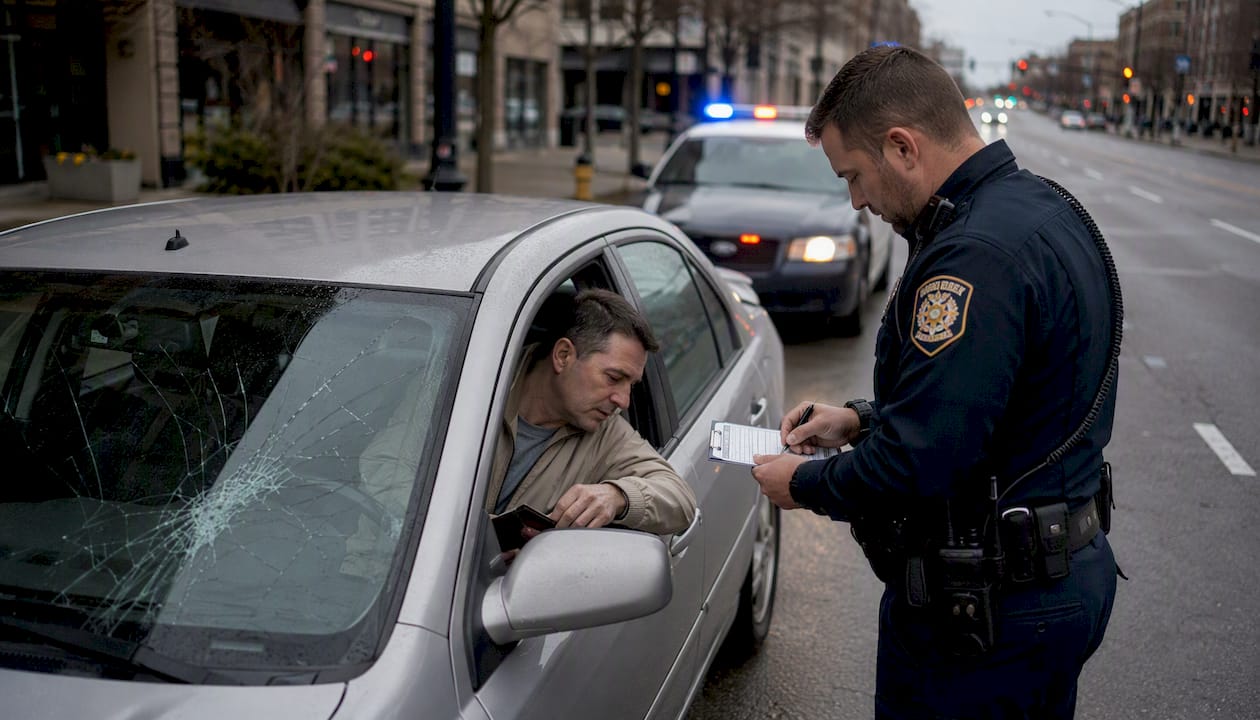
States with periodic safety inspections, such as New York and Virginia, add a second layer of risk. A damaged windshield can cause a vehicle to fail a state-mandated safety inspection, blocking registration renewal until the glass is repaired or replaced.
How officers issue fix-it tickets vs. standard citations
Understanding what happens at the roadside removes a lot of anxiety from the situation. The officer’s legal burden is modest: they need an articulable observation that the damage impairs your vision or falls within a critical zone defined by state code. A crack running through the wiper-swept area directly in front of the driver’s eyes is the most common trigger.
At the stop, officers generally have three options: issue a warning, write a correctable fix-it ticket, or issue a standard equipment citation. Fix-it tickets are by far the most common outcome for windshield damage. A standard citation, by contrast, carries a fine with no correction pathway and goes straight to court.
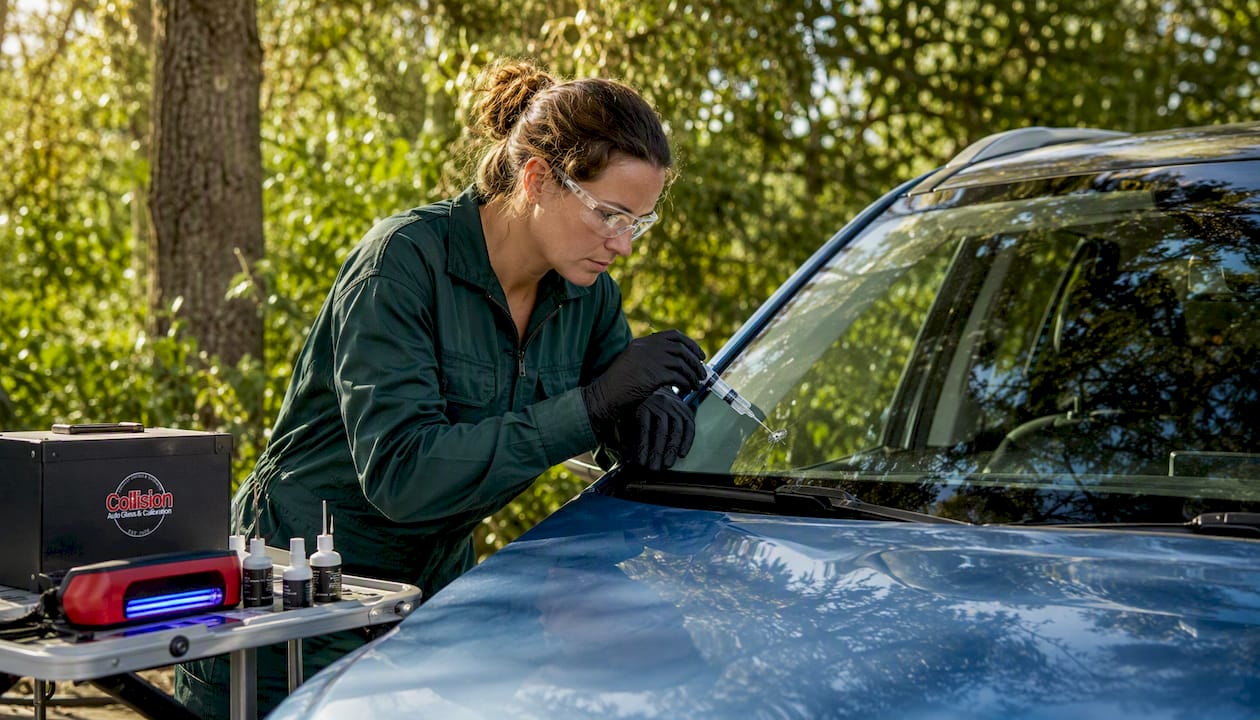
Officers also have broad discretion: a minor crack that doesn’t meet a numeric threshold can still produce a citation if it distracts or scatters light into the driver’s eyes. That means even a small crack in the wrong location carries real citation risk.
Here is how to handle the stop calmly and efficiently:
- Remain calm and provide license, registration, and insurance without delay.
- If you have comprehensive coverage that includes glass, mention it; some officers note this in their report.
- Ask the officer directly: “Is this a correctable violation, and what is the proof-of-repair deadline?”
- Note the citation number, the officer’s name, and the exact deadline written on the ticket.
- Do not argue about crack size at the scene; that conversation belongs in court with documentation.
A cracked windshield citation is typically a non-moving equipment violation, which means it generally does not add points to your driving record. That said, driving with unaddressed damage that contributes to a crash can create a negligence per se argument in civil litigation, a far more serious consequence than the ticket itself.
What the fines and out-of-pocket costs actually look like
The base fine for a windshield damage citation varies by state and local court schedule. That number alone understates the real cost.
Court fees commonly increase the base fine substantially. A base fine can multiply significantly once administrative, processing, and court fees are added. Total out-of-pocket for a single ticket often exceeds the initial base fine by a considerable margin.
Compare that to the cost of fixing the problem. Windshield repair for small chips is generally inexpensive; replacement typically costs more, varying by vehicle and circumstances. For a crack that qualifies for repair rather than full replacement, costs can be relatively low. You can explore current pricing in detail on the windshield repair and replacement cost page.
The hidden costs are where drivers get hurt financially:
- Administrative dismissal fees: Even when a fix-it ticket is dismissed, many courts charge processing fees for handling the dismissal.
- Inspection failure: In states with periodic inspections, a failed inspection can result in additional re-inspection fees.
- Late fees and registration holds: Ignoring a fix-it ticket risks escalating fees, registration holds, and in some jurisdictions conversion to a more serious offense if corrective deadlines are missed.
The math is clear: repairing a chip or crack almost always costs less than the combined fine, court fees, and administrative burden of leaving it unaddressed.
What to do after you receive a windshield ticket: step by step
Acting quickly and methodically after receiving a citation is the difference between a dismissed ticket and a compounding legal headache. Immediate professional repair and documented proof of correction is the most reliable path to dismissal or reduction.
- Note the citation details. Record the citation number, the issuing officer’s name and badge number, the court or agency listed, and the exact proof-of-correction deadline. Most fix-it programs allow roughly 30 days, but the ticket itself controls.
- Photograph the windshield. Take clear photos from multiple angles, inside and outside the vehicle, with a timestamp. This documents the pre-repair condition and the crack’s location relative to the driver’s sightline.
- Get a professional repair or replacement promptly. For cracks that qualify for repair rather than full replacement, see whether repair is an option for your specific damage. Do not delay; cracks spread with temperature changes and vibration.
- Collect an itemized receipt. The receipt must include your vehicle’s VIN, the date of service, a description of the work performed, and the shop’s contact information. This is the core document courts and verification stations accept as proof.
- Obtain a verification or correction form if required. Some jurisdictions require an authorized inspector’s stamp or a signed verification form in addition to the repair receipt. Ask the shop at the time of service.
- Submit proof to the court or agency before the deadline. Bring or mail the citation copy, your timestamped photos, and the itemized repair receipt. Fix-it ticket programs typically require documented correction within a defined window, commonly 30 days; missing that window converts the citation to the full fine and court process.
Document checklist for proof of correction:
- Original citation copy
- Pre-repair timestamped photos
- Itemized repair receipt with VIN and date
- Verification form or inspector stamp (if required by your jurisdiction)
Contesting a windshield ticket is realistic in specific circumstances: the officer misidentified the crack’s location relative to the statutory zone, the measurement method was inconsistent with state code, or the damage was in a non-critical area. Bring your photos, the repair receipt, and any measurements to the hearing. Request the officer’s notes through the court clerk in advance.
How windshield damage affects safety and insurance coverage
A windshield is not just glass. It contributes roughly 30% of a vehicle’s structural rigidity in a rollover and serves as the backstop for the front passenger airbag during deployment. A damaged windshield can compromise vehicle structural integrity and worsen injury risk during airbag deployment, which is why the legal standards exist in the first place. For a deeper look at the physical risks, the hazards of driving with a cracked windshield are worth understanding before deciding to delay repair.
Modern vehicles add another layer of complexity: ADAS (Advanced Driver Assistance Systems). Cameras and sensors mounted to or near the windshield, including lane departure warning, automatic emergency braking, and adaptive cruise control, require precise calibration after any windshield replacement. An uncalibrated system can produce false alerts, fail to detect obstacles at the correct distance, or disable safety features entirely. What happens if ADAS is not calibrated after replacement is a question every driver with a camera-equipped vehicle should answer before choosing a repair shop.
On the insurance side, the picture is generally favorable for drivers. Many comprehensive auto insurance policies cover windshield repair or replacement, and some insurers waive the deductible entirely for repair (not replacement). Insurance policies vary: some comprehensive policies waive the deductible for windshield repair; others treat both repair and replacement under standard comprehensive coverage. Check your policy’s glass endorsement and contact your insurer before filing a claim, since filing a small claim can sometimes affect your renewal rate depending on your insurer and state.
Practical steps to avoid a windshield ticket in the first place
Prevention is straightforward once you know what officers look for. The wiper-swept area directly in front of the driver is the highest-risk zone; any crack there is a citation waiting to happen.
- Repair chips immediately, before they spread. Temperature swings and road vibration turn a quarter-sized chip into a 12-inch crack faster than most drivers expect. Knowing the signs your windshield needs repair before it spreads helps you act before the damage reaches citation territory.
- Keep windshield washer fluid topped off. Dry wipers dragging across a chip accelerate crack propagation.
- Avoid parking in direct sun when possible. Thermal stress is one of the fastest ways to turn a repairable chip into a crack that requires full replacement.
- Do not use DIY resin kits on cracks longer than about 6 inches or on damage in the driver’s direct sightline. Professional repair uses calibrated injection equipment and optical-grade resin; consumer kits rarely achieve the same optical clarity or structural bond.
- If a chip is outside the wiper-swept area and you cannot repair it immediately, document it with a timestamped photo. That photo establishes the pre-existing condition if you are stopped.
Pro Tip: If you are planning a road trip across state lines, address any visible windshield damage before you leave. Differences in out-of-state enforcement mean a crack that hasn’t drawn attention locally may flag a citation in a stricter jurisdiction.
When a windshield ticket is worth consulting an attorney
Most windshield citations resolve cleanly through the fix-it process and do not require legal counsel. A few situations change that calculus.
Consider consulting a traffic attorney when: the officer’s citation describes damage in a location you believe is outside the statutory critical zone and you have photographic evidence to support that; the ticket has escalated beyond a correctable violation because a deadline was missed; or the damage was present during an accident and a civil negligence claim is now in play. In that last scenario, the windshield’s condition at the time of the crash becomes a liability question, not just a traffic matter, and an attorney’s involvement is genuinely warranted.
What an attorney can realistically do: subpoena the officer’s notes and measurement records, challenge whether the cited location meets the statutory definition of the critical zone, or negotiate a reduction to a non-equipment charge that carries no inspection consequence. For a $75 base fine, that cost-benefit rarely works in your favor. For a case involving a registration hold, a repeat citation, or civil exposure after an accident, legal help pays for itself.
Key Takeaways
A cracked windshield ticket is almost always a correctable violation: repair the damage, document it properly, and submit proof before the deadline to avoid the full fine.
| Point | Details |
|---|---|
| You can be ticketed in any U.S. state | Officers can stop you if damage appears to obstruct or impair your vision, regardless of crack size. |
| Base fines typically fall in the $50–$250 range and court/administrative fees commonly push the total to $100–$300; repair usually costs less. | |
| Fix-it tickets require proof within a specified correction deadline | Missing the deadline converts the citation to the full fine and may trigger a registration hold. |
| Document before and after repair | Timestamped photos plus an itemized receipt with VIN are the two documents courts most commonly accept. |
| Collision Auto Glass & Calibration | Provides same-day documented repair with itemized receipts and ADAS calibration for Portland-area drivers. |
The real cost of waiting: a perspective from Collision Auto Glass & Calibration
The drivers who end up in the most difficult situations are rarely the ones who got the ticket. They are the ones who got the ticket and waited. As a family-owned shop that has been serving Portland drivers since 2008, we have seen this pattern more times than we can count: a small chip ignored for a few weeks becomes a crack that crosses the driver’s sightline, triggers a citation, and then fails a safety inspection, all before the driver has scheduled a single appointment.
What most guides do not tell you is that the fix-it ticket process is genuinely forgiving, but only if you move quickly. Courts and verification stations are set up to accept a straightforward repair receipt. The documentation is not complicated. What complicates it is delay: cracks spread, deadlines pass, and a $75 correctable violation becomes a $250 fine with a registration hold attached.
The other thing worth saying plainly: a windshield is a structural component. The legal standard exists because a compromised windshield changes how a vehicle behaves in a crash. ADAS calibration after replacement is not an upsell; it is the step that makes the safety systems in your vehicle work as designed. Skipping it to save money on a replacement is a trade-off that shows up later, usually at the worst possible moment.
Fast, documented windshield repair in Portland: Collision Auto Glass & Calibration
When a fix-it ticket is on the table, speed and documentation are the two things that matter most. Collision Auto Glass & Calibration offers same-day windshield repair and replacement for cars, trucks, RVs, and commercial vehicles throughout the Portland area, with free mobile installation so you do not have to take time off work to get to a shop.
Every completed job comes with an itemized repair invoice that includes your VIN, the date of service, and a full description of the work performed, exactly the documentation most courts and verification stations require for a fix-it dismissal. When your vehicle has ADAS cameras mounted to the windshield, in-house calibration is completed before the vehicle leaves the shop. Direct insurance billing is available, and many comprehensive policies cover glass repair or replacement with no out-of-pocket cost to you.
To schedule same-day service or get a quote, visit the windshield replacement service page or call the shop directly. The sooner the repair is documented, the cleaner the path to dismissal.
Useful sources for state statutes and federal guidance
Verifying the exact rules in your state is always worth the few minutes it takes. The sources below are the primary references for federal standards, model codes, and state-specific enforcement.
- 49 CFR § 393.60, Legal Information Institute (Cornell Law): The federal regulation governing windshield glazing standards for commercial motor vehicles; the baseline for understanding what federal law actually requires.
- eCFR § 393.60, Electronic Code of Federal Regulations: The official, continuously updated federal text; use this to confirm current commercial vehicle glazing requirements.
- FMCSA Windshield Guidance: Federal Motor Carrier Safety Administration interpretations of § 393.60, including specific crack-depth questions relevant to commercial operators.
- California Vehicle Code § 26710: California’s specific windshield obstruction statute; the primary reference for California drivers contesting or complying with a citation.
- New York DMV Safety Inspection Program: New York’s periodic inspection requirements, including windshield criteria that affect registration renewal.
- LegalClarity: Material Obstruction Standard: A clear explanation of the model code standard most states use and how fix-it ticket programs work in practice.
- Progressive: Cracked Windshield Laws: Practical insurance and legal guidance on what comprehensive coverage typically covers and how proof-of-repair works.
- Collision Auto Glass & Calibration: Auto Glass Repair: Portland-area same-day repair and replacement with documented invoices for fix-it ticket compliance and ADAS calibration.
This article provides general legal information, not legal advice. Windshield laws vary by state and are subject to change; confirm current rules with your state DMV, highway patrol, or a qualified traffic attorney before making decisions based on your specific citation.
FAQ
Is it illegal to drive with a cracked windshield?
Driving with a cracked windshield is not automatically illegal in every U.S. state, but it becomes a violation when the damage materially obstructs the driver’s view or falls within a critical zone defined by state law. An officer can lawfully stop and cite you in any state if the damage appears to impair your vision.
Can you get a ticket in Texas for a cracked windshield?
Yes. Texas uses a broad obstruction standard, and officers have wide discretion to issue a windshield damage citation if a crack falls within the driver’s sightline. Base fines typically run $100–$200 but court and administrative fees often push the total to $100–$300. A fix-it ticket is commonly available if you repair and document the damage promptly.
What is the penalty for a cracked windshield?
Most windshield citations carry a base fine of $50–$250; court and administrative fees commonly push the total to $100–$300. In states with periodic safety inspections, a failed inspection can also block registration renewal until the glass is repaired.
How much is a ticket for a cracked windshield in California?
California base fines under Vehicle Code § 26710 typically start around $25 and the total with court fees commonly ranges from $100 to $300. The citation is usually correctable: repair the windshield, obtain an itemized receipt with your VIN, and submit proof to the court before the stated deadline to seek dismissal.
How do I get a fix-it ticket dismissed?
Repair the windshield professionally, collect an itemized receipt that includes your VIN and the date of service, and submit that documentation to the court or verification station before the deadline on your citation, which is commonly around 30 days. Some jurisdictions also require an authorized inspector’s stamp or a signed correction form alongside the receipt.
Recommended
- How to Avoid Windshield Damage – Collision Auto Glass
- The Hazards of Driving With a Cracked Windshield – Collision Auto Glass & Calibration
- How Long Can I Leave A Cracked Windshield? – Collision Auto Glass & Calibration
- 7 Signs Your Windshield Needs Repair Before It Spreads – Collision Auto Glass & Calibration
🎧 Listen to This Article
Share
Recent Posts
October 16, 2026
Fleet Auto Glass Programs: Keep ADAS Records Ready for DOT Checks
A fleet auto glass program combines mobile repairs, ADAS calibration, and records that support 49 CFR 393.60 compliance and limit fleet downtime....
October 15, 2026
Auto Glass Claims: Choose a U.S. Shop Before ADAS Billing Surprises
See how U.S. drivers can choose an auto glass shop for an insurance claim, confirm ADAS calibration, protect their rights, and prevent billing...
October 14, 2026
Fleet Windshield Maintenance: A 20 Minute Repair Can Prevent Days Down
Catch chips early, log the VIN and photos, and require part number and ADAS calibration records to keep fleet vehicles moving and avoid...