Auto Glass Repair
A calibration certificate for insurance is a dated, auditable ADAS calibration report tied to the vehicle’s VIN and the manufacturer’s repair procedure. It documents the pre-scan, the calibration itself, and the post-scan confirming the cameras, radar, or other sensors work to factory specification. A properly built certificate is what stands between a paid claim and a denial, because it gives an adjuster verifiable proof that safety systems were restored, not just reinstalled.
TL;DR:
- Calibration certificates must document pre-scan, calibration, and post-scan results, including specific vehicle, technician, and equipment details, to verify proper ADAS restoration.
- Repair scenarios triggering calibration include windshield replacements on vehicles with cameras, sensor removals or reinstallation, and repairs affecting vehicle geometry, all guided by OEM procedures.
- Static calibration involves stationary target alignment, while dynamic calibration requires road testing; some repairs need both, with certificates listing results in the correct order.
- Only certified technicians with manufacturer-specific training or proven ongoing experience can sign certificates, and outsourced calibrations must reference the contracted party’s details and tools.
- Submit calibration reports as separate PDFs with OEM citation on the invoice, and build a one-page reconsideration packet for denied claims by citing OEM procedures and attaching raw scan data.
Table of Contents
- Why Insurers Request Calibration Certificates and When You Need One
- What Fields Must Appear on a Valid Calibration Certificate
- Static vs. Dynamic Calibration: What Each One Documents
- Who Can Sign Off, and What Proof of Competence Looks Like
- How to Attach a Calibration Certificate to a Claim (and Fight a Denial)
- What an Insurer-Ready Certificate Looks Like in Practice
- Get an Insurer-Ready Calibration Certificate From Collision Auto Glass & Calibration
- Sources
- FAQ
Why Insurers Request Calibration Certificates and When You Need One
Insurers ask for calibration documentation because they’re managing risk, not paperwork. A vehicle with a misaligned forward-facing camera or a radar sensor that wasn’t reset after a bumper repair is a liability the insurer inherits the moment they approve the claim. A calibration report that shows a pre-repair scan, confirmation that calibration was actually needed, evidence it was completed, and a post-repair scan closes that gap, and shops that hand over these reports consistently see fewer disputes.
Calibration isn’t triggered by guesswork. It follows the vehicle’s own OEM service data, and certain repair scenarios almost always call for it:
- Windshield replacement on any vehicle with a forward-facing camera mounted to the glass
- Removal or reinstallation of ADAS sensors, including radar units, ultrasonic sensors, and side-view cameras
- Replacement of parts that sit near or support a sensor, such as bumpers, mirrors, or brackets
- Any repair that changes vehicle geometry, including suspension work or frame straightening
The only way to know for certain is to pull the VIN-specific OEM procedure at intake and document which section applies. That citation becomes the backbone of the certificate and, later, the claim.
What Fields Must Appear on a Valid Calibration Certificate
An insurer reviewing a claim isn’t looking for a friendly summary. They’re looking for specific, checkable data points that prove the work happened, on that vehicle, on that day. According to IIR guidance, a defensible record includes the repairer’s name and address, the VIN, date, and mileage, along with proof of technician competency, equipment used, and the calibration result itself.
A complete certificate should include, at minimum:
- Repairer name, shop address, and contact information
- Vehicle VIN, make, model, year, and mileage at time of service
- Date and time the pre-scan, calibration, and post-scan were performed
- Pre-scan findings, including any stored fault codes
- Type of calibration performed (static, dynamic, or both) and the systems addressed
- Post-scan results confirming no remaining faults
- Technician name and signed completion statement
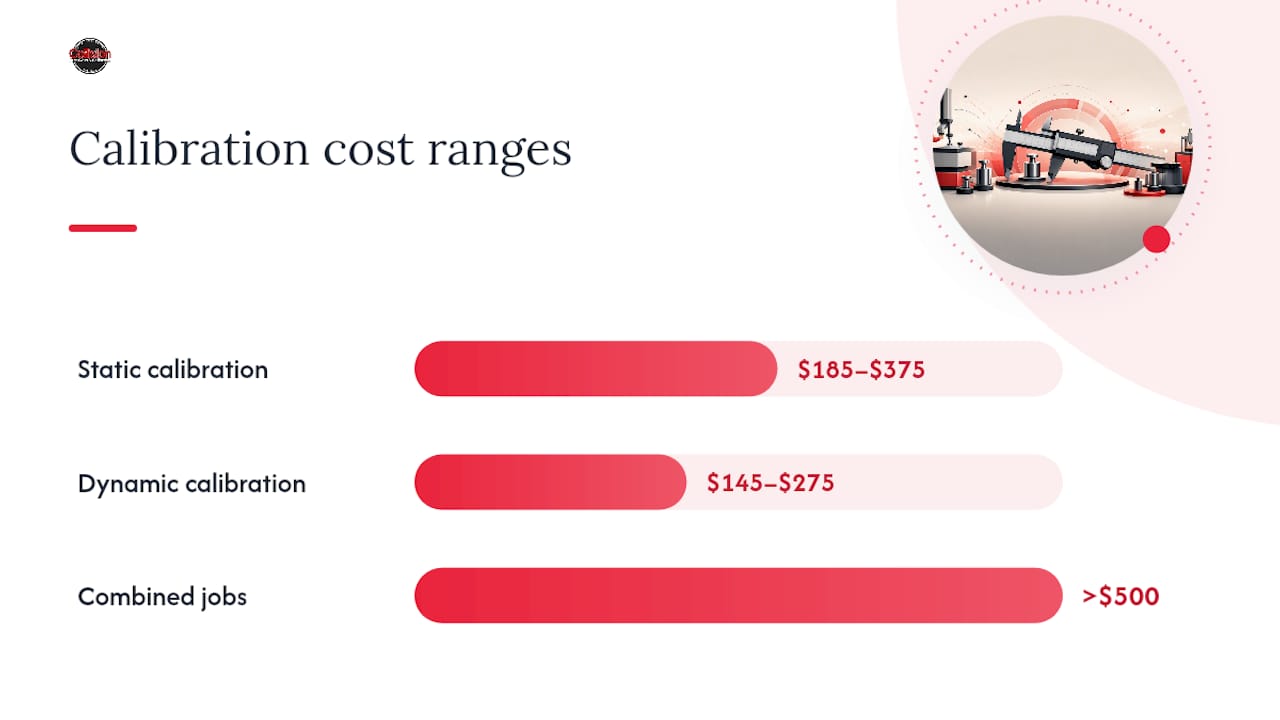
Static calibration alone typically runs $185 to $375, and dynamic calibration falls between $145 and $275, according to 2026 carrier pay data, with combined jobs often exceeding $500. The certificate should be delivered as a PDF with the scan reports embedded, not summarized, so an adjuster can see the raw data rather than a technician’s paraphrase.
Static vs. Dynamic Calibration: What Each One Documents
Static calibration happens in the bay, with the vehicle stationary and target boards positioned at OEM-specified distances and heights. The documentation for a static job should capture:
- Target board placement measurements and alignment readings
- Floor level verification and lighting conditions
- Static test pass/fail results for each system calibrated
Dynamic calibration requires driving the vehicle at a specified speed range, usually on roads with clear lane markings, while the system self-learns. That evidence looks different:
- A road-test log showing speed, duration, and route conditions
- Lane-marking quality notes, since poor markings can invalidate the drive
- Post-drive scan confirming the system completed its learning cycle
Many repairs, especially windshield replacements on vehicles with multiple camera-dependent features, require both. When that happens, the certificate should present the static results first, followed by the dynamic road-test log, so the sequence matches how the work was actually performed.
Who Can Sign Off, and What Proof of Competence Looks Like
Not just anyone with a scan tool can sign a calibration certificate that will hold up to insurer scrutiny. Industry guidance is direct on this point: inspections, realignment, and calibration must be carried out by a currently competent person, and the equipment used has to produce results that can be checked against the manufacturer’s own technical specification.
Acceptable proof of competence generally includes:
- Manufacturer-specific ADAS training completion records
- Competency-based assessment documentation, not just a certificate of attendance
- A record of ongoing calibration experience, especially for less common OEM systems
When a shop outsources calibration to a specialist, the certificate needs to name the contracted party directly: business name, address, and their own competency proof, attached or referenced. The certificate should also list equipment fields, including the tool manufacturer, model, serial number, and software version used, since that’s what lets an adjuster or a future claims reviewer verify the results independently.
Pro Tip: Keep a standing file of your calibration tool’s calibration date and software version. If an insurer questions a certificate six months later, you’ll want that equipment record on hand, not buried in an old service log.
How to Attach a Calibration Certificate to a Claim (and Fight a Denial)
Calibration should never ride along inside a general repair line. Bill it separately, cite the OEM procedure number, and list every system addressed. This single change, treating calibration as its own line item, tends to reduce pushback because it gives the adjuster something specific to approve rather than a vague repair charge to question.
When submitting a claim or supplement:
- Attach the pre-scan report, the calibration certificate, and the post-scan report as separate PDFs
- Cite the OEM procedure document number directly on the invoice line
- Include timestamped photos of the calibration setup where relevant
- Note the technician’s name and competency reference on the same page as the invoice
If the claim comes back denied, don’t resubmit blindly. Build a one-page response following the structure that wins reconsideration: the disputed line item, the OEM citation supporting it, a brief position statement, the completion documentation, and a direct request for reconsideration. Keep it to one page. Adjusters process volume, and a tight, well-cited packet gets read faster than a thick file.
What an Insurer-Ready Certificate Looks Like in Practice
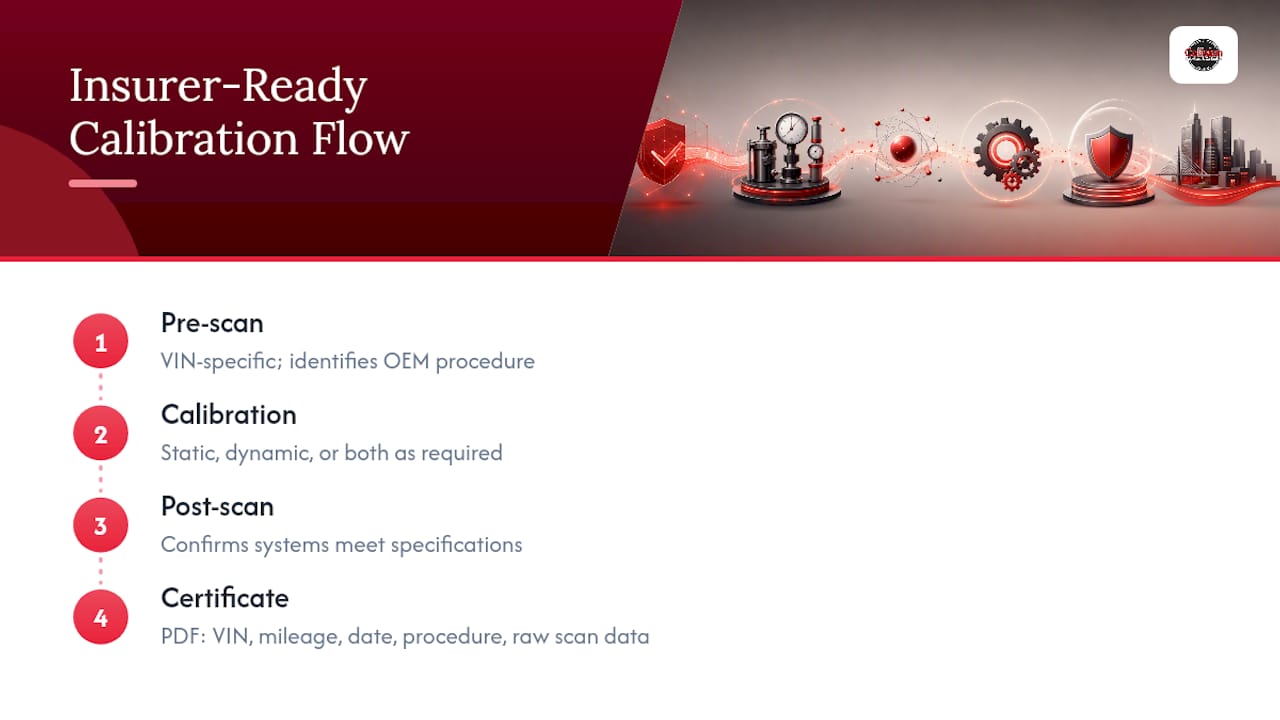
At Collision Auto Glass & Calibration, every calibration starts with a VIN-specific pre-scan before any glass or sensor work begins. That scan determines exactly which OEM procedure applies, whether the job needs static calibration, dynamic calibration, or both. Once the work is done in-house, a post-scan confirms the systems are functioning to specification.
The result is a PDF certificate built around what an adjuster actually needs to see: VIN, mileage, date, the procedure citation, and the scan data itself, not a summary of it. That structure tends to move faster through insurer review, and it gives repair shops and fleet managers a document they can attach directly to a claim or supplement without reformatting it first.
— Collision Auto Glass & Calibration
Get an Insurer-Ready Calibration Certificate From Collision Auto Glass & Calibration
If you’ve read this far, you already know the paperwork is half the battle. Collision Auto Glass & Calibration handles the other half by pairing same-day mobile windshield replacement with in-house ADAS calibration, so the certificate comes from the same shop that did the glass work, not a third party you have to chase down for records.
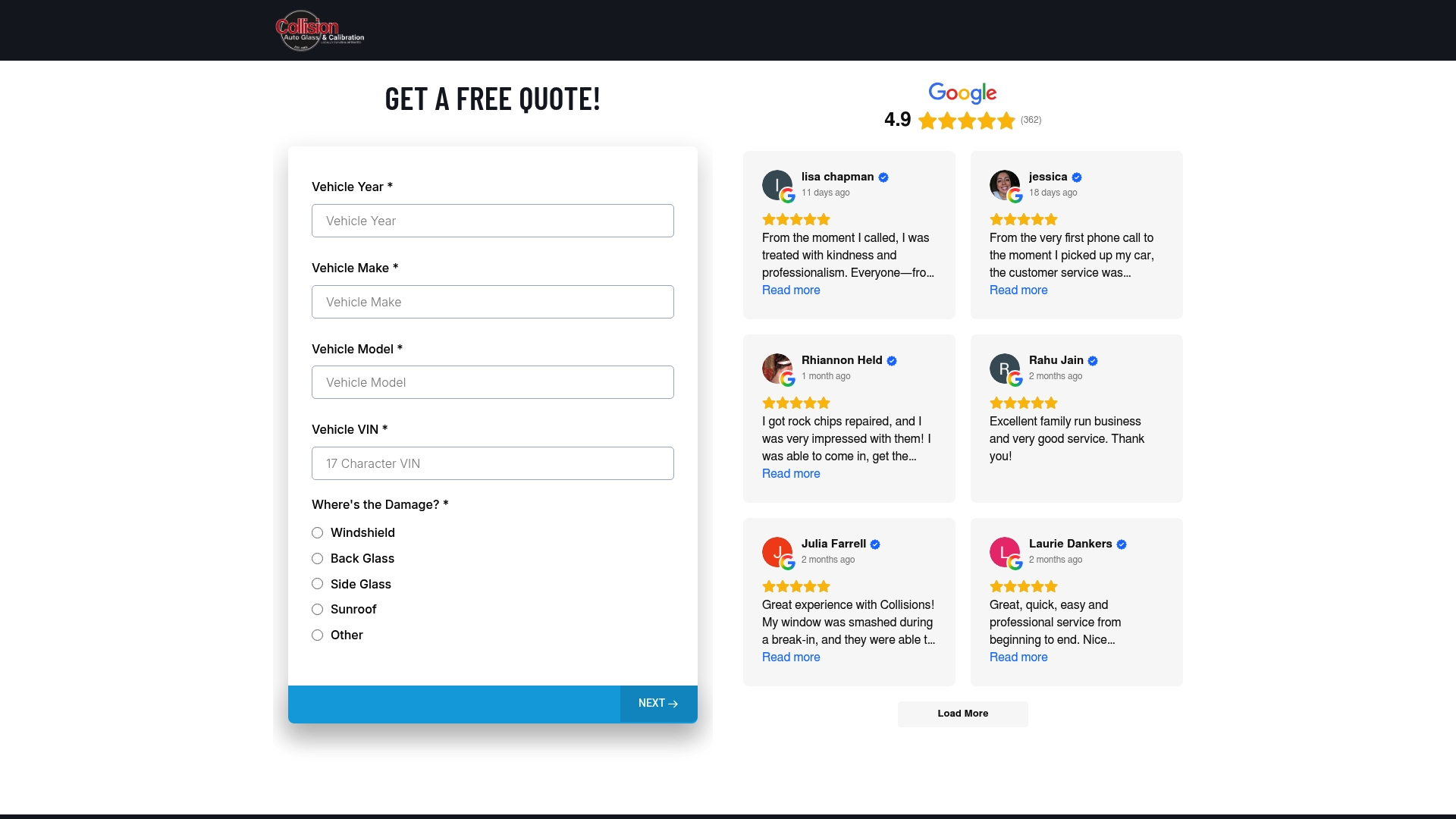
Every calibration performed on-site produces a PDF certificate with embedded pre-scan and post-scan reports, technician competency records, and the specific OEM procedure citation your claim needs. Collision Auto Glass & Calibration also bills insurers directly, so you’re not stuck submitting the paperwork yourself, and every installation carries a lifetime no-leak guarantee. If your vehicle needs a windshield replaced or an ADAS system checked after a repair, request a quote and get a certificate built to satisfy your insurer the first time you submit it.
Sources
For supplements and appeals, keep these close: the ADAS IIR Guidance for competency and record-keeping standards, and the denial appeal framework for structuring a reconsideration request. Both are short enough to reference directly in a claim packet.
- ADAS IIR Guidance (July 2020) — HELLA
- Why Insurers Ask for ADAS Calibration Reports — Ape Auto Tools
- What to do when an insurer denies a calibration claim — Revv HQ
- What ADAS Calibration Pays in 2026: Carrier-by-Carrier Breakdown — Claimory Blog
FAQ
Do You Need a Calibration Certificate for Insurance?
Yes, if the repair triggered an ADAS calibration under OEM procedure. Most insurers now expect pre-scan and post-scan documentation before approving or reimbursing the calibration line item.
How Long Is a Calibration Certificate Valid?
A calibration certificate reflects the vehicle’s condition on the date it was issued. It has no fixed expiration, but insurers may request a new one if additional repairs affect the same sensors later.
How Do Insurers Verify a Calibration Certificate Is Real?
Adjusters cross-check the VIN, date, mileage, and technician competency details against the shop’s records and the OEM procedure cited on the invoice. Discrepancies between the scan data and the claimed work are the most common red flag.
What Happens If a Repair Skips Calibration?
The claim can be denied outright, or the insurer may require the vehicle to return for calibration before closing the file. Beyond the paperwork issue, an uncalibrated ADAS sensor can genuinely fail to detect hazards correctly.
Can a Third Party Perform the Calibration Instead of the Repair Shop?
Yes, but the certificate must name the contracted party directly, including their address and proof of competency. The original repair shop remains responsible for attaching that documentation to the claim.
Recommended
- Prove Your Windshield Calibration Is Correct With a Technician Checklist
- Calibration After Windshield Replacement: What You Must Know
- Need a New Windshield? Don’t Forget Calibration
🎧 Listen to This Article
Share
Recent Posts
September 14, 2026
Stop Claim Denials: Insurer Ready Calibration Certificate
Make ADAS calibration claims stick. Use a VIN tied pre scan and post scan certificate with OEM citation, separate billing line, and a...
September 13, 2026
Net VLT Math for Car Owners: Privacy Glass vs Tint and Legal Limits
Car owners: use net VLT math to compare factory privacy glass and aftermarket tint. Learn UV, heat, safety differences, legal limits, and an...
September 12, 2026
Acoustic Windshield: SAE Evidence and 3 Installer Questions
Learn how acoustic windshields cut up to 6 dB of high frequency road noise, SAE results, and 3 installer questions that protect your...