
Auto Glass Repair
Under industry standards, some cracks up to 14 inches can qualify for repair, but length alone never makes that call. What matters just as much is whether the damage penetrates both layers of glass, touches the windshield’s edge, sits in the driver’s direct view, or shows the branching pattern of a stress crack. Any of those conditions can push a shop toward replacement even on a shorter crack.
TL;DR:
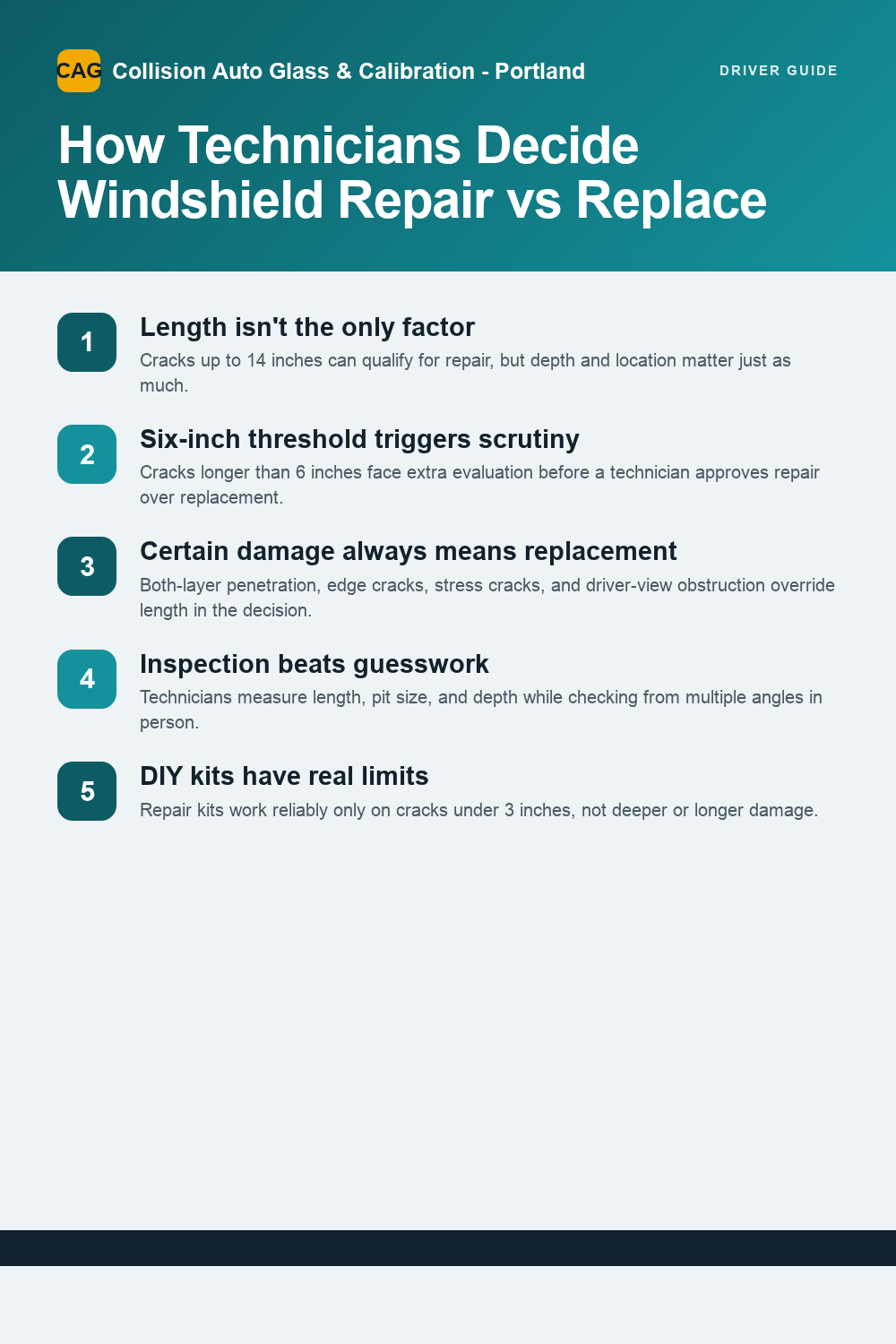
- Cracks longer than 6 inches require extra scrutiny, especially if they penetrate both glass layers, reach the edges, or obstruct the driver’s view.
- Damage that spans both layers, reaches the windshield’s edge, or involves multiple cracks longer than 6 inches should be replaced instead of repaired.
- DIY repair kits are suitable only for cracks under 3 inches and are unreliable for longer or deeper damage that compromises structural integrity.
- Proper evaluation involves measuring crack length, pit size, and penetration depth, as well as inspecting damage from multiple angles in person.
- Insurance often covers repairs for chips and short cracks, but longer cracks or those in critical areas typically lead to a full windshield replacement.
Table of Contents
- What Windshield Crack Length Repair Standards Actually Allow
- When Does a Windshield Need Replacement Instead of Repair?
- How Do Technicians Decide Whether to Repair a Crack?
- Do Windshield Repair Kits Work on Long Cracks?
- How Much Does Crack Repair Cost and Take?
- Our Take on Repair vs. Replacement Decisions
- Ready to Get Your Windshield Assessed?
- Sources
- FAQ
What Windshield Crack Length Repair Standards Actually Allow
Auto glass technicians don’t eyeball a crack and guess. They work from the ANSI/AGSC/NWRD/ROLAGS 002-2022 standard, the closest thing the industry has to a rulebook for what can and can’t be fixed. It sorts damage into distinct categories, each with its own repairable size.
- Bullseye: a circular dark ring of damage, repairable up to 1 inch across.
- Combination break: mixed crack and chip patterns, repairable up to 2 inches in the damaged body.
- Star break: several short legs radiating from a central point, repairable up to 3 inches.
- Single-line crack: the long, thin fracture most drivers picture, repairable up to 14 inches.
The standard also draws a line at 6 inches: anything longer is classified as a “long crack” and gets extra scrutiny before a technician commits to repair rather than replacement. Length is only one measurement that matters. ROLAGS also caps the finished pit size, the small dimple left after resin injection, because a pit that’s too wide or too deep weakens the glass further and distorts the driver’s view. Depth counts too. A crack that only scores the outer layer behaves very differently from one that has worked partway into the glass. The deeper it runs, the harder it becomes for resin to fully bond and restore structural strength, which is exactly why a tape measure alone never settles a repair vs. replace argument.
When Does a Windshield Need Replacement Instead of Repair?
Certain damage patterns override length every time, according to the National Windshield Repair Division’s guidance. Recognizing these before you call a shop saves time and sets realistic expectations.
- Both-layer penetration. If the crack has broken through the inner layer as well as the outer glass, structural integrity is already compromised and resin can’t restore it.
- Stress cracks. These form under pressure rather than impact and tend to keep spreading even after a repair attempt, making them unreliable candidates.
- Edge cracks. Damage that reaches or crosses the windshield’s perimeter weakens the bond between glass and frame, an area that carries real structural load in a collision.
- Multiple long cracks from one impact. Three or more cracks longer than 6 inches from a single event usually signal glass that’s too compromised to repair safely.
- Driver-view obstruction. Cracks sitting directly in the driver’s primary sightline get rejected for repair even when they’re technically small, because a hazy or distorted resin fill in that zone is a genuine visibility risk.
Pro Tip: Photograph the crack next to a coin or ruler before calling a shop. It helps a technician give you a realistic phone estimate of repair versus replacement before you even schedule a visit.
None of these checklists replace an actual inspection for edge damage and depth. A technician who can angle a light source and measure penetration in person will always make a more reliable call than a driver estimating from the driveway.

How Do Technicians Decide Whether to Repair a Crack?
A proper evaluation follows a sequence, not a snap judgment. Here’s roughly how it plays out during an in-person inspection:
- View from both sides. Technicians check the crack from inside and outside the vehicle, since damage that looks minor from one angle can reveal a deeper split from the other.
- Measure length and finished pit size. Precise measurements determine which ROLAGS category applies and whether the projected repair result stays within acceptable limits.
- Test for depth and inner-layer penetration. This step distinguishes a surface-level crack from one that has compromised the laminate structure underneath.
- Check lighting and clarity. Technicians angle a light at roughly 45 degrees to spot contamination, moisture, or dirt already inside the crack, all of which weaken resin bonding.
- Assess edge proximity and ADAS camera location. A crack near a forward-facing camera bracket or windshield edge changes the calculus even if the numbers look fine on paper.
- Follow the repair sequence when approved. ROLAGS-based repair means fully filling the crack with the correct resin, placing a finishing bead, curing it properly, finishing the surface flush with the glass, and inspecting the result at that same 45-degree angle.
This is also where practical shop-level knowledge closes the gap regulation leaves open. The NHTSA has stated that FMVSS 205 governs replacement glazing performance but doesn’t prescribe how repairs must be done or set a length cutoff, which is why the ROLAGS framework and technician judgment carry so much weight in the field.
Do Windshield Repair Kits Work on Long Cracks?
DIY kits earn their keep on small chips and short cracks, generally anything under about 3 inches. Beyond that, the physics start working against you.
- Resin volume and viscosity matter. Long cracks need specialized, lower-viscosity resins designed to travel the full length of the fracture, something most retail kits aren’t formulated for.
- Repeated injections are often required. Professional-grade crack resins are tested on specimens up to 12 inches under thermal cycling and weathering conditions, a level of validation a $20 kit never goes through.
- Curing equipment affects the result. UV lamps and controlled cure times used by shops produce a harder, clearer fill than sunlight alone.
- Incomplete fills are the most common DIY failure. Air pockets or partial resin coverage on a long crack often lead to continued spreading within days.
- Insurance and warranty coverage rarely extend to DIY attempts. A failed home repair can also complicate a later insurance claim if the crack has grown or contaminated the glass.
If your crack has crossed that 3 inch threshold, a long crack windshield repair from a professional shop is the safer bet, both for the fill quality and for any insurance paperwork that follows.
How Much Does Crack Repair Cost and Take?
Time and money both scale with how far the damage has progressed. A basic DIY kit takes anywhere from a few minutes to about an hour, mostly waiting on cure time. A professional resin repair usually runs 20 to 60 minutes in a shop or via mobile service. Full replacement takes a few hours once you factor in adhesive cure time, and longer still if ADAS recalibration is part of the job.
- DIY kits: the lowest upfront cost, but the least reliable outcome on anything beyond a small chip or short crack.
- Professional repair: moderate cost, and often the better value since a proper fill can prevent a much larger bill down the line.
- Full replacement: the highest cost of the three, with variation depending on vehicle model, glass features, and whether ADAS calibration is required.
Insurance often tilts the decision. Many carriers waive the deductible entirely for chip and short-crack repairs because it’s cheaper for them than paying out a full replacement claim later. Ask your insurer about coverage and confirm whether your shop offers direct billing before you authorize anything, since that single call can change your out-of-pocket cost significantly. Careful windshield polishing after minor surface damage can also help preserve clarity between repairs, provided you stay under safe heat limits for the glass.
Our Take on Repair vs. Replacement Decisions

Collision Auto Glass & Calibration evaluates every crack against the same priorities every time: does it penetrate both layers, does it sit in the driver’s line of sight, and will the vehicle need ADAS calibration if replacement is the answer. Length matters, but it’s the starting question, not the final one.
Some customers get same-day, free mobile installation, a lifetime no-leak guarantee, and in-house ADAS calibration handled by a family-owned local team. That combination means a borderline crack gets an honest answer instead of an upsell, and a straightforward quote once the inspection confirms which way it should go.
— Collision Auto Glass & Calibration
Ready to Get Your Windshield Assessed?
If you’re staring at a crack and can’t tell whether it’s a quick fix or a full replacement, that’s exactly the judgment call a proper inspection settles in minutes, not a ruler.
Certain auto glass service providers offer same-day service with free mobile installation in some areas, so you don’t have to drive around on a compromised windshield to get an answer. The lineup covers what most drivers in this situation need:
- Windshield repair for cracks and chips within safe standards-based limits, priced at $90.
- Windshield replacement for damage that’s crossed into replacement territory, running $200 to $500 depending on the vehicle.
- ADAS calibration built in-house, so a replaced windshield doesn’t leave your camera systems misaligned.
- A lifetime no-leak guarantee on every installation, backed by direct insurance billing to keep the paperwork off your plate.
To get a fast, accurate quote, have your vehicle’s year, make, and model ready, along with a photo or two of the damage and your availability for mobile service. Head to the quote request page and a technician will tell you plainly whether you’re looking at a repair or a replacement, no guesswork required.
Sources
- The Right Repairs at the Right Time | National Windshield Repair Division
- NHTSA interpretation (FMVSS 205 position)
FAQ
Can a 7-Inch Windshield Crack Be Repaired?
A crack falls into the “long crack” category under ROLAGS if it is longer than 6 inches, but any crack up to 14 inches can be considered repairable. Whether it actually gets repaired depends on depth, edge proximity, and whether it sits in the driver’s view, so a technician inspection is the real deciding factor.
Can a 3-Inch Windshield Crack Be Fixed?
Yes, a 3-inch crack is well within typical repairable limits and is often a good candidate for a professional resin fill rather than replacement. It’s also close to the upper edge of what most DIY kits can handle reliably, so a shop repair tends to produce a cleaner, more durable result.
Can You Fix a 2-Inch Crack in a Windshield?
A 2-inch crack is generally very repairable under standard guidelines, assuming it hasn’t penetrated both layers of glass or reached the windshield’s edge. This size sits comfortably within both professional and many consumer repair kit capabilities, though a professional fill still tends to hold up better over time.
Do Windshield Repair Kits Work on Long Cracks?
DIY kits are built for small chips and short cracks, typically under about 3 inches, and they struggle on longer damage because of resin viscosity and injection limitations. For anything approaching or past 6 inches, a professional using tested crack resins and proper curing equipment gets a far more reliable result.
What Determines Whether a Long Crack Gets Repaired or Replaced?
The main factors are depth of penetration, whether the crack touches the windshield’s edge, and whether it sits in the driver’s direct line of sight. Collision Auto Glass & Calibration inspects each of these in person before recommending repair or replacement, since length alone rarely tells the full story.
Recommended
- Three or More Windshield Chips: When Repair Meets ROLAGS Criteria
- 1–2 Inches From the Edge? How Drivers Can Self Screen a Rock Chip
- 7 Signs Your Windshield Needs Repair Before It Spreads
- Long Crack Windshield Repair: What You Need to Know
🎧 Listen to This Article
Share
Recent Posts
September 26, 2026
Up to 14 Inches? How ROLAGS and Technicians Decide Windshield Repairs
Under ROLAGS, some cracks up to 14 inches can be repaired. Learn technician checks, including depth, edge proximity, ADAS, and when replacement is...
September 25, 2026
8 Steps: Safe Tempered Glass Cleanup for Drivers, When to Call a Pro
Follow OSHA backed, driver focused steps to clear shattered tempered glass safely. Covers protective gear, tape and vacuum timing, disposal, door cavity…...

September 24, 2026
15 Minute Fix for Portland Drivers: Clear Windshield Water Spots
Clear most windshield water spots with a 1:3 vinegar to distilled water mix and a microfiber towel. Follow safe DIY steps and learn...