Auto Glass Repair
A solar coated windshield reduces the radiant heat and UV exposure hitting your dashboard, steering wheel, and skin, and it does it through one of two technologies: an absorptive PVB interlayer or a reflective metallic coating. Each has different trade-offs for visibility, radio signal transmission, and repairability. The practical payoff is real but modest, a few degrees cooler surfaces, slightly less air conditioner load, and a small bump in fuel economy or EV range in hot, sunny driving.
TL;DR:
- Reflective metallic coatings can reject up to 40% of solar heat, providing more noticeable interior cooling compared to absorptive PVB layers.
- Replacing a solar-coated windshield requires matching the original solar spec and ensuring ADAS calibration, with aftermarket films offering shorter lifespan and potential RF interference issues.
- A de-metalized patch behind the mirror indicates a metallic coating, and testing toll transponder performance can confirm if the glass has a metallic layer.
- Metallic coatings may develop halos after chip repairs, and their higher cost is justified mainly in hot climates or for EV owners aiming to preserve range.
- Confirming the original solar spec, proper calibration, and asking for documented part details minimize risks of comfort loss, malfunctioning systems, or warranty gaps.
Table of Contents
- What Is a Solar Coated Windshield, and How Does the Technology Work?
- How Much Cooler Does a Solar Coated Windshield Actually Feel?
- How Do I Know if My Windshield Is Solar Coated?
- What to Require When Replacing a Solar Coated Windshield
- What Are the Downsides of Solar Control Glass?
- Your Buying Checklist for a Solar Coated Windshield
- How Collision Auto Glass & Calibration Handles Solar Coated Windshield Jobs
- Should You Prioritize a Solar Coated Windshield?
- Get Your Solar Coated Windshield Replaced the Right Way
- Sources
- FAQ
What Is a Solar Coated Windshield, and How Does the Technology Work?
Every windshield starts the same way: two layers of glass bonded around a polyvinyl butyral (PVB) interlayer. That interlayer is where the solar-control technology lives, and how it’s built determines whether your windshield absorbs heat, reflects it, or does neither.
Manufacturers use a few distinct approaches, and they behave differently enough that it’s worth knowing which one you’re dealing with:
- Absorptive solar PVB: The interlayer itself is formulated to soak up infrared energy before it reaches the cabin. It works, but the glass warms up in the process and re-radiates some of that heat inward.
- Reflective metallic coatings (MSVD): A microscopically thin metal layer, applied through magnetron sputtered vacuum deposition, bounces infrared energy away from the glass entirely. Pilkington’s automotive solar-control coatings use this method, including their Siglasol construction, and can reject up to roughly 40% of incoming solar energy without noticeably dimming the view through the glass.
- Pyrolytic low-E coatings: Baked directly onto the glass during manufacturing rather than laminated as a separate layer, offering more durability but generally less reflective punch than metallic stacks.
- Aftermarket nano-ceramic film: Applied after the fact by an installer rather than built into the part, using ceramic particles instead of metal, which sidesteps the radio-frequency interference metallic coatings can cause.
The permanence and visibility differences matter more than they sound. Factory-integrated coatings, whether absorptive or reflective, last the life of the windshield and don’t shift the tint you see through. Aftermarket film is a bonded layer with its own service life, and it can alter total visible light transmittance when stacked on top of factory tint, something worth checking before you add it to a windshield that already has solar-control PVB built in.
How Much Cooler Does a Solar Coated Windshield Actually Feel?
More than 40% of the solar heat that enters a vehicle comes through the windshield, which is exactly why this piece of glass gets so much engineering attention. Reflective coatings tend to deliver the more noticeable comfort win, since they keep infrared energy from ever converting to heat in the glass, while absorptive interlayers still let some of that warmth radiate inward even as they block it from passing through directly.
By the numbers: NREL’s thermal soak testing and vehicle simulations on a Saflex S Series solar control PVB windshield measured an average interior air temperature drop of about 1°C, with surface temperature drops of roughly 5.3°C on the steering wheel and 3.5°C on the dashboard. The modeled 4.0% reduction in air conditioning power translated into small but real gains, roughly 0.6 to 1.0 mile of added EV range and up to 1.1 mpg depending on the drive cycle.
That’s not a dramatic number, but it compounds in the conditions where it matters most:
- Hot climates where A/C runs near-constantly during daytime driving
- EVs parked in direct sun for hours, where every watt saved on climate control is a watt not pulled from the battery
- Long highway commutes where marginal mpg gains add up over thousands of miles a year
- Dark-colored interiors and dashboards that otherwise absorb and re-radiate heat aggressively
For a short commute in a temperate climate with covered parking, the difference is barely worth mentioning. For an EV owner navigating scorching summer traffic, shaving A/C draw is a legitimate piece of a broader energy-management approach rather than just a comfort perk.
How Do I Know if My Windshield Is Solar Coated?
You don’t need a lab to figure this out. A few minutes of inspection usually tells you what you’re working with.
- Read the monogram in the corner of the glass. Look for words like “Solar,” “IR,” or trade names such as Sungate, Siglasol, or Saflex XIR etched into the small print near the edge.
- Sight along the glass at a shallow angle. Reflective coatings often show a faint bronze, purple, or green sheen when light hits them obliquely, an effect that’s easier to spot with polarized sunglasses on.
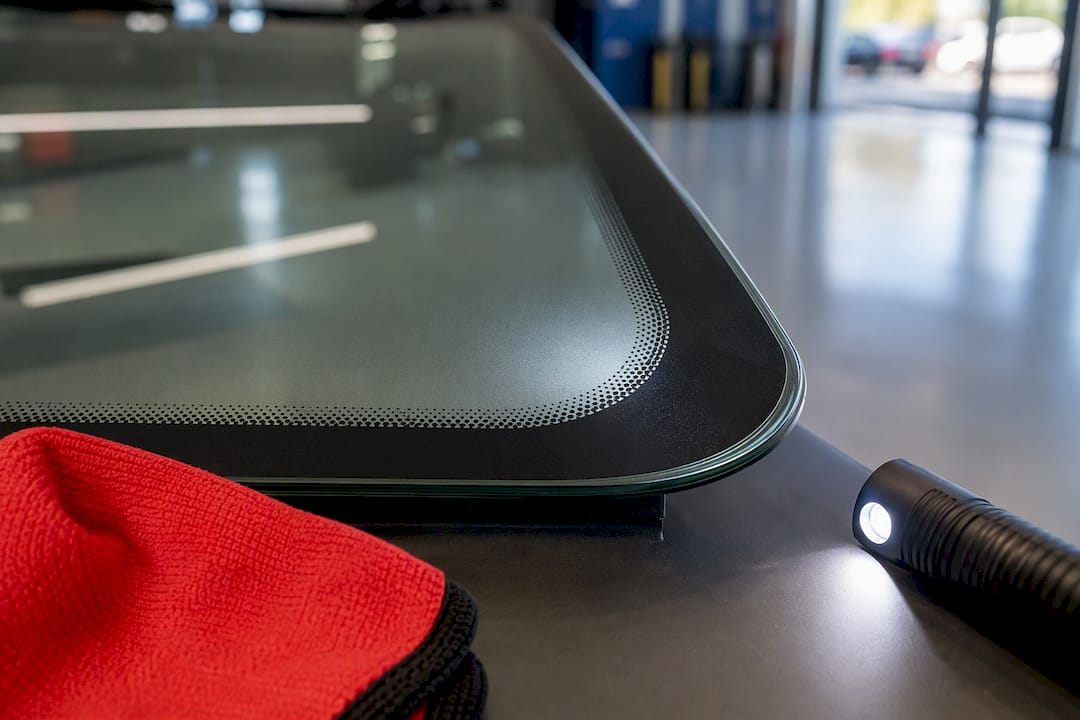
- Check behind the rearview mirror mount for a de-metalized patch. A small clear rectangle in an otherwise coated windshield signals a metallic coating designed to let radio signals pass through that specific spot.
- Test your toll transponder or garage door remote near that patch. If it works there but struggles elsewhere on the glass, that’s a strong sign of a metallic coating.
- Photograph the monogram and ask your installer to confirm the part spec if anything is ambiguous. A quick phone photo settles more disputes than any visual guesswork.
What to Require When Replacing a Solar Coated Windshield
Getting a replacement wrong on a solar-coated windshield doesn’t just cost you comfort, it can knock out your toll transponder, misalign your driver-assist cameras, or leave you with a warranty gap you didn’t know existed. A few non-negotiables protect you here.
Match the OEM solar spec, not just the shape. Ask to see the monogram or part number on the replacement glass before it goes in. The difference between OEM and aftermarket parts isn’t always visible on the surface, and a generic clear windshield swapped in for a solar-coated original will feel noticeably hotter, even if it fits the frame perfectly.
Confirm ADAS calibration is part of the job, not an afterthought. Any windshield with a forward-facing camera or sensor mounted behind it needs recalibration after replacement, because the glass itself affects how those systems read the road. Skipping this step, or assuming it happened when it didn’t, is one of the most common ways drivers end up with malfunctioning driver-assist features they paid for but can’t rely on.
Ask about halo risk before agreeing to a repair instead of a replacement. Metallic-coated windshields, including many Sungate-branded products, can develop a milky white ring around a resin-filled chip repair. The structural fix holds, but the aesthetic outcome doesn’t disappear, and a technician should tell you that up front rather than after the resin cures.
Budget for the upgrade. Solar and IR-coated replacement parts typically run higher than standard glass, and that premium is worth confirming against your total cost of replacement before work begins, along with what the warranty actually covers if the part underperforms.
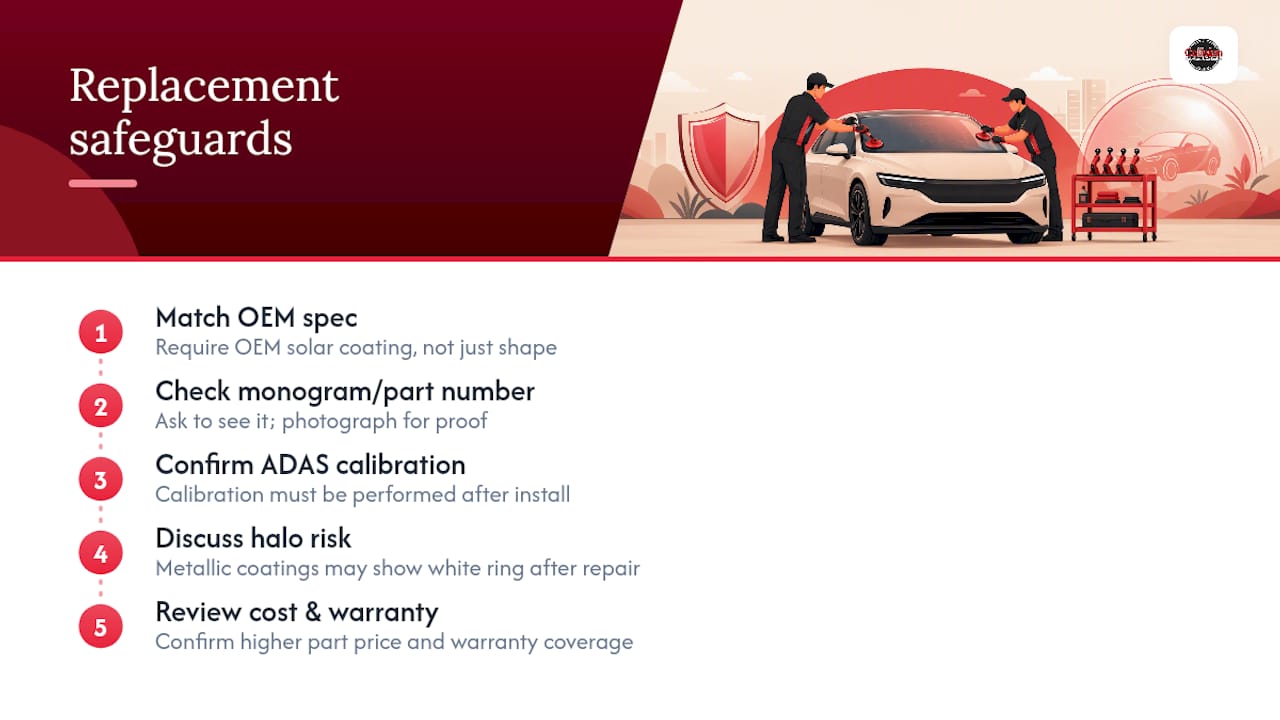
Pro Tip: Before any repair or replacement appointment, snap a photo of your windshield’s monogram yourself and keep it in your phone. If a dispute comes up later about whether the original glass was solar-coated, that photo is your best evidence.
What Are the Downsides of Solar Control Glass?
No solar-control technology is free of trade-offs, and knowing them upfront saves you a frustrating call to your installer later.
- Radio signal attenuation is the biggest practical limitation of metallic coatings. The metal layer that reflects infrared also blocks radio frequencies, which is why vehicles include a de-metalized patch near the mirror for toll transponders, GPS units, and similar devices. A replacement without that patch, or with it in the wrong spot, causes real functional problems.
- Repair halos show up almost exclusively on metallic-coated glass, where moisture and air interacting with the coating during a resin repair leave a visible ring that doesn’t fade.
- Durability differs by type. OEM-integrated coatings, whether absorptive or reflective, last the life of the windshield. Aftermarket nano-ceramic film typically runs 5 to 10 years before it needs replacing.
- Legal tint limits still apply. Most states cap windshield visible light transmittance, and stacking aftermarket film on top of factory solar coating can push a windshield out of compliance even when each layer alone would pass.
Your Buying Checklist for a Solar Coated Windshield
Whether you’re specifying a replacement after a crack or considering an upgrade, work through this before you sign off on any job.
- Confirm the replacement part matches your original’s solar-control spec, not just its dimensions.
- Ask where the de-metalized patch sits and verify it lines up with your toll transponder or GPS mount.
- Request photos of the part monogram before installation, not after.
- Make sure ADAS camera or sensor calibration is explicitly included in the scope of work, with documentation.
- Get the warranty terms in writing, including what happens if the part underperforms or the patch is misaligned.
Aftermarket film makes sense on side and rear glass, where legal tint limits are usually more permissive and RF interference isn’t a concern. On a windshield, it’s a reasonable stopgap only when the factory coating has failed or when a state’s tint law allows a compliant, clear IR-rejecting film like 3M’s Ultra-Clear option. It’s rarely the better first choice over factory-equivalent glass.
Pro Tip: At pickup, before you leave the lot, check that your transponder or garage remote works through the patch, glance for any distortion near a forward camera or HUD projection, and take the car for a short drive to confirm lane-keeping or automatic braking systems respond normally.
How Collision Auto Glass & Calibration Handles Solar Coated Windshield Jobs
A shop’s process matters as much as the part itself. A reputable auto glass shop has operated as a family-owned business since 2008, offering same-day mobile installation, a lifetime no-leak guarantee on every installation, and in-house ADAS calibration rather than outsourcing it to a third party.
That combination directly addresses the risks covered above: wrong part specs, missing de-metalized patches, skipped calibrations, and warranty gaps. Whichever shop you choose, ask for photo documentation of the part monogram and written confirmation that calibration was performed, not just offered.
Should You Prioritize a Solar Coated Windshield?
Prioritize it if you drive in a hot climate, park in direct sun regularly, or own an EV where every bit of preserved range counts. Deprioritize it if your car sits in a garage or covered lot, your climate stays mild, or your budget is tight right now. Either way, the smarter next move is confirming what your current windshield already has before spending on an upgrade you might not need.
— Collision Auto Glass & Calibration
Get Your Solar Coated Windshield Replaced the Right Way
Getting the wrong part, a missing de-metalized patch, or a skipped calibration costs you more time and money than doing it right the first time. Some shops handle solar-coated windshield replacements with same-day mobile installation, a lifetime no-leak guarantee, and ADAS calibration performed in-house rather than farmed out to another shop.

Before you book anywhere, ask for a photo of the replacement part’s monogram, confirmation that calibration is included, and a written warranty. Some companies include all three into every windshield replacement, with direct insurance billing to keep the paperwork off your plate. If you’re weighing repair against replacement on a coated windshield, our rock chip repair page walks through when a fix holds up and when it doesn’t. Ready to move forward? Request a quote and we’ll confirm your part spec and calibration needs before anyone touches your car.
Sources
Findings above draw on NREL’s thermal soak and simulation testing, manufacturer technical documentation from Saflex and Pilkington, and practical repair-industry guidance on halo effects and RF interference.
- Impact of Solar Control PVB Glass on Vehicle Interior Temperatures, Air-Conditioning Capacity, Fuel Consumption, and Vehicle Range
- Pilkington — automotive solar-control coatings
FAQ
What Is a Solar Coated Windshield?
It’s a windshield built with an infrared-reflective or infrared-absorptive layer, either a specialized PVB interlayer or a metallic coating, designed to reduce the heat and UV radiation that passes into the cabin.
How Do I Know if My Windshield Is Solar Coated?
Check the monogram etched near the edge of the glass for terms like “Solar” or “IR,” look for a de-metalized patch behind the rearview mirror, and test whether a toll transponder works better in that specific spot than elsewhere on the glass.
What Are the Downsides of Solar Control Glass?
Metallic coatings can attenuate radio signals for devices like toll transponders, some coating types develop a visible halo after resin chip repairs, and aftermarket films have a shorter service life than factory-integrated coatings, typically 5 to 10 years.
What Does “Solar” Mean on a Windshield?
“Solar” on a windshield’s monogram indicates the glass includes a solar-control layer, either an absorptive PVB interlayer or a reflective metallic coating, engineered to cut radiant heat and UV transmission into the vehicle.
Does a Solar Coated Windshield Affect ADAS Calibration?
The coating itself doesn’t change calibration requirements, but any windshield replacement on a vehicle with forward-facing cameras or sensors needs calibration afterward, which shops like Collision Auto Glass & Calibration perform in-house as part of the replacement.
Recommended
- Acoustic Windshield: SAE Evidence and 3 Installer Questions
- How Seasonal Changes Can Affect Your Windshield Replacement Needs
- Rain Sensing Windshield: 4 Questions to Ask Before Replacement
🎧 Listen to This Article
Share
Recent Posts
September 17, 2026
$600–$1,500 ADAS Costs: When to Use Windshield Insurance vs Pay Cash
Decide whether to file a claim or pay cash by comparing repair cost, your deductible, and ADAS recalibration fees. Learn how shops and...
September 16, 2026
Cut A/C Use 4% With a Solar Coated Windshield
Learn how solar coated windshields cut cabin heat and reduce A/C load, and what to demand at replacement: monogram proof, demetalized patch, and...
September 15, 2026
60–90 Minute Rule: Windshield Replacement in Rain for Drivers
Windshield replacement in rain: usually safe to drive after 60–90 minutes. Avoid car washes 24–72 hours. Confirm ADAS calibration....