Auto Glass Repair
Yes, a vehicle with a heads-up display needs a HUD-compatible windshield, not a standard piece of glass. Installing non-HUD glass on a HUD-equipped vehicle typically produces a double image or a distorted, hard-to-read projection, according to Ford’s own service documentation, which recommends dealer or authorized-shop replacement whenever HUD is present. Before you book anything, take three steps.
- Confirm HUD status first. Check your owner’s manual or ask a shop to run a VIN lookup against a glass-specialist database. Many HUD windshields carry no visible label, so eyeballing the glass is not reliable.
- Order HUD-compatible glass by part number, not by guesswork. Tell the shop explicitly that your vehicle has a heads-up display so they pull the correct part, whether that’s OEM or a verified HUD-capable aftermarket option.
- Insist on a certified installer who also handles ADAS and HUD calibration, and get the warranty terms in writing before the glass goes in.
Expect to pay more than you would for a plain windshield. Industry pricing summaries put HUD windshield replacement in the $800 to $2,500-plus range, depending on your vehicle, coatings, and whether calibration is bundled in. Shops like Collision Auto Glass & Calibration handle both the glass sourcing and the in-house calibration, which matters because HUD testing follows established industry guidance, including SAE test protocols for optical performance, and a shop that skips that step is gambling with your safety system.
Key Takeaways
HUD-equipped vehicles require optically specialized windshields, and skipping that specification typically causes double images, ghosting, or distorted projections that no calibration can correct.
| Point | Details |
|---|---|
| Confirm HUD status first | Check your owner’s manual or have a shop run a VIN lookup before ordering glass. |
| HUD glass is optically specialized | Wedge-shaped interlayers and tight thickness tolerances prevent ghosting and double images. |
| Expect higher cost | HUD windshield replacement typically runs $800 to $2,500 or more, often two to three times a standard windshield. |
| Choose a shop that verifies parts and calibrates in-house | Ask about VIN verification, calibration equipment, and warranty coverage before booking. |
| Collision Auto Glass & Calibration offers HUD-capable glass and in-house calibration | The shop sources HUD-verified glass, performs ADAS/HUD calibration on site, and backs installs with a lifetime no-leak guarantee. |
Table of Contents
- What Makes a HUD Windshield Replacement Different From a Standard One?
- Choosing Between OEM, Aftermarket, and Standard Glass
- How Long Does HUD Windshield Replacement Take?
- What Does HUD Windshield Replacement Cost?
- How to Choose a Shop for HUD Windshield Replacement
- How Do You Know the HUD Was Installed Correctly?
- How Are HUD Windshields Actually Tested?
- Why We Push Owners Toward HUD-Spec Glass and Full Calibration
- Get HUD-Compatible Glass Installed Right the First Time
- Sources
- FAQ
What Makes a HUD Windshield Replacement Different From a Standard One?
A HUD windshield isn’t just glass with a fancier price tag. It functions as an optical component of the projector system itself, bending and reflecting light from a dashboard-mounted unit toward your eyes at a specific perceived distance. Change the glass and you change the optics, whether you meant to or not.
The core difference lives inside the lamination. Standard windshields use a flat polyvinyl butyral (PVB) interlayer sandwiched between two glass panes. HUD windshields use a wedge-shaped interlayer, thicker at the top than the bottom, engineered to align the front and back surface reflections into a single, clean image instead of two overlapping ones. Research on wedge-angle measurement shows manufacturers hold these wedge angles and layer thicknesses to extremely tight tolerances. A deviation invisible to the naked eye can still throw off the projected image enough for a driver to notice.
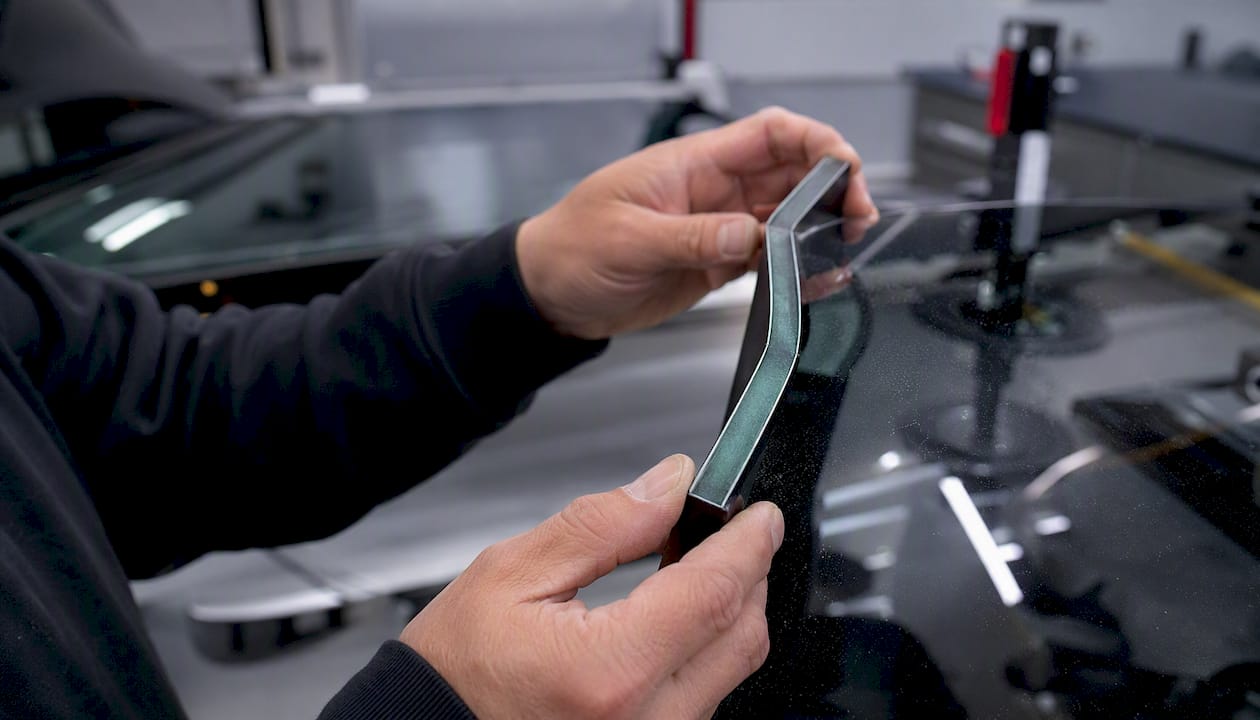
Picture the wedge interlayer as a very shallow prism, thin enough that you’d never see it by looking through the glass, but precise enough to steer two light reflections into perfect overlap by the time they reach your eyes. That’s the visual you’re dealing with when a technician talks about wedge angle.
Some manufacturers apply this wedge only in the section of the windshield where the HUD actually projects, using variable-wedge films such as Eastman’s Saflex HUD interlayer options rather than wedging the entire pane. That approach controls cost while still solving the optical problem where it matters.
Watch for these defects if a replacement goes wrong:
- Ghosting or double images — a faint duplicate of the projected speed or navigation icon, usually caused by a flat (non-wedged) interlayer.
- Image offset — the display appears shifted from where it should sit in your line of sight.
- Color or contrast loss — numbers and icons look washed out or hard to read in daylight.
- Focal misalignment — the projection seems to float at the wrong distance, forcing your eyes to refocus.
Choosing Between OEM, Aftermarket, and Standard Glass
You have three realistic paths when replacing a HUD windshield, and they are not interchangeable. Glass.NET’s coverage of HUD replacement confirms that specialized optical interlayers and tighter thickness tolerances are what separate HUD glass from everything else, and skipping that specification is the single most common cause of post-replacement complaints.
| Option | Fit for HUD | Cost | Installation Source | Warranty | Turnaround | Risk of HUD Defects |
|---|---|---|---|---|---|---|
| OEM HUD glass | Purpose-built, matches factory optics | Highest | Dealer or independent shop with OEM sourcing | Typically strongest, often backed by manufacturer | Longer if part must be ordered | Lowest |
| Aftermarket HUD-capable glass | Good when verified against HUD specs | Mid-range | Independent shops with calibration capability | Varies by installer, ask for specifics | Often faster availability | Low to moderate, depends on manufacturer |
| Standard non-HUD glass | Not designed for HUD projection | Lowest | Any general glass shop | Standard glass warranty only | Fastest | High, if HUD is used |
High-quality aftermarket HUD glass can be a sound choice when the shop verifies it against your vehicle’s actual optical specifications rather than assuming any “HUD-labeled” part will work. OEM glass earns a stronger recommendation when your vehicle’s manufacturer explicitly calls for it, as Ford does in its service guidance, or when you use the HUD daily and can’t tolerate any ghosting.
Pro Tip: A non-HUD windshield only makes sense if you genuinely never use the heads-up display and are willing to accept a distorted or doubled projection permanently. Even then, most owners regret the downgrade the first time they glance up out of habit and see a blurry double readout.
The ordering process matters as much as the glass itself. A shop that verifies your VIN and part number against a glass database is working from your vehicle’s actual specifications. A shop that eyeballs your old windshield and orders “something close” is guessing, and that guesswork is a documented source of mismatched installs.
How Long Does HUD Windshield Replacement Take?
Plan for more than a same-afternoon job if your part needs to be ordered. HUD windshields are less common than standard glass, and limited manufacturing options can extend lead times, especially for less common vehicle models.
- VIN and part verification — the shop confirms your exact glass specification, typically same day.
- Ordering the HUD glass — if it’s not in local stock, expect a wait while the correct wedge-interlayer part ships in.
- Installation and adhesive cure — the urethane bonding the windshield to your frame needs time to reach safe drive-away strength.
- HUD alignment and ADAS recalibration — cameras and sensors mounted near or behind the windshield need to be recalibrated, since ADAS systems depend on that camera positioning to function correctly.
- Post-calibration verification — a final check confirms the HUD projects cleanly and ADAS features respond as expected.
Typical timelines break down roughly like this: part sourcing can run from same-day (if in stock) to one or two weeks for rare vehicles, installation labor usually takes two to four hours, and calibration adds another one to three hours depending on whether it’s a static, dynamic, or dual calibration.
- Do not drive the vehicle until the adhesive has reached its manufacturer-specified cure time.
- Do not treat calibration as optional; an uncalibrated ADAS system can misjudge distances or fail to trigger warnings.
- Ask your shop for a written estimate of both windshield cure time and calibration time before you schedule pickup.
What Does HUD Windshield Replacement Cost?
Expect to pay noticeably more than you would for a standard windshield. Cost research from Windshield Advisor places HUD windshield replacement in the $800 to $2,500-plus range, with the top of that range reflecting luxury vehicles, acoustic coatings, and bundled ADAS calibration. A standard windshield without HUD or camera features often costs a fraction of that.
By the Numbers: HUD-compatible glass can run two to three times the cost of a standard windshield replacement, driven by specialized interlayers and the strict optical tolerances that make the display readable.
Several factors move that price up or down:
- OEM versus aftermarket glass — OEM parts cost more but carry tighter guarantees of fit.
- Vehicle make and model — luxury and newer vehicles with more sensors integrated into the glass tend to sit at the higher end.
- ADAS integration and calibration — a windshield-mounted camera almost always requires recalibration, which adds a separate line item.
- Specialized coatings and interlayers — acoustic dampening, infrared-reflective coatings, and rain sensors all add cost.
- Shop labor rates — vary by region and by whether calibration is performed in-house or outsourced.
Insurance often covers windshield replacement under comprehensive coverage, but ask your provider two specific questions: whether they cover OEM glass or only aftermarket equivalents for HUD-equipped vehicles, and whether they allow direct billing to your chosen shop. A detailed local cost breakdown can help you compare quotes before you commit, and confirming what your policy actually covers up front avoids an unpleasant surprise at pickup.
How to Choose a Shop for HUD Windshield Replacement
Not every glass shop is equipped to handle HUD-specific work, and the gap between a good shop and a risky one usually shows up before you ever see the finished install. Run through this checklist before booking.
Before your visit, confirm the shop will:
- Verify your VIN or part number in a glass-specialist database rather than relying on a visual match.
- Source HUD-capable glass, whether OEM or verified aftermarket, specifically for your make and model.
- Perform HUD alignment and ADAS calibration in-house, not by outsourcing to a third party you never meet.
- Offer a written warranty that explicitly covers HUD image quality, not just leak protection.
Ask these questions on the phone or in person:
- “Can you verify HUD compatibility using my VIN before ordering the glass?”
- “Do you calibrate ADAS and HUD systems in-house, and what equipment do you use?”
- “What’s your technician’s training or certification for calibration work?”
- “What does your warranty cover if the HUD shows ghosting after installation?”
Red flags are easy to spot once you know what to look for. A shop that quotes an unusually low price without asking for your VIN, one that can’t describe or show you calibration equipment, or one that hedges on warranting HUD image quality is telling you it isn’t set up for this job. On the other hand, a lifetime no-leak or installation warranty, a documented ADAS calibration process, and direct insurance billing are all signs the shop treats HUD work as a standard part of its business rather than an afterthought. For a broader rundown of vetting criteria, this shop-selection guide covers the basics that apply to any glass job, HUD or not. Partner networks like GWP Glass Works also publish useful frameworks for what a properly equipped installer should offer.
How Do You Know the HUD Was Installed Correctly?
Don’t wait for a problem to surface on the highway. Test the display before you drive off the lot, or within the first day of getting the vehicle back.
- Check image sharpness. Look at your speed or navigation projection in normal daylight; it should read as crisp as it did before the replacement.
- Look for ghosting. Shift your head slightly left and right; a faint duplicate image trailing the main display is a sign of interlayer mismatch.
- Test across eye positions. Adjust your seat height if possible and confirm the display stays legible, since HUD optics are calibrated for a range of eye positions, not one fixed point.
- Compare against your memory of the original display. If something looks subtly off, even if you can’t name it, that’s worth flagging.
Keep the glass clean with a standard automotive glass cleaner and a microfiber cloth; avoid ammonia-based cleaners on any tinted or coated area near the HUD projection zone, and never place stickers, parking passes, or dash cameras in that zone, since they can interfere with the reflection path.
If something looks wrong, document it. Take a photo or short video of the ghosting or distortion, contact the shop that performed the work, and request a recheck or recalibration under warranty. Most legitimate installers will re-examine the glass and calibration at no charge if the defect traces back to their work. If the problem persists after a recheck and appears tied to the glass’s optical specification rather than the calibration, that’s when it’s worth looping in the dealer or an OEM-authorized service center, since they have access to the manufacturer’s exact optical tolerances for your model.
How Are HUD Windshields Actually Tested?
The defects you might notice as a driver, ghosting, blur, a washed-out display, all trace back to measurable optical properties that testing labs evaluate before glass ever reaches a shop. Understanding the basics helps explain why HUD glass costs more and why substitutions go wrong.
Radiant Vision Systems’ case study on HUD windshield testing describes an image-based inspection process combining geometric and photometric measurements. Geometric tests check for distortion and duplicate-image separation; photometric tests measure luminance and chromaticity, essentially how bright and how color-accurate the projected image appears under different lighting conditions. Systems like Radiant’s ProMetric imaging paired with TT-HUD software automate these calculations, comparing a projected test pattern against its ideal form and flagging deviations.
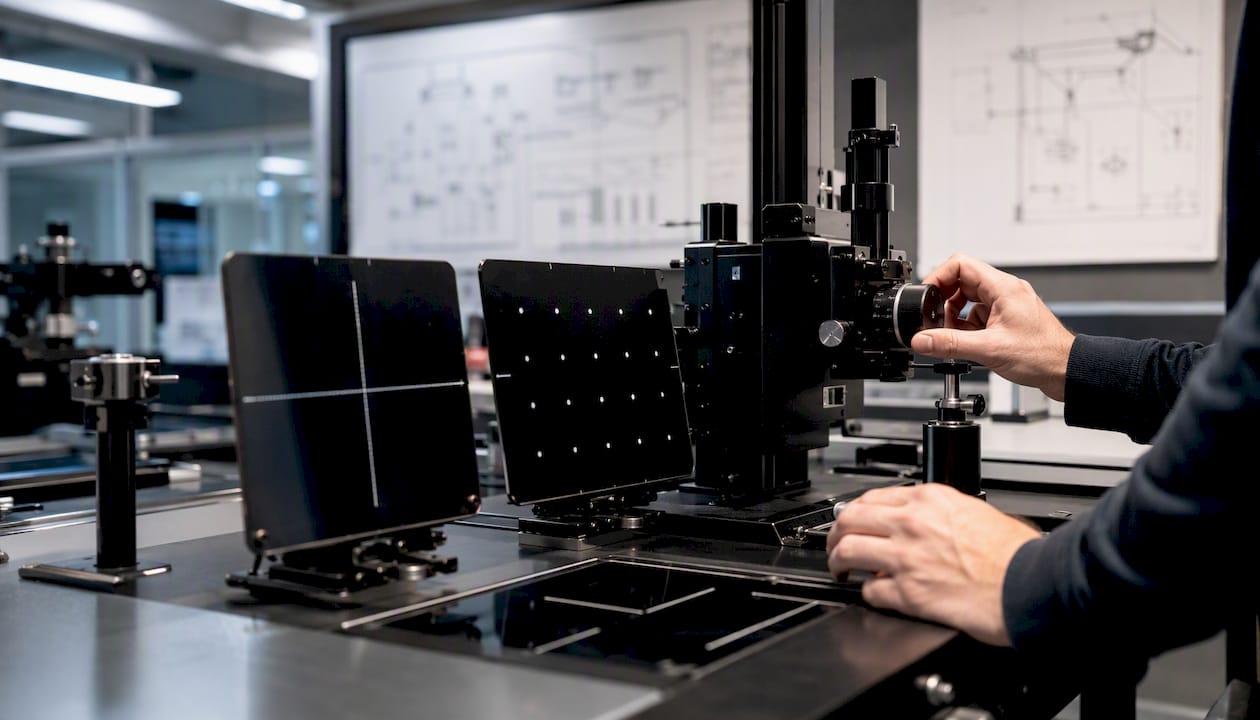
| Test Category | What It Measures | Defect It Catches |
|---|---|---|
| Geometric imaging | Shape and position of the projected pattern | Distortion, image warping |
| Photometric imaging | Brightness and color consistency (luminance, chromaticity) | Washed-out or inconsistent display readability |
| Ghosting analysis | Separation between primary and reflected images | Double images, ghosting |
These test methods exist because the margin for error is genuinely small. Wedge-angle and layer-thickness tolerances on HUD interlayers are measured to fractions of a degree, and research on simultaneous wedge-angle and thickness measurement confirms that even deviations invisible to casual inspection can produce a noticeable double image once the HUD projects through the glass.
By the Numbers: a properly engineered wedge interlayer aligns front and back surface reflections into a single image; get the wedge angle even slightly wrong, and the two reflections separate into a visible ghost that no amount of calibration software can fix, because the flaw is in the glass itself, not the projector.
Why We Push Owners Toward HUD-Spec Glass and Full Calibration
Skipping the HUD specification to save money on a windshield is one of the more common regrets we hear about in this business, and it’s almost always avoidable. If you actively use your heads-up display, whether it’s showing speed, navigation prompts, or lane-departure warnings, a non-HUD windshield doesn’t just look worse, it can genuinely distract you at the moment you need clear information most. Collision Auto Glass & Calibration sources HUD-compatible glass matched to your vehicle’s actual specifications and performs ADAS and HUD calibration in-house, rather than sending your car elsewhere and hoping the numbers line up.
That in-house capability matters for more than convenience. When the same technicians who install the glass also run the calibration equipment, there’s no handoff where details get lost. Combine that with free mobile installation within Portland, direct insurance billing, and a lifetime no-leak guarantee, and the difference between a rushed replacement and a properly specified one comes down to whether the shop treats HUD as a standard part of the job or an afterthought.
Get HUD-Compatible Glass Installed Right the First Time
You don’t have to navigate part numbers, wedge angles, and calibration equipment on your own. Collision Auto Glass & Calibration handles HUD-capable glass sourcing, in-house ADAS and HUD calibration, and direct insurance billing under one roof, backed by a lifetime no-leak guarantee on every installation.
Free mobile installation within the Portland area means you can get HUD-specific glass replaced at your home or office instead of losing half a day at a shop. When you call for a quote on windshield replacement, ask specifically for VIN-based part verification and confirm that HUD calibration is included in your estimate, not billed as a surprise add-on later. If you want a clearer sense of what the job will cost before you call, our glass replacement pricing breakdown walks through the same cost factors covered above, specific to your vehicle.
Sources
- Wedge angle measurements for HUD displays – Lumetrics (technical paper)
- How Head-Up Displays (HUD) Affect Your Windshield Replacement Options – Glass.NET Blog
- True Cost of Advanced Windshield Technology: HUD, ADAS & Smart Glass Prices | Windshield Advisor
FAQ
Does a HUD Require a Special Windshield?
Yes. A heads-up display projects through a wedge-shaped interlayer engineered into the glass, and replacing it with standard windshield glass typically causes ghosting or a distorted image.
What Is a HUD on a Windshield?
A HUD, or heads-up display, projects information like speed, navigation, or lane-departure alerts directly onto a specific zone of the windshield, using it as a reflective screen for the driver’s line of sight.
Are HUD Windshields More Expensive?
Yes, noticeably. HUD windshield replacement typically costs $800 to $2,500 or more, often two to three times the price of a standard windshield, due to specialized interlayers and tighter optical tolerances.
What Cars Have a HUD on the Windshield?
Many mainstream and luxury vehicles now offer HUD as standard or optional equipment; check your owner’s manual or ask a shop like Collision Auto Glass & Calibration to run a VIN lookup to confirm whether your specific vehicle uses HUD-specific glass.
Can I Use a Non-HUD Windshield If My Car Has HUD?
You can, but only if you’re willing to accept a permanently ghosted or distorted projection, since the display relies on the glass’s optical properties to function correctly.
Recommended
- How to Properly Care for a New Windshield – Collision Auto Glass & Calibration
- How Long Does a Windshield Replacement Take? – Collision Auto Glass & Calibration
- 7 Reasons You Should Hire Professionals to Replace Your Windshield
- A Guide to Navigating Windshield Replacement Insurance Claims – Collision Auto Glass & Calibration
🎧 Listen to This Article
Share
Recent Posts
October 15, 2026
Auto Glass Claims: Choose a U.S. Shop Before ADAS Billing Surprises
See how U.S. drivers can choose an auto glass shop for an insurance claim, confirm ADAS calibration, protect their rights, and prevent billing...
October 14, 2026
Fleet Windshield Maintenance: A 20 Minute Repair Can Prevent Days Down
Catch chips early, log the VIN and photos, and require part number and ADAS calibration records to keep fleet vehicles moving and avoid...
October 13, 2026
Calibration After Collision Repair: Ask for Scans Before You Drive
Learn when collision repairs require ADAS calibration, how shops verify the work, and which scan records and paperwork to request before driving....